Days from SEPTA cuts, Gov. Josh Shapiro and unions amp the pressure for transit funding
Shapiro visited SEPTA headquarters Sunday, as state lawmakers advance a bill funding transit and infrastructure projects.

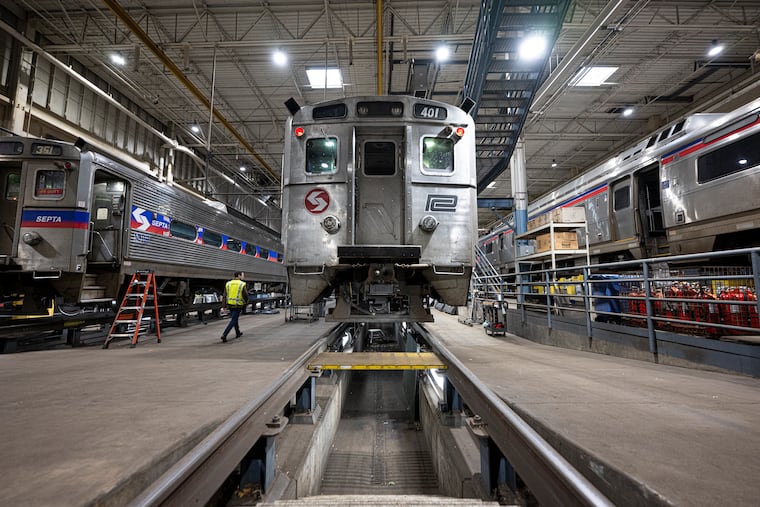
Gov. Josh Shapiro on Sunday urged Senate Republicans to pass a state budget that includes his proposal for $1.5 billion over five years in state funding for mass transit, speaking at SEPTA’s headquarters as the deadline for its first round of service cuts approaches.
“We are past the point of stopgap, short-term solutions. It is time to have recurring long-term revenue for SEPTA and for the other mass transit agencies in Pennsylvania,” Shapiro said.
SEPTA says it will launch 20% service cuts Aug. 24 if it does not receive new state funding by Thursday.
Speaking in front of SEPTA’s ticket sales office, done up to look like an old cream-and-green trolley — and joined by five dozen union leaders and state lawmakers — Shapiro noted it had been 187 days since the budget was introduced.
“In that time, the Senate has been in session for a mere 25 days,” he said.
Members of the state House, controlled by Democrats, were set to convene Sunday night for a preliminary vote on the latest version of its transportation funding proposal.
That bill, HB 1788, was amended last week to include performance accountability requirements recently introduced by three GOP senators from the Philadelphia region. It would provide new state money to highway, bridge, and road infrastructure projects, not just transit.
One of the many who stood with Shapiro on Sunday was Autumn Fingerhood, a single mother of two in Fox Chase, who works in food service at the Sports Complex and is a member of Unite Here Local 274. She said her daughter Olivia, 15, is excited to start 10th grade on Aug. 25, but the bus route she takes is due to be eliminated.
“I have a question for the state Senate in Harrisburg and my senator,” Fingerhood said, calling out Joe Picozzi, a Philadelphia Republican. “How do you expect my daughter to get to school?’”
Fingerhood relies on SEPTA buses to get to and from work.
“I cannot be late for work or leave work [early], which lately seems to be what the Republicans have been doing,” Fingerhood said. “Who is going to drop my daughter off and pick her up? Am I supposed to quit my [three] jobs?”
Senate Republicans have long demanded a deal that joins transit and roads. They also have been leery of how much Shapiro proposed spending on transit by increasing its share of sales tax revenues.
Building trades union leaders, who have ties with some GOP lawmakers, on Sunday backed the House bill as a promising basis of compromise that could break the impasse on transit funding and the state budget, which was due June 30.
Leaders of the Republican majority Senate have summoned members from recess to a voting session Tuesday afternoon.
Asked if that means a deal is close, Shapiro demurred and brushed aside questions about details of the private negotiations with Senate Majority Leader Joe Pittman (R., Bradford) and House Majority Leader Matt Bradford (D., Montgomery.)
But he did say that he would not entertain temporary fixes for transit.
In recent days Senate Pro Tempore Kim Ward (R., Westmoreland) has floated a 6-month budget to continue spending at current levels while the issue is worked out. She also has suggested reallocating some $2.3 billion in the Public Transportation Trust Fund.
The fund pays for transit operating expenses and capital projects, with revenue from the sales tax and other taxes and fees. The money available in the fund is obligated for capital work that PennDot has approved for transit agencies infrastructure and vehicles, officials familiar with its operation said.
Transferring it to operating funds would not be wise, suggested Scott A. Sauer, SEPTAs’ general manager.
“If we rob from one pot to give to the other, eventually we’re having the same conversation, but now we’re also going to be talking about shutting things down due to unsafe infrastructure,“ Sauer said. ”Those are much bigger problems that we certainly don’t want to deal with.”
SEPTA, for instance already has a $10 billion backlog of planned upgrades to infrastructure, he said. Most major transit systems face a similar issue.
Despite the zinger about the Senate’s relatively light workload, Shapiro said that talks have been respective and cordial.
“I think we would all like to get this done,” the governor said. “We live in really polarized times right now, the gulf between Democrats and Republicans has probably never been as wide. My job is to try to narrow those differences.”
Shapiro has proposed $292 million in new money for mass transit over five years by increasing the allocation it receives from the sales tax. SEPTA estimates it would get about $168 million this fiscal year, which would, with other measures, enable it to close the deficit.
SEPTA currently receives $1 billion from the state annually, 67% of its operating budget.