Why have Philly trolleys been stopping before they enter the tunnel to Center City for the last two months? Caution.
A new type of slider damaged wires at the 40th Street trolley portal. The problem was resolved, but inspectors are ensuring it doesn't happen again.
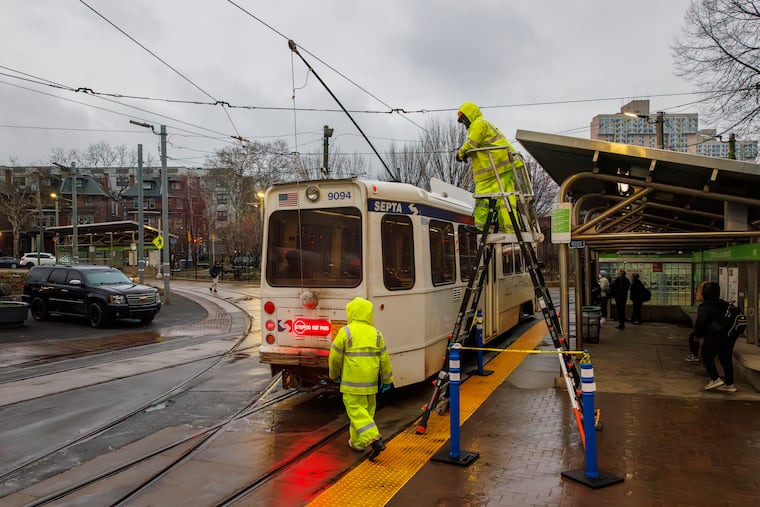
An odd daily ritual has been unfolding at the 40th Street trolley portal in West Philadelphia for the last two months.
A Center City-bound trolley rolls to the opening of the tunnel and stops. Two SEPTA workers, one on a portable scaffold, unhook the trolley pole and inspect the connection to the catenary wires.
Every day. Every trolley.
“As long as the tunnel’s open, we’re out there,” said Edward Carruthers, senior director of Metro rail maintenance.
The workers are focusing on a U-shaped brass slider filled with carbon that rubs off and lubricates the electric wires powering the trolleys. The assembly is hidden under a flexible part at the tip of the pole called a “harp,” which runs along the wires.
Last fall, SEPTA switched to a new type of slider that was supposed to save money by making the carbon last longer.
It did the opposite, damaging the wires as metal ground on metal inside the tunnel. Even the old reliable sliders didn’t work. Hundreds of passengers had to be evacuated in two October incidents when trolleys stalled in the tunnel.
Finally, in November, the tunnel was shut down. SEPTA replaced about 5,000 feet of chewed-up wire. The tunnel stayed closed until Jan. 12 as the transit agency ran dozens of empty trolleys to test the new wire and the longevity of the carbon.
While the problem appeared solved, spot checks continue to this day.
Riders have sometimes been puzzled.
“I thought it was great and was glad SEPTA was double-checking their work. It was a belt-and-suspenders approach,” said Michael Froehlich, a lawyer who commutes on the Route 34 trolley from West Philadelphia to Center City.
“Then, after the second week and the third week, I was wondering if this was now a permanent job at SEPTA,” he said.
Carruthers said the workers visually inspect the carbon for excessive patterns of wear and use a depth gauge to measure the level of lubricant left.
If all is good, the trolley resumes its journey. Elapsed time: about a minute. If a new slider full of carbon is needed, the crew attaches it, which takes about two minutes.
Trolleys from five lines take about 1,210 trips per day through the tunnel. At least four SEPTA employees per day staff the tunnel for inspections.
Carbon is a “sacrificial component” and meant to wear away but usually needs to be replaced only every five to seven days, with some fluctuations for weather, Carruthers said.
There are no plans yet to stop the testing.
“We’re continuing the monitoring program to make sure nothing returns or a new issue doesn’t arise,” Carruthers said. “Collecting a larger and larger data set just increases our confidence that the system is returned to normal.”