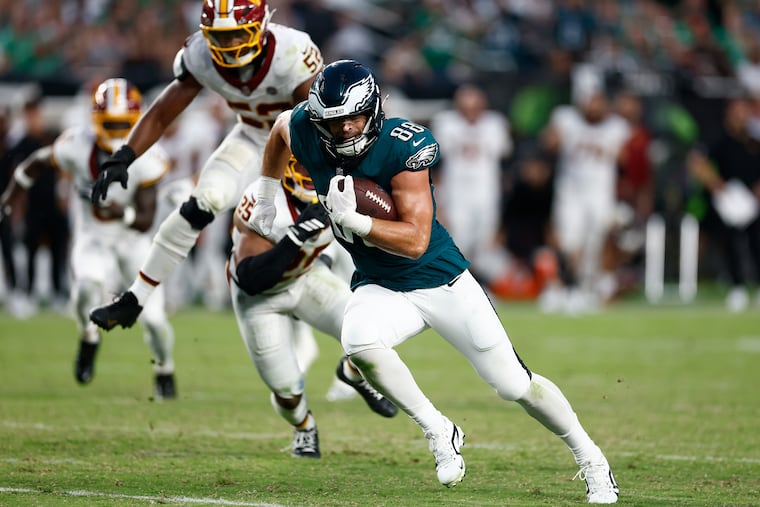
The Eagles left early for Tampa. But maybe not early enough, heat-health experts say.
The Eagles have a history of misfortune in steamy Tampa.

Whatever the outcome, two heat-health experts say that the Eagles’ taking an early flight for their Sunday afternoon game in steamy Tampa against the Buccaneers isn’t going to make much difference.
Typically the team flies to road games the day before kickoff, but Eagles opted to leave Friday evening to give players a chance to adjust to forecast conditions — heat indexes up to 100 — that would trigger heat advisories in Philly.
The experts’ opinions seemed very much in line with someone who has no known medical training — Eagles’ defensive coordinator Vic Fangio.
“People need more than one day to adjust to heat and humidity,” said Samuel Eldrich, medical director of the Temple Health-Chestnut Hill Hospital Emergency Department.
“It typically takes about one to two weeks for the body to acclimate to heat and humidity, with significant physiological changes occurring within the first five to 10 days.”
Leaving early was a “prudent decision,” said Laurence Kalkstein, a retired University of Delaware climatologist who helped Philadelphia develop its highly praised heat-response plan. But “it’s still going to feel very hot to them playing out in the field,” even if they’ve been there for a day or two, he added.
Eagles head coach Nick Sirianni said the early arrival would give the players a full day “to acclimate.”
Sorry, coach: Eldrich and Kalkstein are siding with Fangio, who said Tuesday, “It is too late to do anything right now for it as far as prepping for it.”
Temperatures on Sunday in Tampa are forecast to rise to near 90 degrees with ultrahigh humidity. The dew point, the measure of absolute moisture in the air, is expected to be around 75, which would be at Philly heat-wave levels.
The Eagles have felt the heat in Tampa before
On a sweltering September day in 2024 in Tampa, the Eagles were routed by the Buccaneers, nine months after the Bucs bounced them out of the playoffs.
That wasn’t the first time the Bucs ruined the favored Birds’ Super Bowl dreams. It happened famously on Dec. 29, 1979.
The late Francis Davis, a TV meteorologist and dean of science at Drexel University, recalled imploring then-coach Dick Vermeil to leave behind the Philadelphia winter and take the team to Florida a week in advance of the game, which would be played with temperatures in the mid-70s.
The team didn’t fly to Tampa until Dec. 28. The Bucs would build a 17-0 lead at halftime on the way to a 24-17 win.
Vermeil said later that the proximity of Christmas was a factor in not leaving early.
But, in the end, he said, “The professor was right.”