Downpours set off flood alerts and road closings — but now the Philly region could use some more rain
Despite rains, drought warnings remain. At least the heat has backed off.
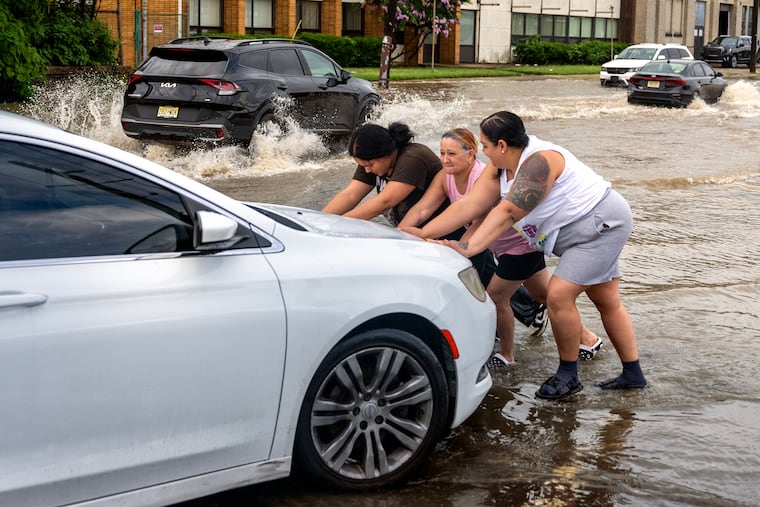
The waterfall downpours came just as the sun-cooked vegetation was showing those hay-brownish tints and taking on that desperate we-need-a-drink-now look.
“You have to be careful what you wish for in the summer,” said Scott Kleebauer, branch forecaster at the national Weather Prediction Center in College Park, Md.
But sometimes too much is not enough.
While downpours flooded streets and caused Regional Rail problems for SEPTA, which also reported weather-relates signal problems, Kleebauer suggested it wouldn’t hurt for Philadelphia and other parts of the Mid-Atlantic to place an order for more rain.
Through Sunday, Philadelphia’s year-to-date precipitation was about 75% of normal, and even with additional rains on Monday, still was roughly 4 inches — or a month’s worth — below long-term averages, according to the Middle Atlantic River Forecast Center.
More rain might be about the last thing some people would want after rounds of strong storms on Sunday with frequent lightning and downpours on Sunday and Monday, when as much as 2 to 4 inches fell in a short period upon parts of Philadelphia, Bucks, and Burlington Counties, the National Weather Service said.
And in the city of Camden, 4.38 inches was measured, the agency said.
“Numerous roads remain closed due to flooding,” the agency said.
In late morning, moderate flooding was reported along Frankford Creek, and the weather service posted a flood warning that remained in effect until early evening. At one point Kelly Drive was closed due to flooding on the Schuylkill.
Comden County received about 1,000 911 calls just in the stretch of the morning storm, said Dan Keashen, Camden County’s public affairs director.
SEPTA train service on the Trenton line was suspended due to water over the rails. A car got stuck in floodwaters by a rail bridge and Eighth Street and Fairmount Avenue, the weather service reported.
The rains backed off during the afternoon, but the weather service has shower possibilities every day this week, except Wednesday.
The federal Climate Prediction Center’s outlook for the 8-to-14-day period favors above-normal precipitation for the region.
So, is the drought on the run in the Philly region?
Maybe, but droughts are slow to develop and slow to abandon their methodical harvests.
All of New Jersey and Chester County remain under state-declared drought “warnings,” and the majority of the region is under “moderate drought,” according to the interagency U.S. Drought Monitor.
“There’s definitely been some improvement,” said Kleebauer. “Unfortunately there’s been some losers.”
Summer rains are notoriously capricious and random.
“My grass has been happy the past few days,” said Lee Robertson, a weather service meteorologist in Mount Holly, but he added that it’s going to “take a while” to make up the accumulated rain deficits.
But in reality, “It’s really difficult to get everybody to win,” said Kleebauer.
The steering currents aloft that move storms get as lazy as a lot of humans in the heat.
“Stuff just kind of meanders or has slow general motion,” he said. Storms can get stuck in place, and the more one place gets, the less other places will get. Even in a juiced atmosphere, moisture is finite.
The extreme heat appears to be over, for now
The rains at least have marked the end of the region’s extreme heat as the “heat dome” has migrated westward. It is not uncommon for storms to break out as a hot spell deteriorates.
But that three-day stretch ending with that torrid 250th birthday party on July 4 was historic in its own right.
It marked the first time in records dating to 1873 that the temperature had reached 101 or higher three consecutive days and only the third time it had hit 100 three days straight, according to the weather service.
It may be hard to remember, but on Feb. 8 it got down to 8 degrees at the airport, proving that Philly truly is a four-season resort.
Inquirer staff writers T.J. Furman and Sarah Nicell contributed to this article.