Philly declares a heat emergency and Welcome America alters events as 100-degree temperatures loom
Philadelphia hasn't had three straight 100-degree days in 33 years.
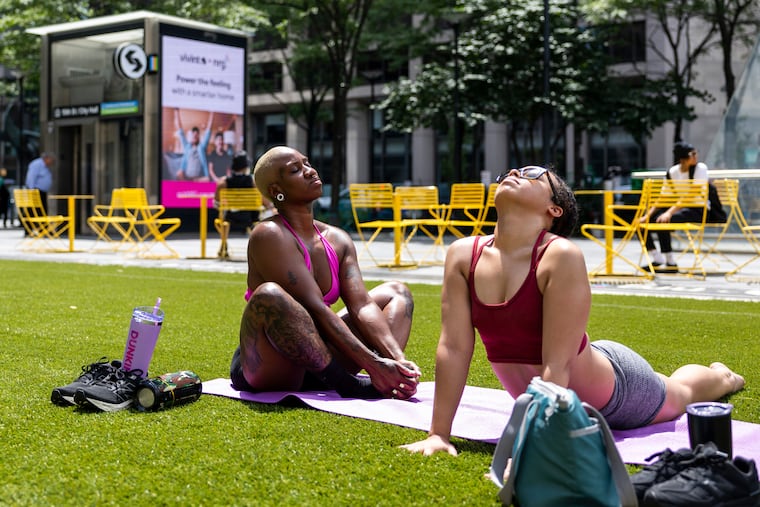
The National Weather Service on Tuesday issued an “extreme heat” warning for the entire region through July Fourth, with a record-tying three consecutive days of 100-degree temperatures possible in Philadelphia.
Though heat warnings may lack the sizzle of warnings for blizzards or hurricanes, health officials advise that they can be more dangerous — slow-motion disasters that target the most-vulnerable populations. Plus, the timing of this one couldn’t be much worse.
Along with the daytime heat indexes approaching 110, the nights aren’t going to be much cooler. Temperatures Friday morning may not get below 80 degrees in the city, said Sarah Johnson, the warning coordination meteorologist with the National Weather Service in Mount Holly, which has been briefing emergency managers since late last week.
“It’s very concerning,” she said.
The city on Tuesday declared a “heat health emergency” in effect from 1 p.m. Wednesday through 8 p.m. Saturday, activating its pioneering heat-response system.
In deference to the heat, Wawa Welcome America announced several schedule changes, including canceling Thursday’s All-American Block Party, and moving back start times for concerts Thursday and Friday.
It also said the Liberty Medal ceremony on Friday honoring Pope Leo XIV would be moved to inside the Constitution Center and the route of the Semiquincentennial Parade, which begins at Fifth and Chestnut Streets, would end at Broad and Chestnut, rather than proceeding to Logan Circle as originally planned.
PJM Interconnection, the region’s electric grid operator and one of the nation’s largest, already has sounded alarm bells regarding power demands. Peco advised that it has a contingency plan in case workers go on strike Saturday, as they have threatened.
SEPTA is making preparations for what would have been a challenging week even if the weather was cool (as it was in 1776, by the way). At Philadelphia International Airport, a bigger concern would be pop-up thunderstorms that could disrupt the weekend celebrations that have been 250 years in the making.
The heat wave will have staying power in Philly
Only twice has Philly had three consecutive days of triple-digit temperatures — in 1993, and on July 2, 3, and 4 of 1966. That could happen again on July 2, 3, and 4 of 2026, the weather service says.
Officially it reached 90 degrees Tuesday at the airport, the 16th time this year that the high reached at least 90 degrees, the second-most number of days before Jul 1 in records dating to 1874. Wednesday’s forecast high, in the mid to upper 90s, would be the prelude to the holiday heat festival.
Along with the heat, of concern for event planners is the potential for strong thunderstorms on Saturday afternoon and evening during the climax of the Semiquincentennial events.
Preparing for the heat and storm threats in the region
At Philadelphia International Airport, it’s not the heat so much as the attendant storm threat that is the major concern, said spokesperson Heather Redfern.
The national extent of the extreme heat — the result of a so-called heat dome of high pressure — and the pop-up storm threat could “impact flights with delays, diversions to other airports and cancellations,” she said.
The airport was expecting more than 680,000 departing and arriving passengers from Wednesday through next Tuesday. Redfern advised travelers to sign up for airline flight alerts.
In its forecast discussion Tuesday, the weather service cautioned “that any holiday weekend festivities could be impacted by thunderstorms,” adding that “the environmental setup would be favorable for strong to severe” storms.
SEPTA was expecting a crush of passengers, especially Saturday when in addition to the 250th bash, a World Cup soccer match will be played in South Philly. The agency may set up misters outside stations where long lines may develop, spokesperson Andrew Busch said. The agency would try to make some cooling buses available if the city requests, he said.
A Saturday complication for Peco is a threatened strike by 1,500 union members. The company said it has a “contingency plan” in place to keep customers’ air-conditioning systems operating and would be able to respond to any severe storm issues.
With or without storms, in deference to the heat SEPTA will be reducing speeds on all rail lines, said Busch, as extreme heat can cause overhead lines to sag and tracks to buckle.
Heat-wave response is a Philly thing
It’s not in a league with the Rocky statue or cheesesteaks, but heat response is a very Philly thing that got its start in the 1990s when the city won high praise from the Centers for Disease Control and the National Oceanic and Atmospheric Administration.
The impetus was the summer of 1993 when Philadelphia recorded 118 heat-related deaths — about triple the combined total of 2015-16. That summer was also the last time the city had three consecutive days of 100-plus degree temperatures.
The relatively inexpensive program includes setting up more than 50 cooling centers; health officials hold that even a short break from extreme heat can save lives. Residents are encouraged to look in on elderly neighbors, and the Philadelphia Corporation for Aging will be operating a heat hotline, 215-765-9040.
Variants of Philly’s response system have spread to other cities around the country.
In Philadelphia, even though summer temperatures have been rising, heat-related deaths have declined dramatically.
May that trend continue.
Staff writer Ariana Perez-Castells contributed to this article.