It may feel like zero in Philly this week, and the ‘wind chill’ has Pennsylvania roots
What we know about the wind's effects has a lot to do with former Eagle Scout Paul Siple, the pride of Erie’s Central High School.
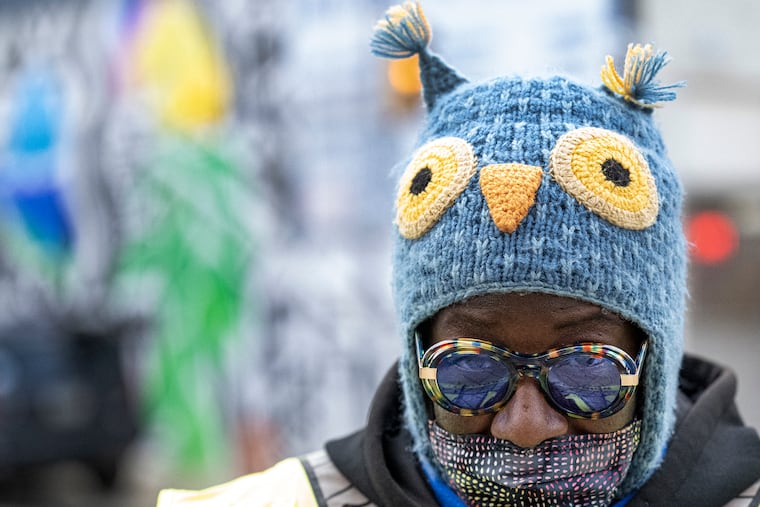
The region evidently is about to migrate from the refrigerator to the freezer this week, with wind-chill levels possibly approaching zero as temperatures fall to the teens and a brisk west wind adds sting.
“Wind chill” has been a staple of National Weather Service forecasts and media weather reports since 1973.
(Commercial services, such as AccuWeather Inc., now have their own variants.)
At different times it has been a subject of contention, confusion, derision, and revision; its popularity, however, endures.
In terms of alerting the public to potential health hazards, “I think it’s useful,” said Michael DeAngelis, vice chair of emergency medicine at Temple University’s Lewis Katz School of Medicine.
Said Harvey V. Lankford, a retired physician and writer who has done a deeper dive into wind chill than most humans: “It’s a yardstick.
“The public loves it.”
But where do those numbers come from, and do they tell us how we really feel?
The birth of ‘wind chill’
Wind chill is a measure of heat loss from the body from the combination of temperature and wind.
What we know about its effects has a lot to do with former Eagle Scout Paul Siple, the pride of Erie’s Central High School.
He pursued his quest while accompanying Admiral Richard Byrd on his legendary expeditions to that icy forbidden planet known as Antarctica, where the wind stings “like a knife drawn across the face,” as one of his associates put it. At age 19, Siple had won a highly publicized national competition to join Byrd.
Siple minted the term wind chill in his 565-page unpublished doctoral dissertation, a copy of which Lankford obtained from Clark University, in Worcester, Mass.
On a later expedition, Siple, assisted by geologist Charles Passel, conducted experiments measuring how long it took to freeze a container of water under a variety of temperature and wind conditions. Winds obviously accelerated the freezing process.
Using that data they estimated heat loss from human skin, publishing their findings in a landmark 1945 paper.
But Lankford said Siple got remarkable results in his more primitive earlier research, which included estimating frostbite thresholds, using a relatively simple formula involving wind speeds and temperatures.
Siple’s work would become the basis for the wind chill factor that the weather service massaged and began sharing publicly in 1973.
Frostbite and the wind chill revision
The wind chill calculations underwent a significant revision a quarter century ago.
U.S. and Canadian scientists during the 1990s used human subjects to upgrade the index, including establishing new frostbite thresholds.
Twelve subjects, with sensors inside their cheeks and their faces bare, were subjected to temperatures ranging from 32 to 58 below at three different wind speeds.
They were monitored for signs of “frostnip,” which precedes frostbite by about a minute.
For the record, the researchers found that with wind chills of 40 below, frostnip occurs within 15 minutes.
The weather service said the revised index profited from “advances in science, technology and computer modeling.”
Yet Siple obviously had been on to something decades earlier, Lankford said.
In a paper published in 2021 in the journal Wilderness and Environmental Medicine, Lankford and coauthor Leslie R. Fox wrote that some of the modern findings on frostbite thresholds were remarkably similar to what appeared in Siple’s dissertation.
Lankford said they were not surprised by the similarities: “We were stunned.”
Staying safe in the cold
Aside from frostnip and frostbite potential, exposure to frigid temperatures and strong winds poses a variety of other health hazards, DeAngelis said.
Those conditions can seriously exacerbate certain lung problems.
For the healthy, he recommends proceeding with caution while exercising. Sweating in the cold — it does happen, just ask runners and hikers — can increase the risk of hypothermia.
Plus, your brain, heart, kidneys, and other internal organs will be diverting blood flow from muscles and extremities, and that could slow recovery from exertion.
Or you could just put off that run or bike workout until Thursday, when it may go up to 40 degrees.