In the days of ‘Chinamaxxing,’ Philly’s mahjong culture remains a way to find and foster community
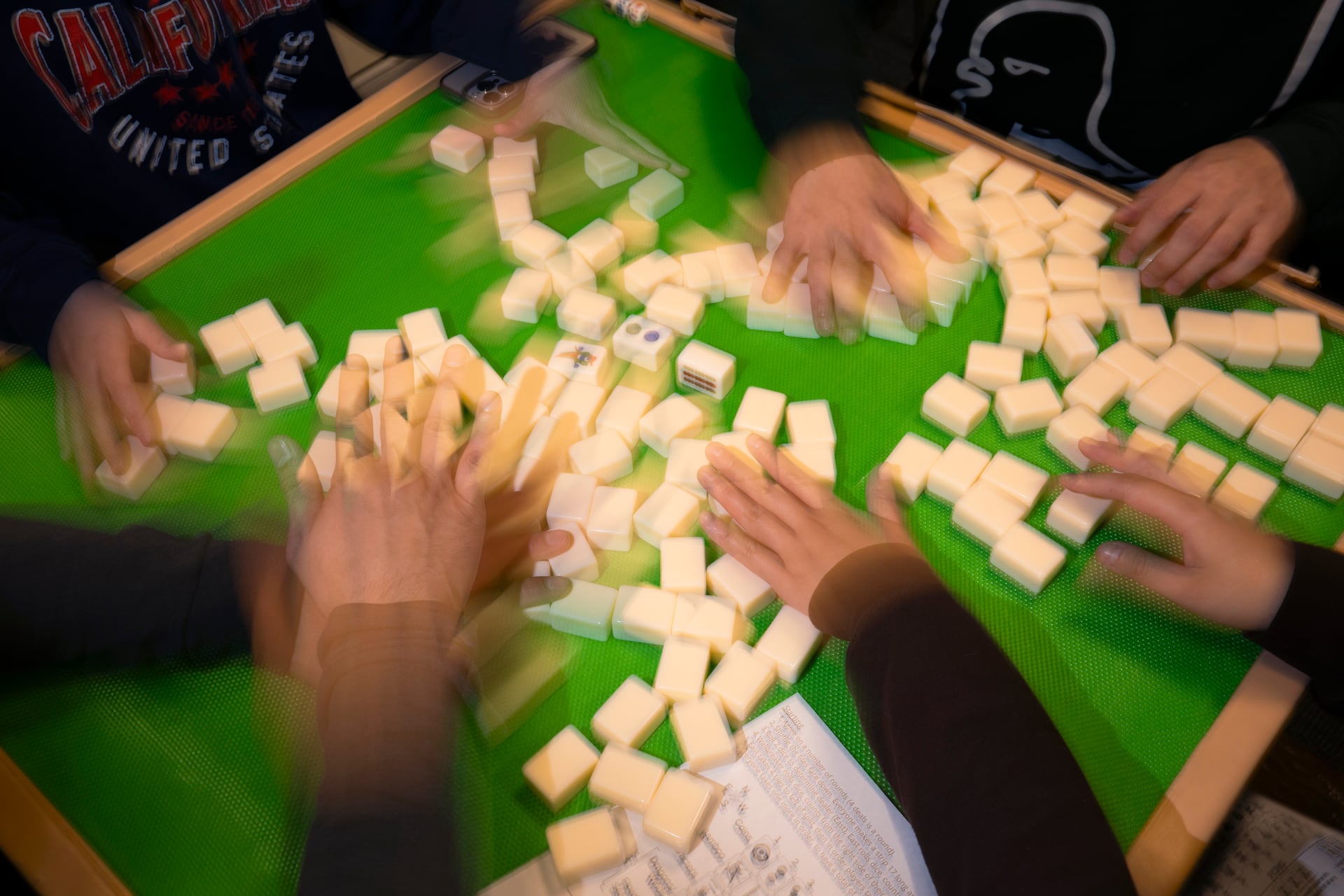
On a recent Saturday afternoon, Vance Novack was a popular man.
Amid the sound of clacking plastic tiles thudding on the green felt surfaces of automatic mahjong tables, the King of Prussia resident zipped back and forth answering questions from newer players.
The room, tucked in the corner of the second floor of an Old City building, was full — more than 30 people crowded around eight tables. The chatter was occasionally interrupted by the whirring from the tile shuffling every time a game ended.
Once Novack, 70, finally sat down with Debbie Evans, his sister who was visiting from Seattle, he started teaching her the rules of his favorite game.
He is a member and volunteer at Philly Mah-Jawn Mahjong Club, which is dedicated to the Japanese riichi style of the tile-based game of mahjong. The organization, founded in 2019, drifted around different venues in Philly before moving into its current space last year.
While people around the world have been playing the game for centuries, mahjong has exploded in popularity in recent years in the United States — and in Philadelphia. So much so, that Costco and Sam’s Club have started selling mahjong sets.
As Evans’ lesson began, the first item on Novack’s syllabus was teaching his sister how to identify the various Chinese characters on the tiles.
“Irene, my wife, reminds herself this is a standing six,” said Novack, gesturing to the tile that said liu wan, or “six of characters” in mahjong. “It looks like a person standing, the arms sticking out.”
Spotting Novack’s quiet lesson from across the room, Edward Zeng, 22, joined the table as its fourth player (this reporter was the third), quickly shifting the beginners’ game into a different gear.
Zeng, a certified riichi mahjong professional and Canada’s top-ranked player, deftly drew and discarded a tile.
“That was a really quick decision,” said Evans, 68.
“Don’t worry about this. That’s part of the intimidation tactic,” Novack — who has been playing mahjong for more than a decade — told her, laughing.
A boom beyond Asians
Mahjong’s roots lie in mid-1800s China. It was played mostly by men, socially and for gambling. By the early 20th century, the game started spreading across the world, developing regional variations inside and outside China.
Cantonese or Hong Kong, American, and riichi mahjong are some of the most common variants played today. The fundamentals are similar: the game is played with a set of tiles marked by symbols and Chinese characters, and players must form a legal hand made up of a combination of sets and pairs to win.
Haoyi Shang, 28, grew up playing mahjong in China with family, and moved to the United States more than a decade ago. When she organized Philadelphia Chinatown Development Corp.’s first mahjong night in 2023, she only set up four tables.
“I did not expect to have too many people … especially from outside the Asian community,” said Shang, who is PCDC’s commercial corridor manager and lives in Chinatown.
But to her surprise, 35 people showed up. Some even brought their own mahjong sets.
PCDC hosted its third annual mahjong night as part of its Lunar New Year programming this year. Shang and a coworker brought in tables from other rooms to accommodate more games. She borrowed her colleagues’ mahjong sets to meet the demand. There have been several requests, she said, to set up a beginners’ table at these meetups.
A time-honored Jewish tradition
While the game has Chinese origins, mahjong is also a time-honored tradition in Jewish communities. Or mah-jongg, as it’s often spelled by those who play the American style of the game.
Sophie Kudler, a student at the University of Pennsylvania, remembers watching her grandmother — her bubbie — playing mahjong with friends. In Kudler’s sophomore year of high school, her mother started taking mahjong classes at their senior center. That’s when Kudler started playing too.
“I had a snow day one day, so I went with her to the senior center, and I really loved it and picked it up very quickly,” said Kudler, 21, who studies biology. “So then my mom and I taught my dad and my sister, and the four of us started playing. Then we would also play with my bubbie.”
After arriving at Penn from Connecticut, Kudler started playing mahjong with a small group on campus during her freshman year, but that group eventually dissolved. Last August, she formed her own club at Penn’s Hillel, where five to eight undergraduate students — a mix of Jewish and non-Jewish — meet every Saturday.
Jewish spaces such as the Society Hill Synagogue and the Kaiserman Jewish Community Center in Wynnewood host weekly clubs, and the Weitzman National Museum of American Jewish History sells mahjong sets and mahjong-themed items in its gift shop.
Fostering community
The gathering where Novack and Evans met Zeng was Jessica Malone’s first meeting. Saturday afternoons from noon to 2 p.m. are dedicated to mahjong lessons at the club, but this session was especially packed since the club had closed the previous weekend to host the Saikouisen Pro Exam.
Malone, 40, moved to Philly five years ago, and she feels as if she’s “just scratched the surface” when it comes to exploring the city’s culture.
As someone who is engaged in community service — she recently volunteered at the Rail Park in Callowhill, and will work at the FIFA World Cup this summer — mahjong was another way for her to find community and explore Philly. After seeing press coverage of Philly Mah-Jawn, she decided to drop by the clubhouse.
“With so much negative news going on, I’ve made it a point to, anytime I was upset by something, try to turn more toward community and in-person experiences and enjoy the positive communities that we have here,” said Malone, who lives in Fairmount Park.
For Bella Vista’s Kaia Chau, too, the game remains “a way to bring communities together.” Chau learned to play during her middle and high school years with her family.
“It’s something about hearing the tiles, shuffling them around, sitting at the table with people and having conversation over that. It’s kind of incomparable,” said Chau, 24, a cofounder of the Ginger Arts Center — a community youth arts center in Chinatown that recently hosted a mahjong and karaoke social night.
‘Chinamaxxing’
Mahjong events nationwide saw a 179% increase between 2023 and 2024 as part of a spike in popularity around “granny core activities,” or hobbies typically associated with older populations, according to Eventbrite.
It’s an extension of a larger trend toward analog gatherings after the COVID-19 pandemic, when people sought connections beyond a screen and to escape from the pressures of daily life.
“During COVID, I think people were playing a lot of video games and discovering this kind of game online. But after the COVID [lockdowns] lifted, they were like, ‘I want to play this in person now.’ So they started coming to our meetings,” said Philly Mah-Jawn president Mike Lee, 40, who lives in Bala Cynwyd.
Mahjong’s resurgence in popularity has also, controversially, sparked allegations of cultural appropriation. Some social media users have started playing the game in their efforts to contribute toward the aesthetic cultivated by the viral trends of non-Chinese people claiming to be “Chinamaxxing” or in “a very Chinese time” in their lives.
Looking to join in on the hype, some non-Asian people have claimed to have “discovered” the game that has existed for centuries.
The Mahjong Line, a Dallas-based company led by two white women, faced backlash in 2021 for their “respectful refresh” of mahjong tiles, which replaced the traditional characters and symbols with illustrations keeping with the sets’ themes — namely “The Botanical Line: Paris Pink Release” and “The Cheeky Line: Skylight Blue Release.”
The company still sells mahjong sets that cost between $375 and $495.
Crazy, rich influence
Mahjong, in Chinese culture, has a reputation as a game played among elders. But the game’s recent surge in popularity has meant a younger crowd of Asian Americans has also started to gather around the mahjong table, bridging generational divides between players and within families.
What made them do it? Crazy Rich Asians.
The 2018 rom-com was the first major studio movie in decades to feature an all-Asian American cast. For some, the climax of the movie — when Constance Wu’s character, Rachel Chu, confronts her soon-to-be mother-in-law, played by Michelle Yeoh — brought mahjong to the pop culture forefront.
Benjamin Leung, a student at Drexel University, said that although his father grew up playing mahjong in San Francisco’s Chinatown, it wasn’t until their family watched the movie that they started playing the game together.
“We were watching the last scene, and I was like, ‘Damn, that was really cool.’ And then we bought a [mahjong] set,” said Leung, 22, a California native who studies data science. “So we spent that whole Christmas learning how to play, and then we’d play for hours.”
He’s been playing mahjong for about a year now with his friends, some of whom he went with to PCDC’s Lunar New Year mahjong night.
For them, it’s a way to connect with their heritage and identity.
Mahjong, like karaoke, is an activity “that I feel like has been very prominent in Asian communities for really a long time,” said Chau. “We all grew up singing karaoke at home. We all grew up playing mahjong. It just seems like a continuation of all these things that we grew up doing.”