See it, hear it, feel it: All the Philly art we loved this week
By Morgan Ritter, Elizabeth Wellington, Earl Hopkins, Peter Dobrin
A different kind of bookstore opens on Pine St.
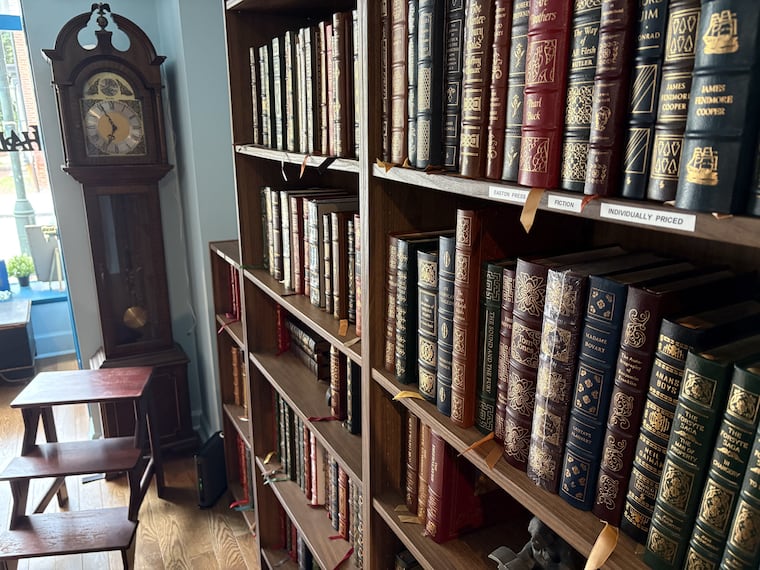
t looks like the antiquarian bookstore of your dreams: a cozy corner storefront, the shelves lined with leather-bound and gilt-edged books. A poetic name is painted on the front window in retro gold letters: Whales & Windmills.
But this new shop in the 1200 block of Pine Street isn’t quite what it seems. The books are old, and surely beautiful. Owner Yaoguang Jiang, however, was aiming for something more specific when she opened the doors in May.
While the volumes in the front room look decidedly 19th century, many in fact are reprints from the middle or late 20th century — books like The Scarlet Letter or The Great Gatsby in handsome Franklin Library editions, or an Easton Press reprint of The Canterbury Tales.
“What I’m really trying to be is something between a rare bookstore and a used bookstore,” says Jiang.
Antiquarian book dealers may charge hundreds or thousands of dollars for first or early editions of certain titles. But these later editions at Whales & Windmills, while often beautifully bound and embellished with illustrations, might go for $15 to $30 (sometimes more, sometimes less).
“I don’t want to sell super-rare books because it’s counter to my purpose, which is to get people to read books,” says Jiang, a former Penn neuroscience research associate.
Among the many authors currently represented in the shop’s fancy-binding front room are John Galsworthy, James Fenimore Cooper, Pearl Buck, and Louisa May Alcott.
In another room there are traditional used-bookstore paperbacks and hardcovers by Alice Munro, Jane Austen, Saul Bellow, and many others, some for $2 or $3 each.
“We want to be on the one hand curative, selective, but on the other hand approachable. So we want books that are pretty and have another 50 years of shelf life, but not cost-prohibitive,” says Jiang.
Her own favorites?
“Shakespeare is pretty high on the list.”
On her Instagram, she admits to an N. C. Wyeth obsession.
About the bookstore’s name, Jiang says the idea came from a joke her husband made involving Moby-Dick and Don Quixote.
“In the beginning when I started the online business and had zero followers, those were the only two books I could reliably sell.”
The name Whales & Windmills carries another kind of literary resonance.
“It’s in the theme of Pride and Prejudice, Sense and Sensibility — but whimsical.”
It sends the message that the shop deals in classic literature, “but we don’t take ourselves too seriously.”
Whales & Windmills, 1220 Pine St., is open Friday through Monday, 11 a.m. to 7 p.m. instagram.com/whalesandwindmills
— Peter Dobrin
An artifact from a little known colonial-era massacre
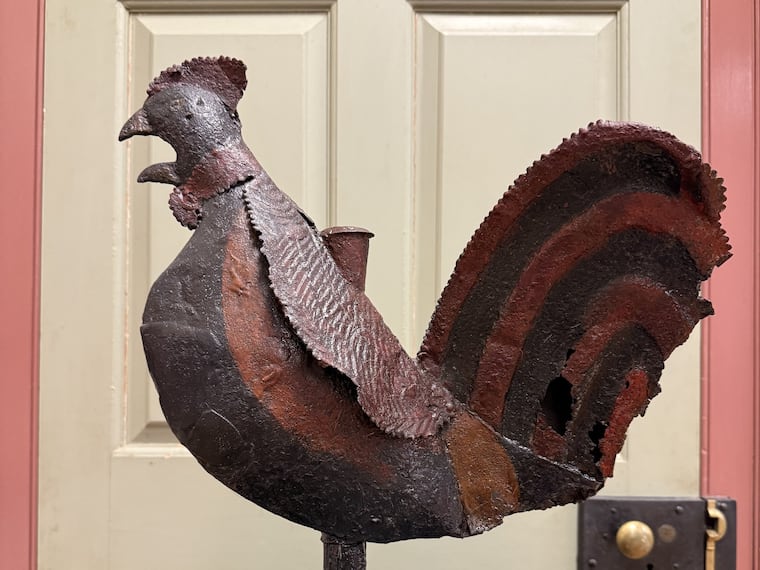
A centuries-old rooster-shaped weather vane greets visitors at the Historic Germantown Visitor Center’s new rotating exhibit, “Rebellion and Remembrance in Freedom’s Backyard.” Its metallic feathers are worn from age. Just below the bird’s comb is a scratch that Historic Germantown’s executive director Tuomi Forrest surmises has been repaired.
It’s how the scratch came to be that I find chilling.
Historians suggest it came from rocks, stones, or perhaps even gunshots lobbed at the Germantown Reform Church on Market Square by the Paxton Boys, a violent group of revolutionaries who wanted to wipe Indigenous people from Pennsylvania.
In December 1763, a mob of settlers from Paxtang Township, about 100 miles northwest of Philadelphia, murdered 20 unarmed Susquehannock Indians in Lancaster County. A month later, hundreds of these “Paxton Boys” marched toward Philadelphia to harass and kill more Indigenous peoples. Ben Franklin halted the march just outside of Germantown.
The weather vane is part of a rotating exhibit examining Germantown’s place in the Revolutionary War. But it’s also a visceral reminder that when hate goes unchecked and is allowed to linger, it can be explosive.
The Historic Germantown Visitor Center is located at 5501 Germantown Ave. “Rebellion and Remembrance in Freedom’s Backyard” runs through December.
— Elizabeth Wellington
Step inside Philly’s dazzling ‘Luminiscence’ experience
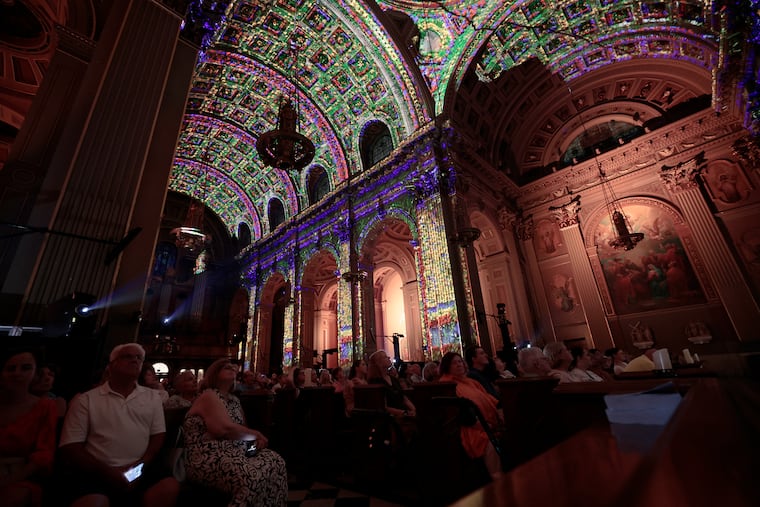
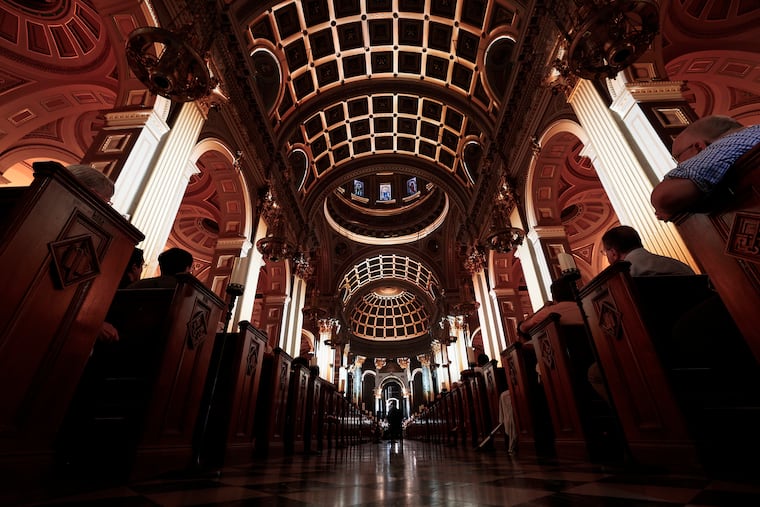
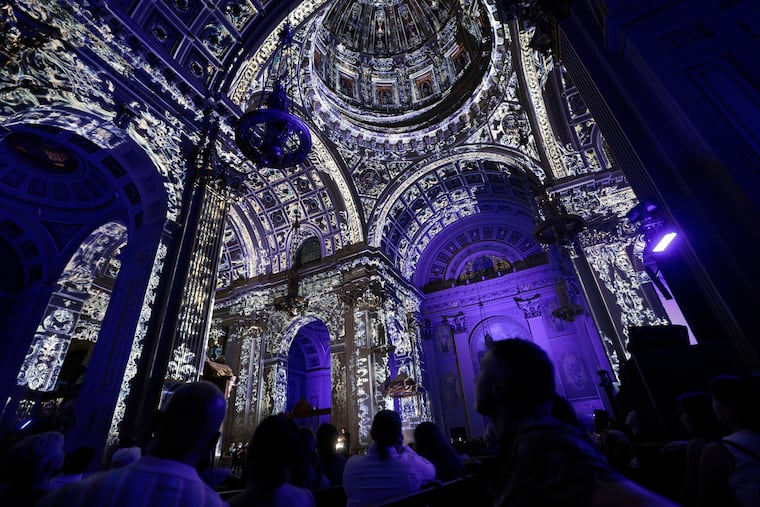
At "Luminiscence Philadelphia," time, history, and music converge inside the Cathedral Basilica of SS. Peter and Paul.
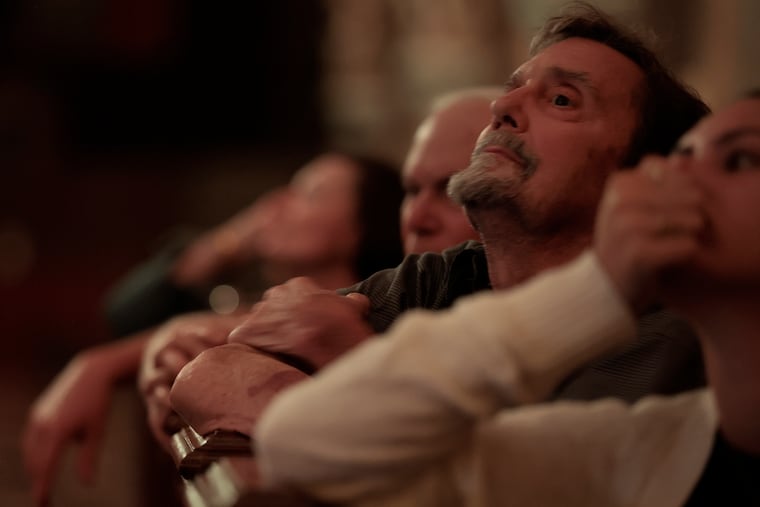
The church’s barrel arches, Corinthian columns, and copper dome are bathed in atmospheric hues and kaleidoscope imagery. Its walls transform into a singular canvas, filled with dreamscapes that stretch from the altar to its entrance doors.
Across the 45-minute show, produced by Banijay Americas Live, there are scenes of a glimmering palace, a starlit sky, a garden of falling blossoms, and angels resting in the heavens — all reminiscent of Italian Renaissance paintings.
Each vista is shaped by 25 high-definition projectors and 360-degree video mapping. As viewers lift their heads from the church’s pews, they are struck by a full panorama of colors, elevated by a blend of orchestral works.
Beethoven’s “Ode to Joy” and Claude Debussy’s “The Sunken Cathedral” blare from the church’s sound system, while human silhouettes walk along the walls. Their shadowy presence adds to the show’s visual depth.
On select nights, there are live choir and orchestra performances. Yet, even with prerecorded music, the experience is still deeply immersive. The narration, however, can be distracting. It’s difficult to make out what’s being said, other than references to the church’s formation and the nation’s 250th celebration.
But what’s clear is Luminiscence’s allure. It’s an audio-visual experience that aims to enliven basilicas and cathedrals, with respect to their religious significance and architectural wonder. And with its unfurling inside the mother church of the Archdiocese of Philadelphia, it successfully melds these distinct worlds – the sacred and the luminary.
“Luminiscence,” the Cathedral Basilica of SS. Peter and Paul on 1723 Race St., is open most Wednesday to Sunday nights into August. luminiscence.com/philadelphia
— Earl Hopkins
What is the true value of a dollar?
A U.S. dollar today doesn’t just represent currency. Artist Kaitlin Pomerantz shows that it also represents centuries of capitalism overriding the importance of the planet.
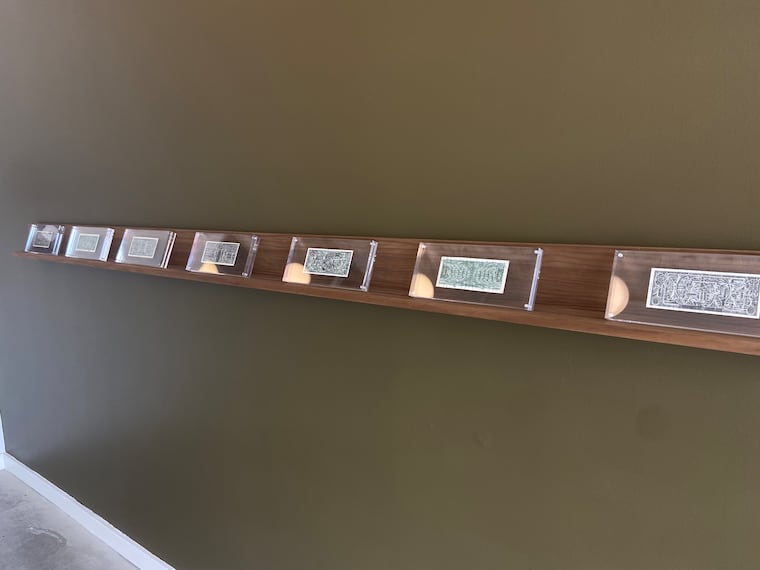
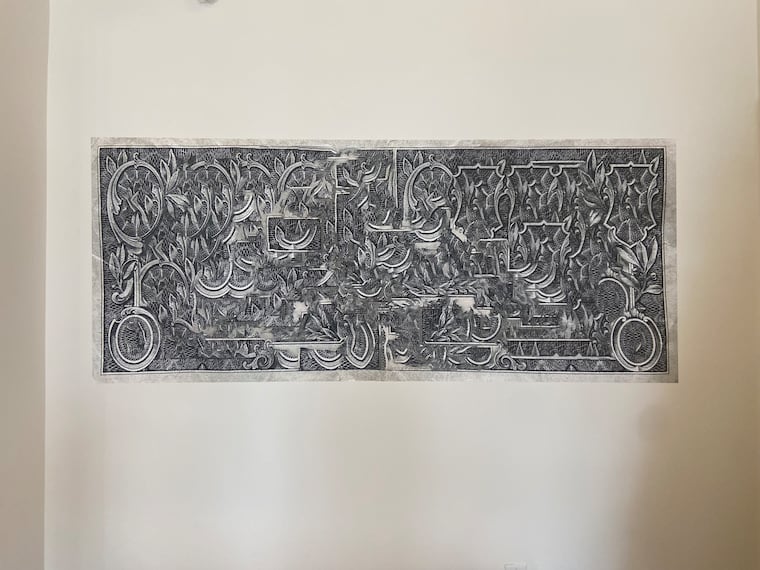
Pomerantz’s new exhibit “(de)growth” in Studio 105 at Ray Philly exhibits the dollar bill in a more ecological fashion. On one wall of the exhibit hang several dollar bills that look normal from afar, but up close, are completely reworked.
Pomerantz eliminated any symbols of political power from the dollar bill, cutting them up and collaging them to highlight the environmental aspects that exist on the dollar bill. Rather than the ecosystem being taken over by capitalism, “(de)growth" imagines a world where nature reclaims itself.
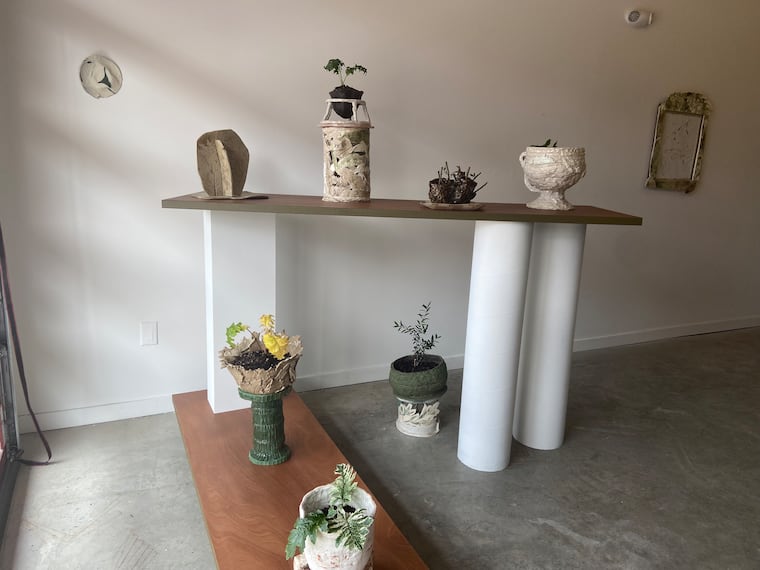
Included in the exhibit are living plant installations placed in deliberately fractured ceramic pots, showing the damage we have already done to the environment, but that it can still regrow.
It was nice to walk around the exhibit, imagining a world where the U.S. government places emphasis on protecting the environment and valuing the natural world around us. That being said, feelings of melancholy soon followed, remembering how damaging the ecological impact from capitalism has been.
Pomerantz powerfully calls out how political domination has caused government powers to lose sight of what’s really important.
It’s easy not to think about the meaning behind the design of the dollar bill. Pomerantz’s vision of changing it to be centered around the planet offers an almost optimistic perspective of what could be valued someday if oppressive systems are dismantled.
“(de)growth” by Kaitlin Pomerantz, is on view through Aug. 2 at Studio 105 at Ray Philly, open Wednesday through Sunday from noon-6 p.m.
— Morgan Ritter
An earlier version of the article had an incorrect name of the exhibition at Ray Philly. It is called “(de)growth.”


