

Best art this week is a centuries-old classical dance, S. Neil Fujita at the Barnes, and, of course, ‘I Play Rocky’
By Bedatri D. Choudhury, Rosa Cartagena, Dan DeLuca, Earl Hopkins, Elizabeth Wellington
I loved ‘I Play Rocky’
ew Hollywood films reflect the spirit of Philadelphia as much as Sylvester Stallone’s 1976 classic, Rocky. The film follows Rocky Balboa, a little-known boxer from Kensington who’s offered a chance to fight for the world heavyweight title.
His training regimen is anything but sophisticated. He downs a half dozen raw eggs in the morning, then punches slabs of frozen beef until his knuckles bleed. Yet, the “Italian Stallion” lasts until the final bell with Carl Weathers, who played undisputed champion Apollo Creed.
Now, that’s a blue-collar Philadelphian.
Earlier this week, I watched an early screening of I Play Rocky, a retelling of Stallone’s fight to make and star in the now 50-year-old film. I went in thinking ‘I know everything about Stallone’s journey,’ but left the Philadelphia Film Society Center with a greater sense of the actor’s brilliance and Rocky’s connection to the city.
The film, directed by Peter Farrelly, chronicles a young Stallone as he ventures from the streets of New York City to the offices of Hollywood producers Irwin Winkler and Robert Chartoff, with the script for Rocky in his hands. No matter the dollar amount they threw at him, Stallone was firm in his convictions. He wrote the 90-page script in three days and was determined to star in the film.
He had to play Rocky.
Actor Anthony Ippolito, who took on dual roles as Stallone and Balboa, captured the legendary actor’s fiery ambition, along with his physicality and distinct voice. The more I watched, the more I was immersed in his portrayal. I didn’t see an impersonator on screen, I saw the man who would later become one of Hollywood’s most bankable stars.
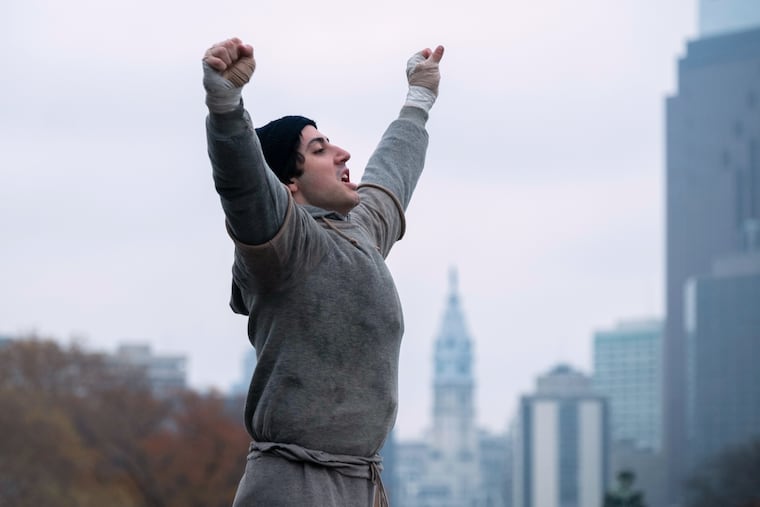
Among the film’s highlights were the reenactment of now-iconic scenes from the original film — most notably Stallone’s training montage. Ippolito, like Stallone, ran to the top of the Philadelphia Museum of Art steps, raising his arms in a triumphant pose.
It’s an image that’s been immortalized in bronze, with the Rocky Statue now standing at the top of those stairs, overlooking the city that’s embraced the fictional character as its own.
— Earl Hopkins
A 2,000 year old dance form comes to Penn Live Arts
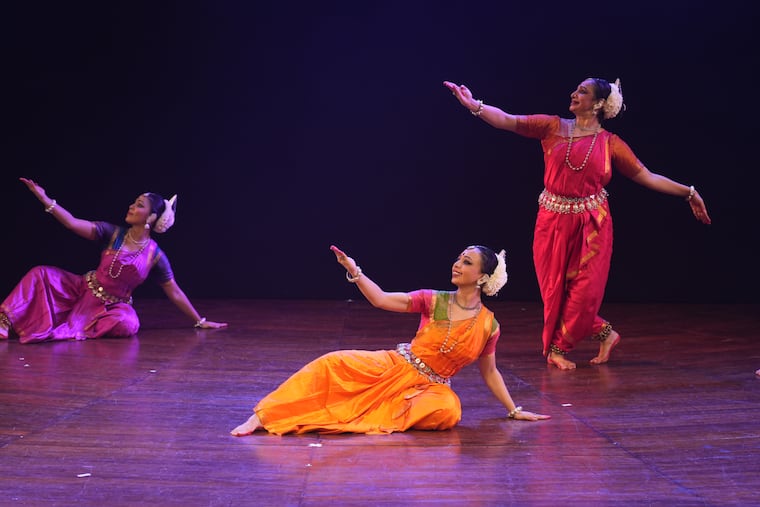
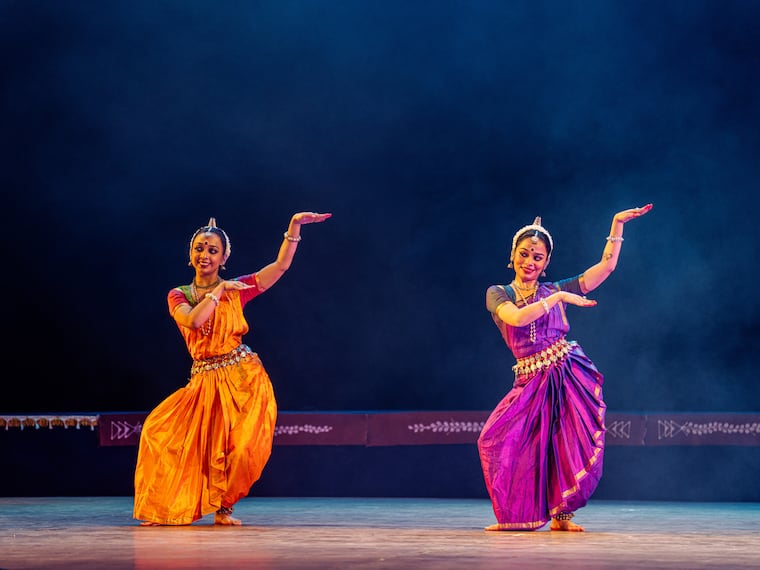
Long before I decided to be a journalist, I wanted to be an Indian classical dancer. At the age of four, I started dancing Odissi, a centuries-old danceform originating from the eastern Indian state of Orissa. It is one of the most beautiful dance forms (for me, anyway) and I am in awe every time I see an Odissi dancer taking to the stage in their silk costumes, wearing their crown-like headdress that symbolizes the spire of the Jagannath Puri temple in Orissa.
And of all Odissi dancers in the world, the ones in the Nrityagram ensemble are arguably the most masterful in technique and the otherworldly form.
Led by choreographer Surupa Sen, the Nrityagram dancers are presenting “KHANKHANĀ” named onomatopoeically after the sound of dancing feet, in the city this week. Sen takes the centuries-old devotional dance (women would dance it inside the temple and young men dressed as women would dance a more acrobatic version outside) and infuses a wonderful modernity into the themes while remaining steadfast in her own devotion to the ancient form of the dance with its distinct tribhangi (where the dancer bends at the neck, knees, and torso) and chauka (a more geometric square-like stance) postures.
Since it’s a form I danced for years, I am 100% biased but anyone who watches Sen’s troupe move around like water on a beautifully-lit stage will agree on the exquisite beauty inherent in the form of Odissi.
It is an honor to witness artforms that are older than anyone we know; an oddly grounding experience that soothes us in the knowledge that arts will outlive us all, bringing delight and wonder to generations as long as time exists. It is an exhilarating feeling and there is absolutely no better way of heralding the festival of lights, Diwali, than witnessing and feeling this for yourself.
The Nrityagram ensemble’s final performance of “KHANKHANĀ” is on Nov. 7, 3 p.m., Zellerbach Theatre, 3680 Walnut St, Phila. pennlivearts.org
— Bedatri D. Choudhury
The brilliance of S. Neil Fujita at the Barnes
When I went to check out the “Noguchi to Asawa: Designing Postwar America” exhibition at the Barnes Foundation last weekend, I knew I was going to see furniture designed by George Nakashima (created in his New Hope workshop) and Isamu Noguchi, as well as Ruth Asawa’s sensual hanging wire mesh sculptures.
What I didn’t expect to see on display were some of the most innovative and visually dazzling album and book covers in music and publishing history, including artwork for LPs by Dave Brubeck, Charles Mingus, and the Philadelphia Orchestra; and well as book jackets for Mario Puzo and Truman Capote.
Those are all the work of S. Neil Fujita, the Hawaiian born designer of Japanese descent who — like the other artists in the exhibition, which also includes the work of sculptor Leo Amino and fiber artist Kay Sekimachi — was interned during World War II. He was sent to the Heart Mountain Relocation Center in Wyoming, where he worked as the art director of the camp newspaper, copies of which are on hand in the Barnes’ galleries.
Fujita enlisted in the U.S. Army where he served in a segregated unit that saw action in Italy and France, and later worked as a translator in Okinawa. After graduating from Chouinard Art Institute in Los Angeles, he moved to Philadelphia to work for the design firm N.W. Ayer & Son, where his work was noticed by Willam Golden at Columbia Records.
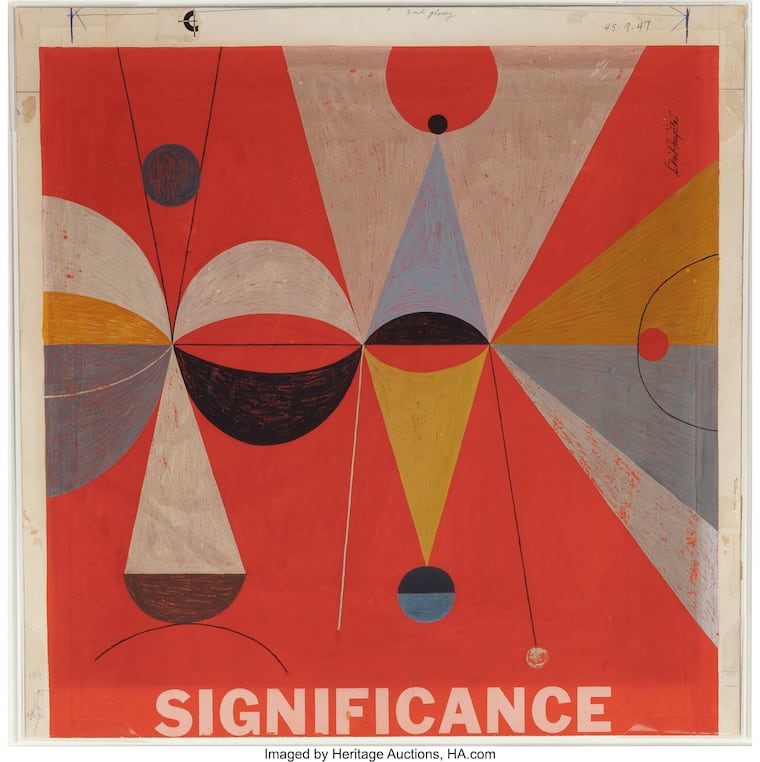
That prestigious label felt it was losing a design race to Blue Note Records, known for moody covers to albums by artists like Miles Davis and Sonny Rollins. Fujita responded by creating a visual language that featured his own abstract painting and drawings filled with geometric shapes that seemed to move on the page, capturing the improvisational energy of the music.
Along with Significance, a stunning poster for a United Aircraft Corporation advertisement, “Noguchi to Asawa” includes Fujita’s covers for Dave Brubeck’s 1959 Time Out (the first jazz album to sell 1 million copies), as well as Charles Mingus’ Mingus Ah Um, from that same year.
The Philadelphia Orchestra conducted by Eugene Ormandy’s Dello Joio: Vincent from 1958 is on display as well as albums by Glenn Gould and Johnny Eaton and His Princetonians. Fujita’s simple, attention grabbing book covers for Puzo’s The Godfather — whose puppet strings design was so powerful that it was also used for Francis Ford Coppola’s film — and Capote’s In Cold Blood are also included.
“Noguchi to Asawa: Designing Postwar America” is on view though Jan. 10 at the Barnes Foundation, 2025 Benjamin Franklin Parkway. barnesfoundation.org.
— Dan DeLuca
An artist examines war at Twelve Gates Arts
Artist Sama Alshaibi has returned home to Iraq only a handful of times during her life in political exile; her Iraqi Palestinian family were refugees after the 1949 Palestine War then exiled during the Iraq-Iran War in the 1980s, eventually moving to the U.S. when she was a teenager.
Now based in Arizona, Alshaibi has dedicated her career to examining war, displacement, and the environment through photography and video. One of her projects, called Iihya’ (Revival), is on view in the small-but-fascinating Old City gallery Twelve Gates Arts, which spotlights South Asian and West Asian artists. (The exhibit “Extended Constellations” includes work by Alshaibi, Carrie Mae Weems, and Lali Khalid.)
During one of Alshaibi’s rare visits to Iraq, she filmed this video project in the Mesopotamian Marshes, not far from where she was born in Basra, where war and resource extraction has left the land damaged in drought. The artist appears in the video herself, wearing a hijab and walking barefoot on the dry, cracked land, completely alone, almost like she’s on the surface of another planet.
Her camera splits into a mirror view evoking a kaleidoscope that renders the landscape beautiful, mysterious, and mythical. She takes a boat through some of the remaining water ways, with the lens capturing the residents and the ecosystem around her for a mesmerizing journey.
In certain moments, the horizon line disappears and the reflection of the water and sky merge, like worlds colliding. The video then goes in reverse, like the artist is trying to go back in time to restore the land’s richness. It’s a captivating and mournful meditation on what has been lost and what the future could hold. Worth watching on repeat.
“Iihya’ (Revival)” is on view through Jan. 16, 2027 at Twelve Gates Arts, 106 North 2nd St., Philadelphia, 215-253-8578 or twelvegatesarts.org.
— Rosa Cartagena
A dash of summer folded up in a silk scarf
As the winds blow colder, I’m trying to hold on to summer florals. A Hawaiian shirt at Thanksgiving wouldn’t work, at least at my family’s persnickety Thanksgiving table. But a silk scar over a navy blue turtleneck and slacks? That would fit in just fine.
Hence my attraction to actress Jane Seymour’s collection of blooming scarves. The popping petals on these bold silk canvasses — especially the floppy rainbow-hued petals on “Poppies and Butterflies” promise to warm my heart when nature abandons it as she always does in the winter.
This Saturday, Seymour will be in Haverford at the popular accessories’ haunt Marlyn Schiff from noon to 4 p.m. Known for her starring role in the 1990s pioneer drama Dr. Quinn Medicine Woman, Seymour will be on hand meeting customers, selling scarves, and helping us ease into the cold weather months with a stylish dash of summers gone by.
Marlyn Schiff, 15 Haverford Station Road, Haverford. Seymour will appear at the meet and greet from noon to 4 p.m.
— Elizabeth Wellington


