Historians may be divided over whether Betsy Ross designed the first American flag. But there’s no denying her early feminism.
She was one of the colonies' premier flag makers with clients who included George Washington. Her story does not end there.
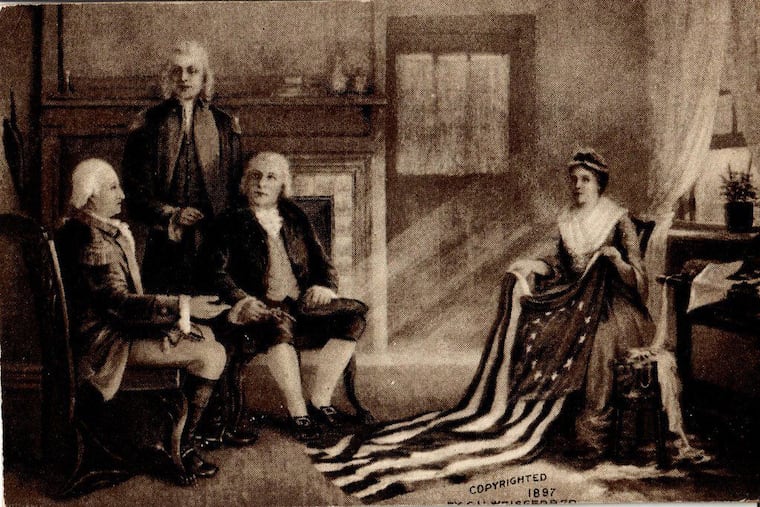
In the late winter of 1776, Betsy Ross, who was known throughout the colonies for her work with bed linens, curtains, and upholstery, was visited by her husband’s uncle, named George, and his friend, Gen. George Washington.
The Revolutionary War was brewing and Washington was in need of a flag to unify the Continental troops for the impending battles.
As the legend goes, Washington presented Ross a prototype of a flag with 13 stripes and 13 six-pointed stars. Ross immediately took out a pair of scissors and started clipping, demonstrating how to make a six-pointed star into a five-pointed one.
On June 14, 1777, the Continental Congress approved Ross’ flag, with its pattern of 13 alternating red and white stripes and 13 stars on a blue field.
That first American flag will be celebrated this Saturday at the Betsy Ross House as part of the Philadelphia Historic District’s ongoing 52 Weeks of Firsts day parties. Each week this year, the Historic District is hosting a “Firstival” honoring events that happened in Philadelphia before anywhere else in America and often the world.
The Betsy Ross House Firstival will kick off Flag Fest, the Betsy Ross House’s annual Flag Day celebration, featuring 10 days of flag-raising ceremonies, storytelling, and arts and crafts projects.
We do know that Ross’ was one of the colonies’ premier flag makers, but whether she actually made the American Flag is a question historians are continuing to grapple with. But a recently discovered receipt of a payment Washington made to Ross and her husband for bed hangings in 1774 indicates that he knew Betsy Ross and liked her work.
Ross’ story does not end with the making of the American flag, explained Desta Pulley, audience engagement manager at the Betsy Ross House.
Before the Revolutionary War began, Ross’ first husband, John, died.
Widowed at 24, she continued her upholstering business, adding flags to her inventory. She moved to 239 Arch St. — where the Betsy Ross House sits now — and rented two rooms. She slept in one and ran her business out of the other.
She remarried in 1777, but Ross was widowed again when sailor Joseph Ashburn, her second husband, died in 1782. She financially supported her third husband, John Claypoole, whom she married in 1783.
» READ MORE: Betsy Ross’ great-great-great-great grandson donates her original sewing table to Philadelphia’s Betsy Ross House
Through it all, Ross kept the business afloat, eventually handing it down to her children. Her descendants made flags well into the 20th century, Pulley said.
“Betsy’s story was significant,” Pulley said. “She was always hustling. When she started the project, the flag wasn’t this great patriotic symbol, she was just doing her job, proving you never really know what your impact will be.”
Ross is one of scores of early American craftswomen who built the country, Pulley said. Like many women of her era, she was a working mother with a business and her own agency. Yet, American history paints her as a cute old woman in a rocking chair who stitched the flag at the behest of the men in her life.
Over the years, the American flag has transformed from being a signal that identified our countrymen on the battlegrounds to becoming a symbol of nationalism. These days it is often seen as a beacon of conservative politics, not necessarily inclusive of all Americans.
“It can be a dog whistle for a certain kind of nationalism and that’s uncomfortable,” Pulley said. “What we try to do is keep our interpretation of Betsy’s story grounded in the historical context for which it happened. We talk less about the flag and more of Betsy’s life and we hope our interpretation of the message is unifying.”
This week’s Firstival is Saturday, June 6, 11 a.m.-1 p.m. at the Betsy Ross House, 239 Arch St.
The Inquirer is highlighting a “first” from the Philadelphia Historic District’s 52 Weeks of Firsts program each week. A “52 Weeks of Firsts” podcast, produced by All That’s Good Productions, drops every Tuesday.