The first Jewish American to serve the government was a Philadelphian. A letter he carried to Paris for Thomas Jefferson just sold for $108,000.
Lt. Col. David S. Franks started out working for Benedict Arnold during the revolution. His story remains in intersection between the "history of Philadelphia and the history of our nation."
In the early 1780s, Revolutionary War era Jewish patriot and Philadelphian Lt. Col. David S. Franks had a desperate work situation in hand.
He had served as one of Benedict Arnold’s high-ranking personal assistants, and after Continental militiamen discovered Arnold’s intentions to sell America out to the British in 1780, it became nearly impossible for Franks to find a job with the United States government.
Franks was cleared of wrongdoing. But working with Arnold made the Founders wary of employing Franks.
But not Thomas Jefferson, who hired Franks as his secretary. By the time the Treaty of Paris ending the Revolution was ratified in January 1784 in Annapolis, Md., then America’s capital, Franks had been Jefferson’s secretary for almost a year.
It was Franks who carried at least one official copy of the finalized treaty to Benjamin Franklin — who was in Paris at the time — and other officials in Britain and France.
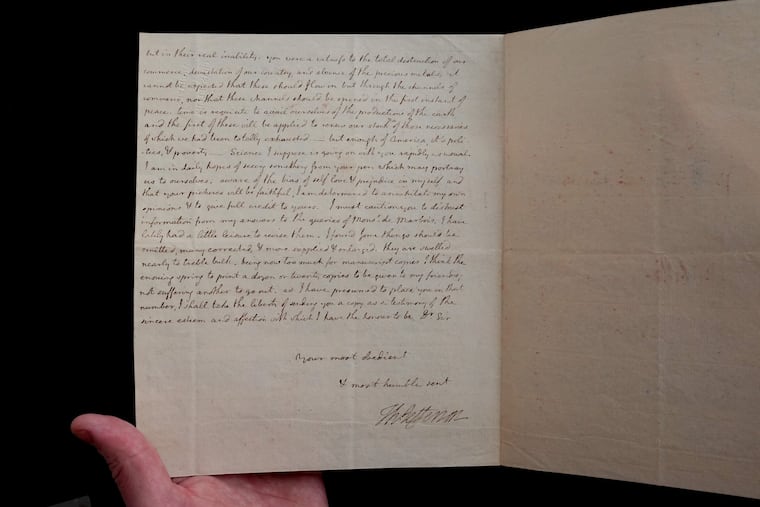
Franks also carried a two-page letter written in Jefferson’s customary neat hand for Francois Jean de Beauvoir, Chevalier de Chastellux. It was a friendly message between the longtime acquaintances, in which Jefferson wrote to the French noble about how America was progressing as a sovereign nation and about his forthcoming book Notes on The State of Virginia.
That letter sold for $108,000 Tuesday as part of an online and in-person auction presented by Philadelphia’s Freeman’s auction house.
“How History Unfolds on Paper: Important Americana from the Eric C. Caren Collection, Part X” boasted more than 320 rare newspapers, books, pamphlets, and ephemera tracing the development of printing and publishing in America, an enterprise that started in Philadelphia in 1690 with the first paper mill.
“Caren goes where the history leads him. His collection reflects that,” said Darren Winston, Freeman’s senior vice president and head of the books and manuscripts department. “When he asked us to host a sale in honor of the 250th, we immediately said yes.”
18th century news treasures
The vast sepia-hued collection of aged newspapers and bound volumes was heaven sent for primary-source junkies who can afford to plop down a few hundred or several thousand dollars for the kinds of historical gems usually found only on microfilm. It’s also a gold mine for those who think hundred-year-old newspapers in near mint condition are frame-worthy.
One such memento was a four-page Pennsylvania Evening Post printed on July 4, 1776, believed to be the first daily newspaper printed on North American soil just declared free of the monarchy.
The Evening Post, founded by printer Benjamin Towne in 1775, was published just a few blocks from the Pennsylvania State House on Tuesday, Thursday, and Saturday evenings.
The July 4 edition contains a short mention that the Continental Congress declared the United Colonies free and Independent States earlier in the day. And “the day before, we had a King in charge,” Winston said.“How History Unfolds on Paper” included five 18th century newspaper editions, including one printed in Scotland, that published the Declaration of Independence in full.
Other archival gems included a copy of the Frederick Douglass Paper from 1860; copies of the Emancipation Proclamation as they appeared in the Daily Globe, the New York Tribune, the Evening Journal Almanac, and The Philadelphia Inquirer; Abraham Lincoln’s second inaugural address as printed in the New York Times in 1865; and more than 70 issues of Civil War-era Philadelphia Inquirers.
But Caren’s collection is more than weathered newspapers.
The auctioned collection bubbled with relics, collectibles, and keepsakes that speak to the economy, such as a note signed by first director of the U.S. Mint, David Rittenhouse — for whom Rittenhouse Square is named — ordering payment of 350 pounds to a doorkeeper employed at the Pennsylvania State House. (That’s about $107,000 in today’s money.)
An 1874 advertisement for Levi Strauss & Co. that appeared in a Montana newspaper was among the cool finds, as was a 1905 Phillies Athletics score card. An 1869 letter signed by Susan B. Anthony and a 1772 volume of poetry including works from Phillis Wheatley are priceless, but their bidding started at $900 and $400 respectively.
“Freeman’s is America’s oldest auction house, and Philadelphia is the birthplace of the United States,” Caren said. “So for the 250th anniversary [of America], I thought this sale would be quite fitting.”
50 years of collecting
Caren, 66, is a New Yorker and said he came out of his mother’s womb collecting — starting with comic books, stamps, coins, and baseball cards.
In 1970, he learned that a few of his friends were going rummaging through an abandoned house in Rockland County and that they had found newspapers from the turn of the 20th century.
“I asked them to try and find me a sports page with Babe Ruth, and they brought me one from 1913 and I was mesmerized,” Caren said.
After some cajoling, Caren convinced his friends to reveal their secret treasure trove. There, he discovered periodicals going back to the 1890s and was hooked.
Caren spent the next 50-plus years collecting the printed and written word. He has traveled the world to estate sales, garage sales, rare book shops, and antique shows. He’s one of the founders of the Ephemera Society of America and a member of the American Antiquarian Society and the Grolier Club.
He owns hundreds of thousands of paper items, and pieces of his collection have been sold at the auction houses Christie’s and Sotheby’s. “How History Unfolds on Paper” was his 10th auction and first in Philadelphia.
“If ever there was a Philadelphia item, this is it”
In his travels, Caren has come across many of Jefferson’s letters. The one written to Chastellux, he says, is particularly noteworthy because Jefferson wrote it himself, as opposed to dictating it to a secretary, like Franks.
The letter had been in the Chastellux family for centuries before landing at an auction a few years ago. Caren passed it over a few times before recognizing Frank’s name in the first paragraph.
“It was a great example of how even great things can slip by,” Caren said.
The Treaty of Paris was signed in September 1783. The following January, legislators ratified it in Annapolis.
Dated Jan. 16, 1784, Jefferson’s letter reads like a chatty blog of late 18th century American happenings. In the five months since the war’s end, news traveled to Europe that Americans were behaving badly. One of the reasons Jefferson penned this missive, Caren said, was to “dispel [this] fake news.”
“There was indeed some dissatisfaction in the army at not being paid off before they were disbanded and a very trifling mutiny of 200 souldiers in Philadelphia,” Jefferson wrote, playing down the Pennsylvania Mutiny of 1783, during which a few Continental Army soldiers rioted in Philadelphia streets when they weren’t paid.
He also mentions his yet-to-be published book Notes on The State of Virginia and encouraged Chastellux to write one of his own. He did.
Voyages de M. le Marquis de Chastellux dans l’Amerique septentrionale, published at the turn of the 20th century, is what rare book dealer Wright Howes described as “the first trustworthy record of life in the United States.”
Franks, the first Jewish American to serve in the early American diplomatic corps, did not fare as well as Jefferson or Chastellux. Lingering rumors from his association with Arnold continued to follow him, and in 1786, he was fired from the government.
He spent years trying to restore his name. During his first term, President George Washington helped Franks secure a job as an assistant cashier at the Bank of the United States of America, but Franks was no longer accepted in the Founding Father’s circle.
He died in 1793 during Philadelphia’s yellow fever epidemic.
“If ever there was a Philadelphia item, this is it,” Caren said. “This letter is the intersection between the history of Philadelphia and the history of our nation.”
The headline and article have been updated to include the winning bid at the auction on Tuesday morning.