1969’s Stonewall Riots became a watershed moment in the fight for queer rights. Four years earlier, LGBTQ activists gathered at Independence Hall for the first Remembrance March.
Philadelphia's Remembrance Marches predated Stonewall and were one of the earliest instances of queer people demanding equal rights in the workplace.
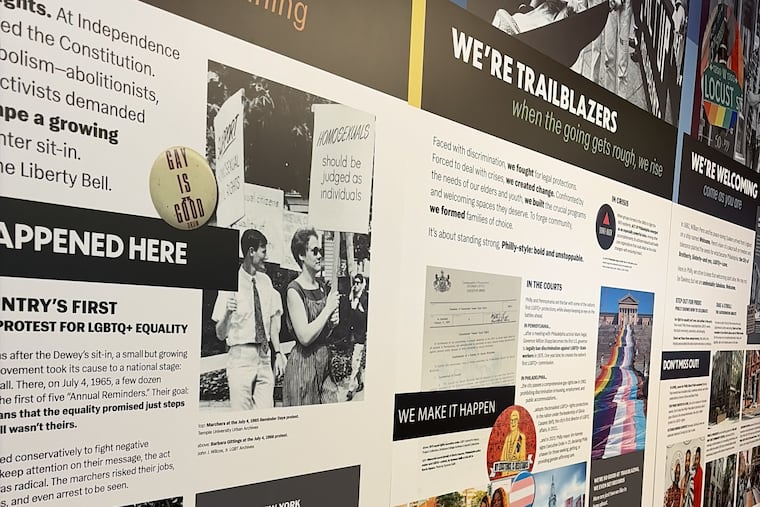
On July 4, 1965, gay activists Frank Kameny of Washington, D.C., Craig Rodwell of New York, and Barbara Gittings of Philadelphia gathered 40 of their LGBTQ brethren in front of Independence Hall to demand equality.
Dressed in three-piece suits, dresses, pumps, and spit-shined tie-ups, the marchers protested discriminatory policies that allowed gay people to be fired from government jobs and to be denied entry into military service.
Their slogan: “We don’t dodge the draft … the draft dodges us.”
Held four years before the Stonewall Uprising in 1969, the march made history as the country’s first gay rights demonstration. That 1965 march became an annual protest, now known as the Remembrance March.
The first gathering in 1965 will be celebrated at Philly Pride Visitor Center on Saturday, one of Philadelphia Historic District’s weekly firstival celebrations. Each week in 2026, the Historic District is throwing a day party honoring important events that happened in Philadelphia before anywhere else in the nation and often the world.
“They were the only 40 to 100 people willing to get on the picket line for gay rights for those five years for the entire nation,” said Mark Segal, editor of the Philadelphia Gay News, who was a teenager in 1965.
“It was the one and only march of its kind, and it was national,” he said. “People came from Chicago, Los Angeles, San Francisco. If you were someone involved in getting equality for homosexuals at the time, then you were there.”
Remembrance Marches predated Stonewall but they didn’t lead to Stonewall, Segal added.
The Philadelphia demonstrators in the late 1960s were out of the closet but were still very conservative.
“We were fighting for federal employment,” Kay Tobin Lahusen, the first openly gay American photojournalist, and Gittings’ partner, told The Inquirer in 2007 after Gittings’ death. “We wanted to look employable.”
That conservative energy largely excluded young people at that time, including Segal.
“I wasn’t allowed to march in the Remembrance Marches because I was too young. I didn’t want to wear a suit and tie. I wanted to protest in my jeans and my T-shirts. As a Philadelphian, I loved my city. I appreciated the marches and respect these brave people. But we were ready to smash invisibility.”
That sentiment bubbled across the nation.
Early in the morning of June 28, 1969, LGBTQ protesters led a series of demonstrations against police raids at the now historic gay bar, Stonewall Inn, in New York City’s Greenwich Village.
As a contrast to the more conservative Remembrance Marches, the Stonewall Riots, which Rodwell also participated in, were more disruptive and intersectional. Trans women of color, like Sylvia Rivera and Marsha P. Johnson, would eventually go on to become key figures in the uprisings.
Philadelphia’s last Remembrance March took place the following week.
The following June, East Coast Regional Conference of Homophile Organizations, also known as ERCHO, adopted a resolution in Philadelphia ending Remembrance March.
» READ MORE: Philadelphia is the birthplace of the nation. It’s also where the U.S. Army was founded.
That same month, on June 28, 1970, America’s first Gay Pride Liberation March in Greenwich Village was held in commemoration of the Stonewall Uprising.
“We went from 40 to 100 people in Philadelphia to more than 15,000 in New York,” Segal said.
“The Remembrance Days are important,” echoed Kristopher Lawrence, Philly Pride Visitor Center’s supervisor. “We were all trying to get to the same place, but we had different views on how we thought it should be done.”
This week’s Firstival is Saturday, June 20, 11 a.m.-1 p.m., at the Philly Pride Visitor Center, 1139 Locust St.
The Inquirer is highlighting a “first” from the Philadelphia Historic District’s 52 Weeks of Firsts program each week. A “52 Weeks of Firsts” podcast, produced by All That’s Good Productions, drops every Tuesday.