Woman’s Medical College of Pennsylvania gave us pelvic exams, nursing schools, and Philadelphia’s first Black MD
In the spring of 1851, eight women were the first graduates of the school’s three-year program. Students paid $10 — roughly $417 in today’s money — per class.
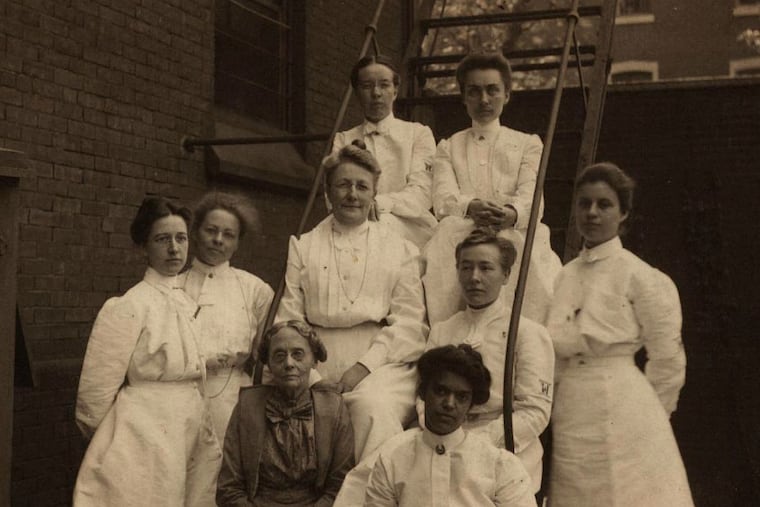
Historically, women have always cared for the sick in their communities as healers, medicine women, and midwives. But only men were allowed to get formal medical training.
It wasn’t until 1849 that Elizabeth Blackwell became the first woman in the United States to earn a medical degree from Geneva College of Medicine, now Syracuse University College of Medicine.
That same energy was in Philadelphia.
In response to the desires of upper-class women in their circles, Quaker philanthropist William J. Mullen teamed up with physicians Bartholomew Fussell and Joseph S. Longshore. In December 1850, they opened the Female Medical College of Pennsylvania at Sixth and Arch Streets.
In 1867, the school changed its name to Woman’s Medical College of Pennsylvania.
This Saturday, the world’s first medical school created exclusively to grant women medical degrees, will celebrate its beginnings at Drexel University’s Health Sciences Building.
The day party is the Philadelphia Historic District’s next fete in its 52 Weeks of Firsts series that marks events that happened in Philadelphia before anywhere else in America and often the world. 52 Weeks of Firsts is part of the city’s 2026 citywide Semiquincentennial celebration.
In December of 1851, eight women — including Longshore’s sister, Anna Longshore-Potts, and his sister-in-law, Hannah E. Meyers Longshore — were among the first graduates of the school’s three-year program. Students paid $10 (roughly $417 in today’s money) per class.
Ann Preston was also in that inaugural class, and joined the faculty in 1853. She helped found Woman’s Hospital of Philadelphia in 1861 on North College Avenue, where the college would move a year later. There, she helped open the Women’s Hospital and started the country’s first state-chartered school for nurses.
In 1866, Preston became the first woman to serve as dean of a medical school in the world.
“Woman’s Medical College of Pennsylvania becomes the foundation for thousands of women to receive their medical degrees,” said Margaret Graham, director of Drexel University’s Legacy Center: Archives & Special Collections. “And many of the graduates become ‘firsts’ in their communities and trailblazers in their fields.”
1867 graduate Rebecca J. Cole likely the first Black doctor with a medical degree to practice in Philadelphia. (Nathan Mossell, the first Black man to graduate from the University of Pennsylvania, completed his medical degree in 1882)
1875 graduate Jennie Kidd Trout was the first woman licensed to practice medicine in Canada.
» READ MORE: ‘This history is here’: Philadelphia was home to the first college established to grant medical degrees to women
1899 graduate Catherine Macfarlane opened the first clinic in Philadelphia to perform pelvic exams for cancer screenings.
Many were not happy with advancements in the women’s medical field. WMCP graduate Hannah E. Meyers-Longshore — the first woman doctor to have a private practice in Philadelphia — had a hard time getting male pharmacists to fill her patients’ prescriptions.
Still, WMCP served as a model for other medical colleges.
» READ MORE: Do you buy a poinsettia to celebrate the holiday season? There is a very Philly history to that.
WMCP moved to its East Falls campus in the 1930s. In 1970, it admitted four men and changed its name to Medical College of Pennsylvania. Medical College of Pennsylvania and Hahnemann School of Medicine merged in 1996 and became Allegheny University of Health Sciences.
In 2002 both programs became the Drexel University College of Medicine.
Today, women make up 55% of United States medical school students, according to the Association of American Medical Colleges. Drexel University’s College of Medicine class of 2029 is 59% women.
This week’s Firstival is Saturday, March 14, 11 a.m.-1 p.m., Drexel University Health Sciences Building, 60 N. 36th Street. The Inquirer will highlight a “first” from the Philadelphia Historic District’s 52 Weeks of Firsts program every week. A “52 Weeks of Firsts” podcast, produced by All That’s Good Productions, drops every Tuesday.