See it, hear it, feel it: All the Philly art we loved this week
By Peter Dobrin, Dan DeLuca, Emily Bloch, Bedatri D. Choudhury, Earl Hopkins
Fireworks heads to church to perform ‘Gospel’
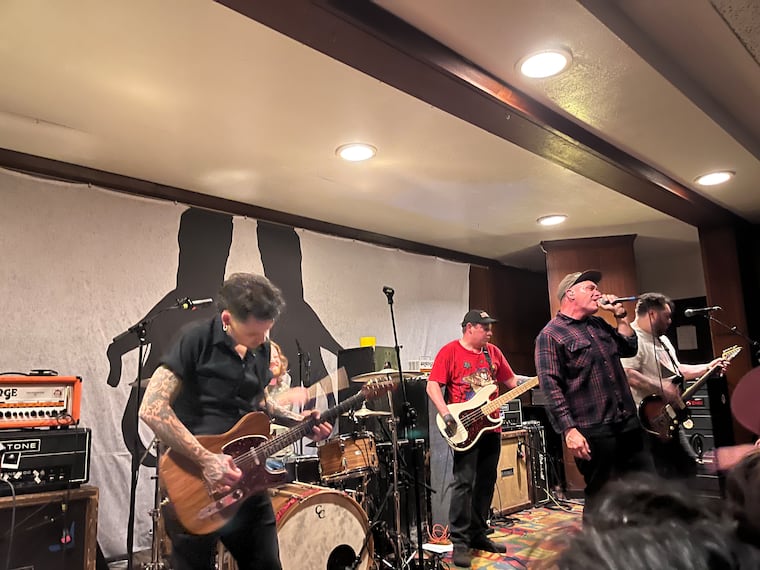
here’s something special about growing up alongside a favorite band, hitting milestones together, then experiencing them again in adulthood. In 2011, Fireworks — a pop-punk band from Detroit, — toured in support of its new album, Gospel. They played my hometown venue in Pembroke Pines, Florida. I was in my late teens and every song felt like the soundtrack of my and my friends’ lives. To experience it all again 15 years later felt like lightning in a bottle. We’ve all been through so much life along the way, but we’re still crowd surfing and yelling the same lyrics together in a sweaty basement.
To see Fireworks play after a lengthy hiatus and feel the weight of Gospel under the current climate felt like a great, fleeting gift. It was more than nostalgia-core (which many bands are understandably doing right now). Gospel holds up profoundly in the current era because at its core, it’s a mature album about growth, grief, self-doubt, relationships, and change. It has some great bridges, too. It’s as much a part of me, and as relevant today in my 30s, as it was when it was first released. Hearing it live again — this time in a sold-out show in First Unitarian Church of Philadelphia’s basement — felt like magic. And it felt like coming home.
— Emily Bloch
A ‘toxic’ dinner setting at the Fabric Workshop and Museum
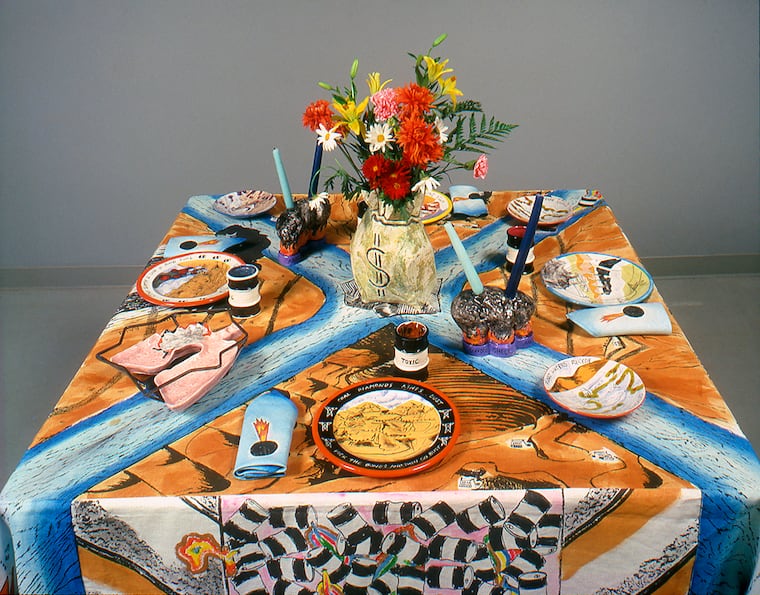
It’s a dinner setting for four. Four plates, cups, napkins, candles, and a vase sit atop a table clad in an 85-inch-by-85-inch brown and blue tablecloth.
It could all be idyllic, but artist Rebecca Howland’s Toxicological Tablecloth is anything but that. The tablecloth, created when Howland was a fellow at the Fabric Workshop and Museum in 1984, is patterned with barrels of oil dumping sludge onto layers of brown soil. There are two intersecting blue rivers flowing across the tablecloth, and there are mines, towers, and sheep.
Howland, whose work explores themes of ecology, extraction, and politics, draws inspiration from Northeastern Pennsylvania’s Centralia where a fire has been burning underground since 1962, when a landfill fire ignited a coal seam.
Howland’s dystopic dinner is set with little cups resembling toxic waste barrels, her dinner plates telling the story of ecological disasters fueled by human greed: like the oil slick that covered Texas beaches in 1984 and the 1982 flooding of Times Beach, Miss., where people of the town had to relocate because of the spread of dioxins. There’s an ashtray shaped like cancerous lungs and the napkins have coal fire drawings. The vase in the middle is shaped like a bag of money marked with a dollar sign. The candlesticks sit on holders depicting coal ash from fires fueled by oil companies like Shell and Sunoco.
The multimedia art installation stuns in its attention to details. It is harrowing in its portrayal of ecological disasters but also amusing in everyday-life dining table presentation. Part of the Fabric Workshop and Museum’s ongoing “Some American Dreams” exhibit, Howland’s Toxicological Tablecloth is a shameful reminder of how we’ve gotten accustomed to the reality of life-altering disasters, so much so that we now treat their existence — literally — as part of the furniture of our world.
“Some American Dreams” runs through June 14, at Fabric Workshop and Museum, 1214 Arch St., Phila., Free ($10 suggested donation). fabricworkshopandmuseum.org
— Bedatri Choudhury
The art of art collecting and life, according to Sheldon Bonovitz
They didn’t set out to be collectors.
“People started referring to us as collectors,” Sheldon Bonovitz said the other night.
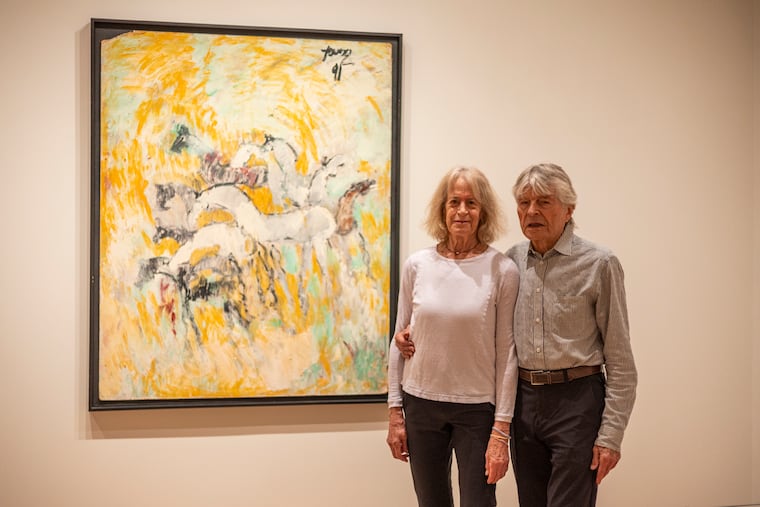
And it developed from there. Over the course of six decades, Jill and Sheldon Bonovitz have amassed one of the most impressive collections of American outsider art anywhere.
How the Philadelphia couple did it is laid out in a charming and accessible book, Visionary Lawyer, Art Collector, Philanthropist: A Memoir, released this week and launched Wednesday night with a talk for invited guests at the Comcast Technology Center’s Ralph J. Roberts Forum.
As the title suggests, Sheldon Bonovitz’s memoir is about more than art collecting, touching on his time on the boards of Philadelphia cultural groups like the Barnes Foundation and Curtis Institute; how he helped to grow the Duane Morris law firm during his years as chairman; and a detailed account of a tough childhood in Cleveland.
But it’s perhaps the Bonovitzes’ adventures in art collecting that are the most intriguing part of the story, including tales of works they should have bought but didn’t, and a piece they ended up not being able to live with (a Basquiat).
When Jill is asked what it is about the work of self-taught artists that she likes, the answer is refreshingly free of art-speak or pretentiousness.
“What appeals to me is the joyfulness, the very bright colors — plus it’s not minimal.”
For Sheldon, 89, the enthusiasm shows no sign of dimming.
As he confessed to Wednesday night’s crowd:
“I bought 10 pieces of art in the past two weeks.”
The book is available via amazon.com or sheldonbonovitz.com.
— Peter Dobrin
Generations of Black music honorees at the Philly Walk of Fame gala
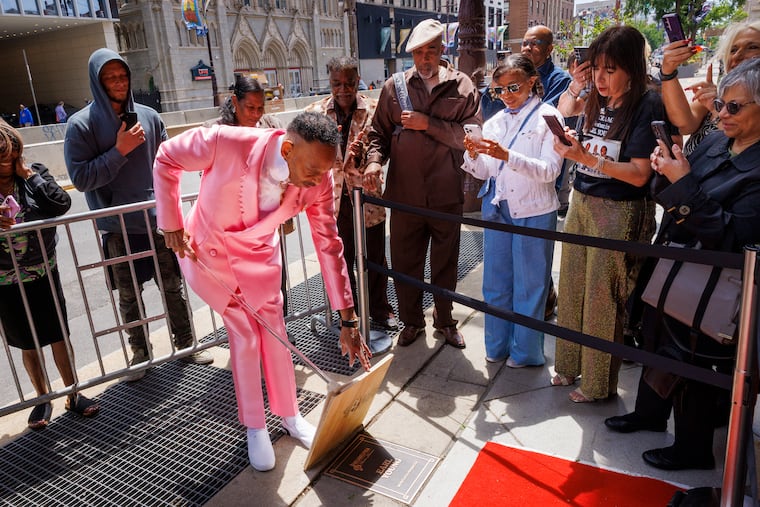
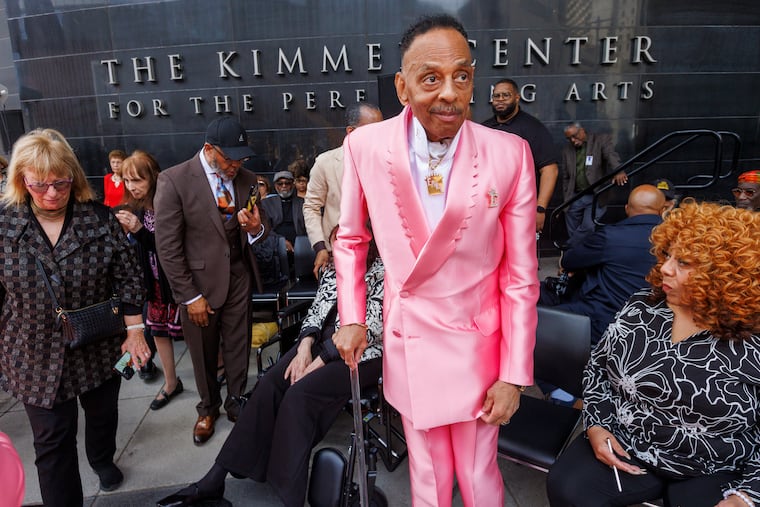
This year’s Philadelphia Music Alliance Walk of Fame inductions took place with a class that included Yannick Nézet-Séguin, Phantom of the Opera star Hugh Panero, and percussionist Pablo Batista getting their names embedded in concrete in front of the Kimmel Center.
After a plaque-unveiling ceremony on a sunny day on South Broad Street, the action moved inside at night for a gala at the Kimmel’s Perelman Theater.
The acceptance speeches were moving.
Louise Williams Bishop, 91, the “Gospel Queen of Philadelphia,” who for decades balanced a career as a DJ on WDAS-FM (105.3) while serving in the Pennsylvania State House of Representatives, talked about confronting racism growing up in Georgia before “God opened up a way” for her to migrate north and attend West Philadelphia High School.
Marshall Allen of Sun Ra Arkestra was present for the daytime ceremony but skipped the gala. (He’s scheduled to perform at his 102nd birthday party at the Ruba Club on May 24.)
Earl Young, 86, was resplendent in powder blue — a costume change from his pink outfit earlier in the day. The Lifetime Achievement Award winner talked about growing up “in some of the hardest neighborhoods of North Philadelphia” where “when I walked the street I also thought the N word was part of my name.”
The drummer and leader of the Trammps whose four-on-the-floor signature sound led him to be known as “The Man Who Invented Disco” said: “I didn’t have a mother or a father, but what I did have was determination. I was determined to be someone.”
Later, Young and the Trammps joined PMA house band David Uosikkinen’s In the Pocket for a scorching “Disco Inferno” finale.
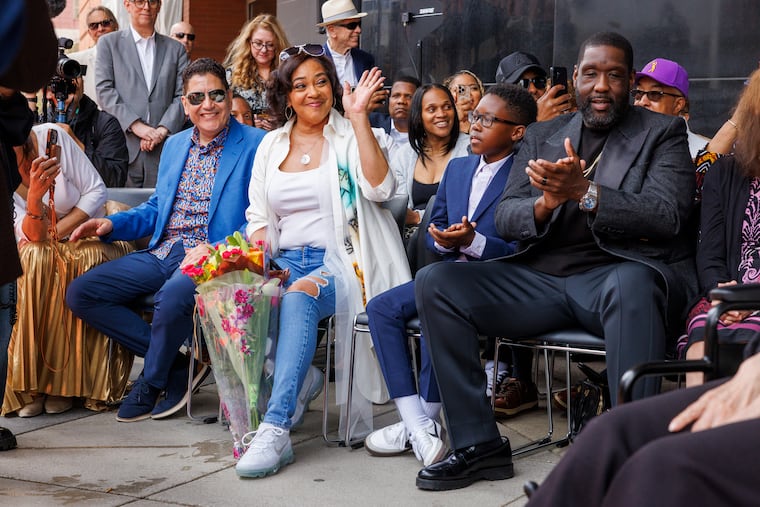
Adam Blackstone, 43, was recognized as bass player and music director to the stars, known for collaborations with Rihanna, Eminem, Alicia Keys, and Justin Timberlake. On stage with son Adam Jr., 10, and scene-stealing daughter Adea, 5, he was moved to tears by the idea of his name being embedded in the concrete on the sidewalk he used to walk as a student at the University of the Arts. “You can’t add days to your life,” he advised the crowd. “But you can add life to your days.”
Philly DJ Lady B, whose 1979 single “To the Beat, Y’All” is considered the first Philly rap record and one of the first rap songs by a woman, was honored as an advocate in hip-hop’s foundational years.
The radio personality, whose given name is Wendy Clark, said her late mother would take her to Broad Street to teach her about culture on a more elevated plane than “that hippity hop stuff that you do.”
Clark said she would look at the plaques with names and clef notes and play a game called “find your favorite mentor.” She shouted out Philly radio legends Mary Mason, Joe “Butterball” Tamburro, Sid Mark, Georgie Woods, and Jerry Blavat.
“Mommy,” she said. “I know you’re looking down. That hippity hop music earned me a clef note with my name on it on Broad Street.”
Adam Blackstone will perform at The Roots Picnic on Belmont Plateau on May 30-31. Lady B’s Annual Basement Party is at the Dell Music Center on Aug. 23.
— Dan DeLuca


