Havertown native’s play about clergy abuse will be performed steps away from the Harrisburg Capitol as the Senate votes on statute of limitation reform
Jay Sefton is lucky to have taken his "and found a way to channel it into" art. He also hopes it helps change minds of Harrisburg lawmakers.
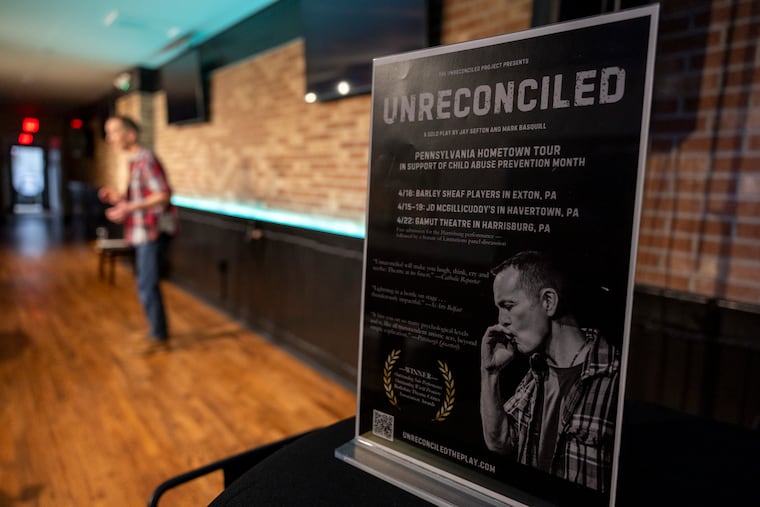
Last week, the chairs were not in their usual place in Havertown’s JD McGillicuddy’s bar.
Instead, there was a shallow performance space where Jay Sefton was impersonating his father’s thick Delco accent, cracking jokes about Death of a Salesman, and the Phillies losing.
Screens around him showed clips from iconic Philadelphia sports moments like DeSean Jackson’s legendary 2010 touchdown against the Giants.
The choice to perform in a bar is not out of scarcity of performance spaces. Sefton, 54, grew up in Havertown hanging out in McGillicuddy’s (when it was called Brownie’s) as a student at West Chester University. This homecoming performance is deeply personal, as is the play he is performing.
Unreconciled, written by Sefton and Mark Basquill, details Sefton’s personal experience of childhood abuse by a priest when he was in middle school, and his later interactions with the Philadelphia Archdiocese’s Independent Reconciliation and Reparations Program for Claims of Clergy Abuse of Minors (IRRP).
Throughout the play, Sefton plays members of his community, including his father, classmates, neighbors, and teachers, as well as the Rev. Thomas J. Smith, a priest defrocked in Philadelphia in 2007, after being accused of sexual misconduct with minors. Sefton also plays attorneys Kenneth Feinberg and Camille Biros, administrators of the IRRP.
“The play tells the story of a family and a community and it’s just amazing to be able to get to do that play in the community that is the story of it,” said Sefton. “I know it’s a hard sell that you’ve got a solo show about clergy abuse. I always joke that ticks two boxes of what I would like to not do with my night.”
Sefton’s piece indicts the abuser but also the wider system that keeps survivors of childhood abuse from reconciling their past traumas. Surprisingly, the play remains upbeat and disarmingly funny.
Sefton’s portrayal of his father in particular, constantly smoking a cigarette and watching a sports game, is so recognizable to Delco audiences, including this writer.
The first time the crew read the play out loud, it was 2 hours and 45 minutes long, said Sefton. “And so we had to start lopping away characters. As we did that, it was like the NCAA tournament … My dad just kept moving along and things fell away, but his [character] never did and it felt right.”
His father, Joe Sefton, spent the last year of his life advocating on his son’s behalf to the Archdiocese of Philadelphia, before his death in 2012. He was a parent attempting to make right the abuse his child had suffered, unbeknown to him in 1985. The spotlighting of that parental grief makes the play particularly effective, not just to survivors, but to anyone who wants a better world for children.
Sefton also runs Unreconciled Project, a nonprofit organization that aims to empower survivors of childhood sexual abuse to reclaim their voices through the art of storytelling.
Unreconciled is presently on a two-week, three-city tour in conjunction with Child Abuse Prevention Month and Sexual Assault Awareness Month.
The tour will culminate on April 22 at Gamut Theatre Group, steps away from the Harrisburg Capitol, in support of legislation seeking to reform Pennsylvania’s statute of limitations and establish a retroactive two-year civil “look-back” window for survivors of childhood sexual abuse to file lawsuits over decades-old abuse.
On Wednesday, Unreconciled will be presented at the Capitol as a part of a wider slew of programming aiming to focus the conversation on survivors.
A day after the performance, the Democratic Policy Committee will bring in survivors and experts in the psychology of survivors to testify on the long-standing impacts of child abuse.
First-term State Rep. Nate Davidson, a Democrat who represents parts of Dauphin and Cumberland Counties, is the latest torchbearer of House Bills 462 and 464, which have passed the Democratic-controlled Pennsylvania House of Representatives and are now being brought to the Republican-controlled Senate.
Survivors could initially sue the church until they turned 20. That age was changed to 30 in 2002 and 55 in 2019. But these changes were not retroactive.
House Bill 462 offers a statutory change to the law to open a temporary look-back window.
House Bill 464 is a constitutional amendment, ratifying a permanent look-back window.
In 2018, the state of Pennsylvania released a grand jury report detailing decades of abuse by 300 priests, and alleged cover-ups. Several lawsuits against dioceses were filed across the state, all of which are now stuck in the bog of bureaucracy as lawmakers like Davidson seek to push for the two-year window for lawsuits.
These amendments were not appropriately advertised before a planned vote under Gov. Tom Wolf’s administration in 2021. The error was considered a result of “internal systemic failures,” leading to the resignation of Secretary of State Kathy Boockvar.
Davidson, who ran on the promise of ratifying the bills as his first goal, hopes to carry them over the finish line.
Davidson, who has previously been a legislative staffer and campaign staffer, has “watched this saga play out” for about a decade. He has seen former Rep. Mark Rozzi (D., Berks), a clergy abuse survivor, champion this issue for years and been frustrated to see Rozzi’s experience “getting bounced around the Capitol.”
“It seemed like a fairly open and shut issue: giving survivors of childhood sexual abuse access to our legal system.”
Those who have paid attention to Harrisburg politics, legislators and survivors alike, are not hopeful that these bills will pass. That includes Sefton.
“Honestly, I can’t imagine it happening. It’s never happened,” he said. “We’ve been at this place for 20 years. It goes through the House, it gets stalled in the Senate. Somebody refuses to bring it to the floor for a vote, even though the polls show that the people of Pennsylvania want this.”
Davidson cites partisan disputes in the divided state legislature as the block to ratifying these bills.
“Pennsylvania’s a pretty purple state. We swing back and forth all the time. I still don’t understand how this got to be a political football. You’re either going to choose the side of the survivors, or you’re going to choose to protect the institutions and the abusers,” he said.
Sefton’s show seeks to exemplify the power of a survivor’s ability to reconcile and reclaim their own story.
“I’m really lucky that I took that rage and found a way to channel it into something really beautiful,” said Sefton, who started writing Unreconciled in 2021 in response to the failures of the Wolf administration to ratify this legislation. “It speaks to the alchemy of theater, to take what was born in rage, and have it be an expression of joy. I love performing it,” he said.
For information on future performances of “Unreconciled,” visit unreconciledtheplay.com/.