The University of the Arts’ archive will now live on at the Historical Society of Pennsylvania
The collection, which might hold almost a million items, could've ended in a dumpster. But now, it will be HSP's largest and will cost an estimated $500,000 to catalog, conserve, and digitize.
The University of the Arts is now history, literally.
A vast and varied cache of historic archival materials from the bankrupt and shuttered university and its predecessor institutions has been acquired by the Historical Society of Pennsylvania, HSP announced Monday.
How vast, how varied?
The collection includes student portfolios, exhibition catalogs from the university’s galleries, graduate theses, one-of-a-kind books, artwork, rare photographs, architectural renderings, and more. HSP doesn’t know exactly how many individual documents have come over from UArts’ Broad Street buildings to HSP at 13th and Locust Streets, but the material takes up 870 linear feet.
“We have no idea how many records, but from our experience something like 870 linear feet could hold close to a million records,” said HSP librarian and CEO David R. Brigham. “It’s a huge collection that spans a century and a half.”
That makes it HSP’s single-largest collection. The materials are still being processed, but are available for public consumption, Brigham said.
“We’re getting requests to use it already. One of the developers [of a former UArts building] is asking for architectural records. Harvard University Museums has already borrowed our work for an exhibit that opens this fall.”
No money changed hands in the transaction, Brigham said, though it will cost HSP an estimated $500,000 to catalog, conserve, and digitize materials. An initial $50,000 grant toward the effort has already been committed. The collection may grow; the society expects to hear from faculty, alumni, and others who might have materials that they would like to donate.
That the University of the Arts’ archives would survive was not a given. The school closed abruptly in June, 2024, citing a cash position that had “steadily weakened” and “significant, unanticipated expenses.” It filed for bankruptcy the following September. A court order this past March authorized the bankruptcy trustee in the case to “abandon, and/or destroy, recycle and/or dispose of any records that the trustee determines are not necessary to the administration of the estates or are cost-prohibitive to store.”
But HSP officials had already become concerned about the fate of the materials and raised their hand as a potential steward, and the court order also included an option for the trustee to send them to HSP. The society’s collections committee reviewed the potential acquisition in August, and the board approved the move on Sept. 8.
(A separate court order in December approved the transfer of student transcripts to Moore College of Art and Design.)
The UArts records at HSP go back to 1876 and encompass institutions that, over the years, merged into what became the University of the Arts: the Philadelphia Musical Academy, Philadelphia Conservatory of Music, Philadelphia Dance Academy and the Philadelphia College of Art (previously the Pennsylvania Museum School of Industrial Art).
A recent visit to the archive was a walk through the history of the school — and the arts in Philadelphia generally.
Edna Andrade, a Philadelphia proponent of the Op Art movement that used optical effects and illusions, is represented with a sketch of a mural for a Free Library of Philadelphia branch. Modern dance pioneer Nadia Chilkovsky Nahumck appears in a large photograph, and the archive holds the charter of the Philadelphia Dance Academy, which she founded.
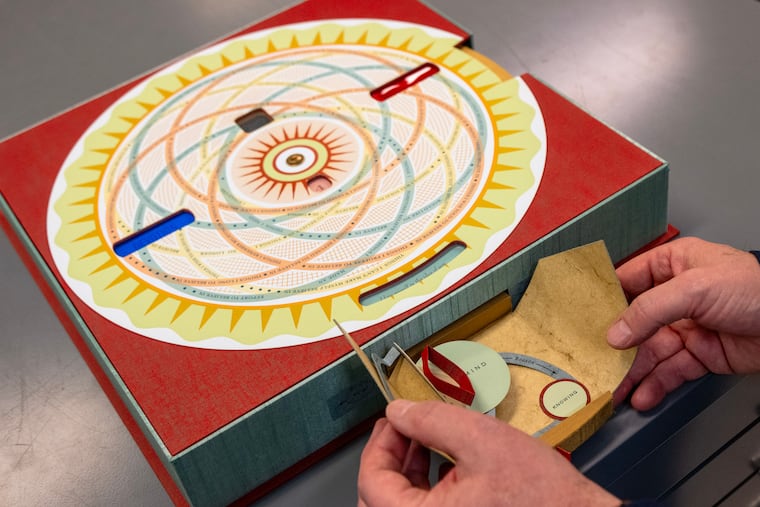
A handmade book by Julie Chen has the user spinning a wheel that, depending on the position, reveals a different booklet in a drawer that opens. Musical notation can be seen peeking through the cutout of a box holding the papers of composer Donald Chittum.
Looking over posters and other items carefully cushioned in protective archival padding in a large flat file, Brigham said the University of the Arts had kept the materials in good condition.
“They were caring lovingly for their own history. But the question still remained, ‘Where will it go, how will it survive? It’s a big undertaking, obviously. It will keep us busy for a long time. It’s a responsibility, but we know how to do it.”
Highlights from the University of the Arts collection will be on view Nov. 8, from noon to 4 p.m., during an afternoon of UArt-related events at HSP, 1300 Locust St., hsp.org.
