As data center water demand surges, rivals American Water and Aqua are merging
The all-stock deal combines the two largest U.S. companies seeking to take over municipal water and sewer systems.
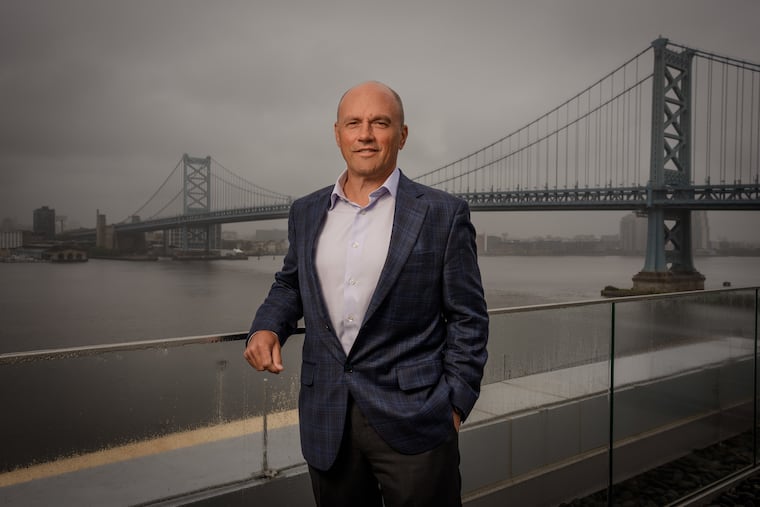
Camden-based American Water has agreed to buy its Bryn Mawr rival Essential Utilities and its Aqua water division in an all-stock deal that combines the two largest municipal water and sewage system companies in the U.S. into a single entity that aims to acquire more.
The deal joins two companies that trace their roots to the late 1800s, Essential chairman and chief executive Christopher Franklin told investors Monday in a conference call.
Joined under the American Water brand at its Camden headquarters, the enlarged company will be worth around $40 billion on the stock market, ranking with water and electric companies among the 10 most valuable U.S. utility stocks, American Water CEO John Griffith, said in an interview.
“It’s going to be a real powerhouse, must-own” stock, said Griffith, a former investment banker who took over as American Water CEO last year and will head the merged companies.
With around 10,000 total employees, the companies together serve around 5 million water and wastewater customers across 17 states, plus military bases in more than a dozen states, with Pennsylvania accounting for around one-third of the total.
The two companies are “by far the two largest players in the regulated water utility industry,” said Ryan M. Connors, a veteran utility analyst now with Northcoast Research in Cleveland. Together they would be “a truly dominant” water utility, he said.
Locally, American Water serves users in the Coatesville, Downingtown, Exton, Norristown, Phoenixville, and Plymouth Meeting areas, and in Burlington, Glassboro, Haddonfield, and other areas in South Jersey.
Aqua has customers in communities throughout Philadelphia’s Pennsylvania and New Jersey suburbs.
Franklin acknowledged that Essential’s share price has been trading “at a discount,” adding that sales and profits should grow more quickly under American Water.
The companies are looking for a possible buyer for Essential’s Pittsburgh gas utility, Peoples, which Franklin bought for $4.3 billion in 2020.
The partners will need approvals from shareholders and state utility regulators in at least five states, including Pennsylvania and New Jersey, to close the deal on schedule by early 2027. Connors said the combined company from its New Jersey headquarters needs to show it can continue Aqua’s success getting Pennsylvania regulators to approve water charges and plans.
Franklin said that on Sunday, he told his predecessor, longtime Aqua CEO Nicholas DeBenedictis, about the merger. “He said, ‘It could have happened 20 years ago. These companies belong together.’”
As a combined company, the leaders said it would be easier to finance the $28 billion in improvements needed over the next five years to upgrade systems.
About two-thirds of that total will go toward routine upgrades and new technology. The rest includes environmental improvements, including the cost of complying with lead and copper limits, and cleaning water from potentially cancer-causing PFAS chemicals formerly leached into U.S. waters by chemical manufacturers and government firefighting gear.
Franklin said the merger would make it easier to “keep customer rates affordable” as the business expands.
As a larger company, the two CEOs said they also would be able to more easily service AI and high-speed data centers and other large new customers.
Essential has committed to investing $26 million to supply 18 million gallons a day to International Electric Power’s 1,400-acre data center and nearly 1,000-megawatt natural gas and battery storage plant, which sit on former coal-mining lands in western Pennsylvania’s Greene County. Griffith said other large projects are under consideration.
Though neither company ruled out back-office job cuts, offices in Bryn Mawr and Pittsburgh as well as the Camden headquarters will remain open. Griffith said he plans to honor union contracts with dozens of labor organizations, including locals of the Operating Engineers and Steelworkers.
“This is really not a cost savings-driven transaction. Both American Water and Essential are growing in a robust way,” Griffith said.