Citizens Bank CEO talks about record business profits, data centers, and Phillies’ prospects
Citizens Bank has boosted profits by targeting more-affluent Americans and their businesses, while shutting some branches.

Big U.S. banks have hit record stock-market highs this month, with hopes for cheaper money from Federal Reserve rate cuts outweighing fears of war, tariffs, and rising prices.
Citizens Financial Group stock topped $65 for the first time Tuesday, as the owner of Citizens Bank reported higher-than-expected profits. Citizens, based in Providence, R.I., is one of a dozen U.S. banks with a thousand or more branches. With rivals Wells Fargo, PNC, and TD, it controls more than half of Philadelphia-area bank deposits.
Like its rivals, Citizens has boosted profits by targeting more affluent Americans and their businesses, while shutting some branches. Wall Street is happy: The share price has gone so high, Citizens can afford to buy other banks, analyst David J. Long wrote in a report to clients at Raymond James & Associates on Jan. 23.
Locally, Citizens is best known as the longtime sponsor of the Phillies ballpark, under a $95 million deal expiring in 2028.
Bruce Van Saun, chief executive of Citizens Bank’s parent, Citizens Financial Group, since it went public in 2013, agreed to answer questions about business and consumers, whether the data-center boom is for real, and hopes for the Phillies’ 2026 season. Answers edited for clarity and brevity.
Was business hurt by trade and tariff costs, inflation, or the labor market slowdown?
The very biggest companies have more diversification and more ability to withstand choppy waters. The smaller the business, the less diversified it is and the more impacted it is by exogenous factors.
But most middle-market companies have had a successful year. They have come through the pandemic closings, the bout with high inflation, the higher interest rates, then the tariffs.
Businesses had to become more adaptable and better at scenario planning, at predicting what events will do to their suppliers. Companies have sharpened how they manage real estate, digital technology, and now AI. And they locked in very attractive financing when rates were lower.
What about the middle class, homebuyers, credit card borrowers?
People lost a little purchasing power. People are eating out a little less. They are taking fewer trips.
But we are not seeing a lot more loan delinquencies. Prices go up more than wages, but they are still saving for kids’ education and retirement. Maybe they are taking a home-equity line of credit.
As economic growth stabilizes and inflation comes down, you’ll see wages increase and people get to a place where they feel better.
Which sectors are improving?
Tech-related, health-related show a lot of strength and resilience. Aerospace and the whole military defense sector, companies like Day & Zimmerman [which makes ammunition for the U.S. and clients such as Israel]. There are many wars going on; people need their armament. We’ve seen pretty dynamic strength last year.
Transportation and logistics — road construction — is pretty strong.
And data center construction. I hope Pennsylvania gets its share.
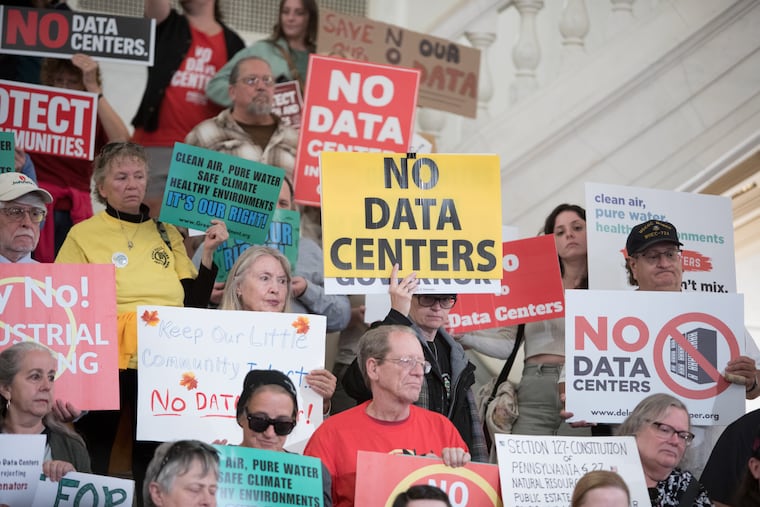
Is Pennsylvania a good place for data centers? How do you overcome local opposition?
There is a general NIMBY attitude: ‘I like to play on my phone and get the advantages of Microsoft Copilot and AI. Just don’t put a data center near me to use a lot of power.’ There’s controversy around that.
But if you look at the investment and jobs that go with data centers — they need access to low-cost energy and water — then look at Pennsylvania with its natural gas and its nuclear plants like Three Mile Island. Data centers need low-cost energy and water. Pennsylvania has it.
Will 2026 improve on last year?
Our returns should continue to go up. Our net interest margin [the difference between what banks charge borrowers and what they pay depositors] widened last year, and we expect it will be up this year. And all our businesses are demonstrating loan growth.
Whom do you lend to?
We serve the middle market, from $25 million in revenues up to corporations with around $3 billion in yearly sales. PNC and Wells Fargo [are larger, but] we aren’t playing the game materially differently from what they offer. If a company wants to finance more, they go to maybe JPMorgan or Bank of America.
We started building a private bank [focused on business owners and wealthy professionals] a couple of years back. Now we have $14 billion in deposits, $7 billion in loans, $10 billion in client investments, just in that unit. And growing faster than we projected, with more accretion to our bottom line.
We help our clients become more successful: ‘Here’s an acquisition idea. Here’s a working-capital idea.’ That level of personalized attention has been a winning strategy for us.
U.S. software start-ups, and biotech centers like Philadelphia, staggered a bit when the best-known tech banks failed in 2023. JPMorgan bought First Republic, but you hired a lot of their staff. How’s that going?
What First Republic did really well for company founders was advice banking, wealth needs, family financial planning. And we invested heavily in technology to get to the service levels First Republic was famous for. We took on 150 of their people, teams of strong, highly regarded wealth managers, and added private bankers, to locate with our banking teams. That group is now 550 people.
We went into areas where they were strong — Boston, New York, Palm Beach, and three areas of Northern California. We had to add teams in Southern California — San Diego, Orange County, and one in Los Angeles.
But not Philly?
Philly is high on the list of new markets we want to attack with that approach. There is a cadre of successful people here. We want to be known as the bank for successful people.
Gov. Josh Shapiro talks about a Pennsylvania manufacturing revival. What signs do we see that’s happening?
We are positioning ourselves for a lot of inbound investments. President Donald Trump is going to our allies in Japan and South Korea to invest and bring skilled jobs into our country to be more self-sufficient in manufacturing — in steel, in shipbuilding, for example. It all sounds good on paper. I think it will come.
Why do car factories and other big manufacturers open down South, instead of in Pennsylvania?
They find the states willing to take a fresh look at how much bureaucracy they have and cutting it back. You are competing with Texas, Virginia, the Carolinas, which are very successful at attracting industry. I don’t think Pennsylvania will want to miss out.
What will it take to bring the World Series back to Philly, which increases fan and ad spending?
We are hopeful the Phillies have a great offseason. I’m a little disappointed [Bo] Bichette went to the Mets. But, hey, they signed J.T. [Realmuto]. John [Middleton, the Phillies’ lead owner] is very committed to fielding a winning team. Go Phils!