Hanwha Philly and a partner are competing with a California shipyard to build U.S. Navy oiler ships
The Philadelphia shipyard’s owner will split a $4.5 million contract with Vard Marine in Houston to draft plans to build oiler ships for the Navy.
Under a new Navy contract, Hanwha Philly Shipyard will work with Italian-owned barge maker Vard Marine US Inc. on plans to build oiler ships for the U.S. Navy.
It’s the first Navy subcontract for Hanwha since the Korean-owned company bought the shipyard almost two years ago. Hanwha began applying for Navy work alongside civilian ship construction deals as it enlarges the yard, which is on the site of a Navy shipyard that closed in 1994.
The government has agreed to pay $4.5 million for the companies to prepare design, construction, and cost plans to build Light Replenishment Oilers.
Hanwha hopes to win more contracts and build the ships at Hanwha Philly Shipyard, according to company officials. Vard’s U.S. shipyard is in Houston.
The Navy also granted $3.9 million to General Dynamics to develop a competing ship proposal at its NASSCO shipyard in San Diego. NASSCO is already building larger oilers for the Navy.
The contracts are early steps in the Navy’s plans to build hundreds of updated ships and support vessels. Hanwha officials hope those plans lead to more work for the Philadelphia yard.
The Vard and Hanwha contract is “an important step in leveraging Hanwha’s shipbuilding expertise” for the Navy, Tom Anderson, president of Hanwha Defense USA’s shipbuilding division, said in a statement.
About 2,100 people work at Hanwha Philly Shipyard, up from around 1,700 before Hanwha purchased it from Aker in 2024.
Hanwha says it has invested over $100 million in improvements at the South Philly site. The yard’s location at the junction of the Delaware and Schuylkill was described by former Navy Secretary John Lehman in a recent interview as “one of the best in the world” with “great potential if it is properly capitalized and run.”
Yards in China, Korea, and Japan construct most of the world’s new ships, building dozens at a time.
Hanwha hopes to take advantage of U.S. plans to rebuild the commercial shipping industry. It wants to build more cargo ships in Philadelphia and use commercial efficiency to cut costs on Navy projects.
Hanwha has said it will spend an eventual $5 billion to boost Philadelphia production from its recent one ship every eight months to 20 ships a year to make the facility profitable. Philadelphia’s yard has just one giant crane to assemble ship sections, compared to Korea’s four.
The new oilers, which would refuel ships and Marine and Navy shore locations, are to be constructed using off-the-shelf commercial and “proven” technologies, which military planners have advocated as a way to keep costs down.
The oiler contract includes options for additional design and planning studies, according to a Hanwha statement.
Finding workers
In her March 12 budget address, Philadelphia Mayor Cherelle L. Parker mentioned the shipyard as a place for job growth in the city.
The Hanwha yard is the largest but not the only shipbuilding industry in Philadelphia. Its neighbors include Rhoads Industries, which employs around 700 to build decks and other sections of Navy submarines for General Dynamics, which builds submarines in Groton, Conn.
Both Hanwha and Rhoads say they have been hiring welders and other skilled workers and expect to double employment in the next few years.
Hanwha says its union workers are paid an average of $34 an hour, with overtime bringing top jobs to over $100,000 a year.
After initial worries about finding workers, especially welders, Hanwha officials said the company has received a flood of applications.
Backed by government aid, community colleges in Delaware County, Philadelphia, and other areas have expanded their industrial training programs, sending graduates to apply.
Pre-apprenticeship programs such as the Welcoming Center’s Global Skills Union Pathways Project have prepared dozens to successfully apply to Hanwha’s welding and machine-operation union apprenticeship programs.
Abdourahmane Diallo, who ran his own food warehouse in Guinea, West Africa, before moving to Philadelphia, said construction workers back home had little safety protection.
Visiting the yard as one of 20 students in the Pathways program, “I was so impressed with the safety protocols — everyone had helmets, safety shoes, safety glasses — I saw that at Hanwha they respect everyone,” he said.
He passed the union-backed pre-apprenticeship program and was accepted into a Hanwha apprenticeship program in March.
Yacine Bouaziz, an Algeria native and college graduate who says he worked as a teacher and plumber back home and a baker in Philadelphia, earned his pre-apprentice certificate with Diallo and is now on Hanwha’s waiting list. He is learning welding “to have a stable career,” he said. “I already have two friends in the shipyard. I feel like I’m in the right place.”
More ships
In recent years, Hanwha Philly Shipyard has built more ships than any U.S. yard under provisions of the U.S. Jones Act, which limits cargoes between U.S. ports to ships built in the U.S. and crewed by U.S. sailors.
Hanwha is completing ships contracted by the yard’s previous owner, Norway-based Aker.
On Monday, the State of Maine, the third of five training and multimission ships built for merchant-marine academies in a U.S. Maritime Administration (MARAD) program, arrived in Maine.
Work on the last two ships is underway. The Lone Star State is scheduled to be completed this year; the ship will be sent to Texas. The last of the five, the Golden State, is expected to arrive in California next year.
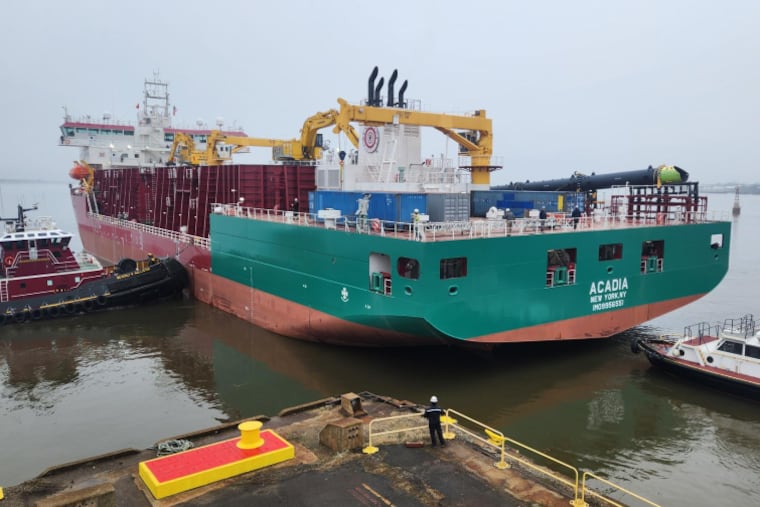
Last month the rock installation ship Acadia, built for Great Lakes Dredge & Dock Co., left the yard for sea trials. Great Lakes was purchased this winter by Seattle-based Saltchuk Resources, which also owns TOTE Group, the private company that has been overseeing ship construction at Hanwha Philly Shipyard.
Hanwha officials have said they expect the yard will be profitable when they add space and equipment and are able to build and repair more ships simultaneously.
President Donald Trump has said he wants to build more Navy ships, though planners are still reviewing proposals for updating the Navy’s submarine fleet, traditional manned surface vessels, and the unmanned craft that Hanwha and other shipbuilders expect will make up an increasing part of the world’s fleets.
“The problem for Philly is, they can’t be competitive [with East Asian shipyards] until they are building 20 ships per year. But there is no demand for 20 U.S-built ships per year,” said Colin Grabow, an analyst for the Cato Institute, a Washington, D.C., think tank that researches and opposes public subsidies for private industry.