Hanwha details plan to speed Philly shipbuilding with more piers, dry docks, cranes, and robots
Can $5 billion deliver 20 ships a year?
Hanwha, the Republic of Korea industrial giant that bought Philly Shipyard for $100 million two years ago, began filling in its $5 billion plan to make a lot more ships at the former Navy Yard, after last week’s visit from President Lee Jae Myung.
The company said it wants new docks and piers, cranes and sheds, workers and robots. Its Hanwha Shipping affiliate has ordered 10 medium-range oil and chemical tankers from the yard, with the first to be delivered in 2029. Those will help keep employment steady as Hanwha recruits welding and machine operating apprentices to more than double its 1,800 direct and contract workers over several years,
These vessels would qualify as U.S.-built under the Jones Act, the protectionist law that requires U.S.-built ships for cargoes carried between U.S. ports.
The company hopes to make the yard profitable by boosting production from about one ship every eight months under its previous, money-losing owner, Norway-based Aker, to as many as 20 a year, while also upgrading older ships. President Donald Trump and Congress members of both parties want to revive U.S. maritime industry and counter China’s emergence as a naval and cargo-shipping power.
A revived industry
The yard plays “a critical role in American shipbuilding,” Sen. Dave McCormick (R., Pa.) said in a statement. It built more Jones Act-compliant ships than any other shipyard in the past 20 years, but Hanwha’s expansion is “a game changer” for the whole U.S. “The rebuilding of our shipbuilding industry will begin right here in Philadelphia.”
McCormick promised Hanwha “additional resources.”
Hanwha vice chairman Kim Dong Kwan told hundreds of Hanwha staff and guests at Lee’s visit Aug. 26 that the assembly formed “a physical embodiment of our two nations working side by side to reindustrialize industry, expand our capacity to build ships, and invest in the skilled workforce that will drive the industry forward,” Kim said in his remarks to the crowd. His late grandfather Kim Chong-hee founded Hanwha to make explosives; his father, Kim Seung-youn, is CEO.
“This is just the beginning,” he said. “Hanwha is committed to being a partner in building the next chapter of American shipbuilding.”
New features
Hanwha now operates one nearly 1,000-foot dry dock at the former U.S. Navy Yard, where it lays keels — the steel, underwater backbones of each ship — and attaches deck-to-keel sections of new ships, built in the nearby Grand Block shed and carried to the dry dock by the yard’s Goliath crane, which is now painted Hanwha orange.
Hanwha is using what was once a second dry dock at the site, now stripped of its gate and pumps, as a pier for ship finishing work. The company wants to convert this back into a dry dock at a cost of around $70 million.
A third, shorter dry dock, formerly operated by the defunct Philadelphia Shipbuilding Co. and coveted by Hanwha, was acquired last year by Rhoads Industries, a ship repair company and Navy contractor that has been the recipient of recent Pennsylvania state grants.
Hanwha is also considering a second Grand Block shop and a second Goliath crane.
The company has four Goliath cranes at its larger shipyards on Geoje Island, built by its predecessor Daewoo near Korea’s southeast tip, which turns out a ship every nine days, on average. A new crane would cost $60 million to $80 million.
Hanwha is weighing plans to crowd more structures onto its property, which covers 118 acres where the Schuylkill dumps into the Delaware River at the heart of the former U.S. Navy base.
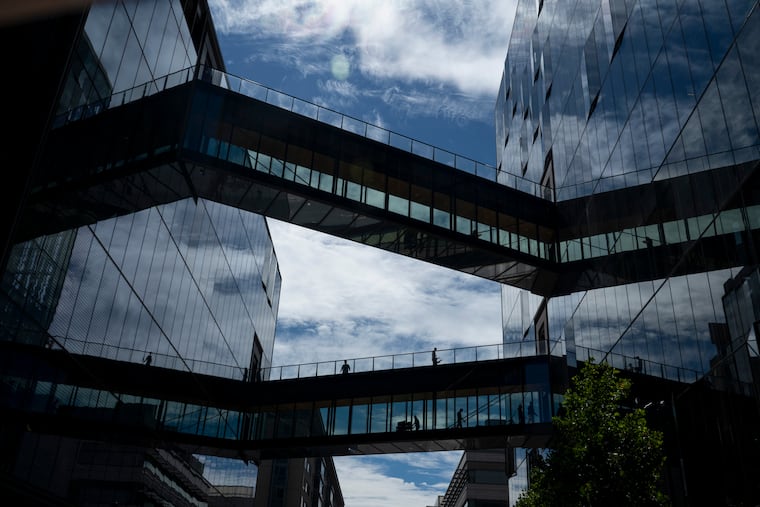
Other parts of the old base have been redeveloped as offices, labs, and some residential housing. The Navy remains a major tenant, with 4,000 of the 15,000 jobs on the property.
Hanwha hopes to regain piers now used to dock decommissioned U.S. Navy ships. The Navy has been asked to consider moving those ships, which are used for spare parts, to other locations. The company and its contractors are considering properties up and down the Delaware, and the nearby Bellwether development at the former Sun, Gulf, and Atlantic Richfield oil refineries in South Philly.
Local outreach
Kevin Kim, a Cheltenham lawyer who heads the Korean American Association of Greater Philadelphia, said Korean shipbuilders were active in Philadelphia even before Hanwha moved in. Aker, the yard’s previous operator, built ships based on Korean designs. Korean-owned S-One MNO USA LLC, which adds living quarters inside ships, already had a facility in Philadelphia when Hanwha arrived, Kim added.
He said Hanwha plans to ship a classic “turtle”-style warship model, a replica of the innovative cannon-bearing, iron-pointed ships that fought for Korea’s independence more than 400 years ago, to the U.S. for America’s 250th birthday celebrations next year.
Kim added that Hanwha has mobilized the Korean American community in its search for ship engineers and other professionals, including multilingual employees.
“It’s a broad spectrum they are looking for,” Kim said, noting that City Council President Kenyatta Johnson, State Sen. Sharif Street, and other leaders have joined meetings about Hanwha training and hiring plans. He said the company is scheduling “workforce development seminars” in Philadelphia and Montgomery County this fall.
Ships ahead
Hanwha said earlier this year that it hoped the Philadelphia yard would play a role in building liquefied natural gas (LNG) carriers, specially made to withstand heavy pressure and extreme temperatures while exporting U.S. gas across oceans.
In July, Hanwha said it was planning a new LNG carrier, but “a significant portion of the construction” will take place at its Geoje shipyards in Korea. Staff assigned to Hanwha Philly Shipyard will ensure the ship conforms to U.S. construction and safety rules. Last week, Hanwha said it had agreed to build a second LNG carrier with Philly ties.
For additional LNG carriers, the company added, “Hanwha plans to gradually transfer its advanced shipbuilding technologies to Hanwha Philly Shipyard, enabling the latter to expand into high-value shipbuilding” and helping modernize U.S. shipbuilding, which has withered since World War II. Future LNG carriers are to be built at least partly in Philadelphia, according to Hanwha.
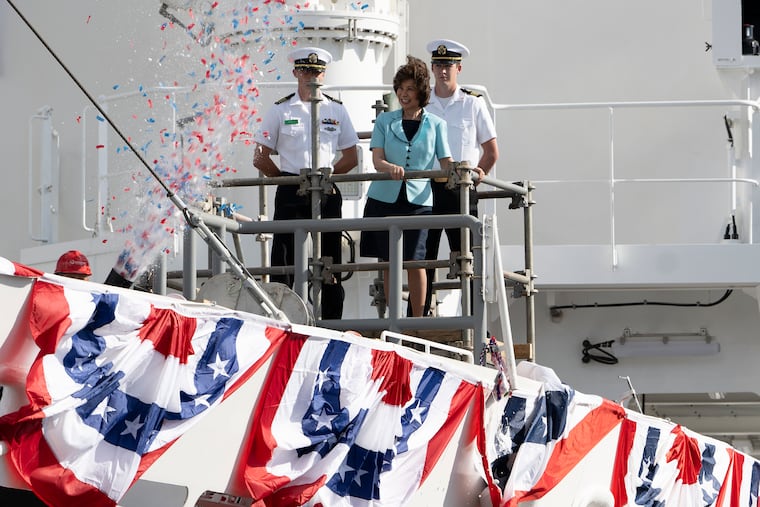
The yard is more than halfway through a contract to deliver five National Security Multi-mission Vessels for the U.S. Maritime Administration (MARAD). As they are completed, each is assigned to a state Merchant Marine academy. The academies train officers for U.S. cargo ships. Hanwha hopes to make Navy support ships and, eventually, combat ships, in Philadelphia.
Another ship, originally designed to serve the offshore wind energy program that was canceled by Trump, is being repurposed for harbor construction duties before delivery to its owner, Great Lakes Dredging Co.
Trump met with Lee on Aug. 25. The Lee administration pledged a total of $150 billion for U.S. shipbuilding investments by Hanwha and other industrial groups, including units Hyundai and Samsung. These could include improvements at other U.S. commercial shipyards on the Gulf Coast and the Pacific.