In Narberth, a zoning fight raises questions over whether a small borough can help solve the housing crisis
Some residents say zoning updates will diversify the Main Line community and prop up its downtown. Others say a small contingent of officials is pushing an unpopular and unrealistic plan.
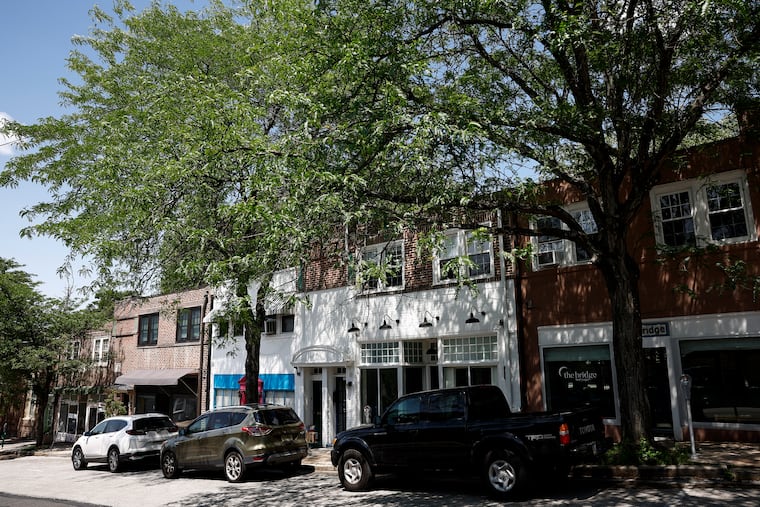
Brenna Carswell has lived on the same street in Narberth for a decade.
Carswell moved to Narberth, a small Montgomery County borough encircled by Lower Merion, in 2011 from Upper Darby with her younger daughter after a divorce. She knew early on that her daughter would need more support than the Upper Darby schools could provide, so she scraped together the cash for a rental in the Lower Merion School District.
“It’s been a great place for my girls to grow up,” Carswell said of her Main Line community. “It’s given them a town that I didn’t have.”
After four years and three rentals, Carswell, 44, a small-business owner, bought a home in the borough. In early 2020, she sold her house with the intention of buying another place in Narberth, but the pandemic hit and Carswell was furloughed. She ended up in a rental across the street, where she still lives. By the time Carswell was ready to buy again, houses around her had exploded in price.
She and her family have outgrown their space, but in the current market, “there’s literally nowhere to go.”
Narberth’s borough council last August directed its planning commission to study how it could use zoning to increase affordable housing and support the local economy. Officials say living in the borough has become increasingly expensive, as experiences like Carswell’s become more and more common.
In February, the commission came back with a handful of recommendations in two zoning districts: the higher-density residential area that surrounds the Haverford Avenue downtown, and the commercial mixed-use corridor along Montgomery Avenue.
Recommendations included allowing apartments, cottages, and rowhouses by-right, in the ring around the downtown core, and permitting extra floors for apartment buildings that include affordable units in both zoning districts. The commission suggested reducing minimum parking requirements, allowing ground-floor apartments on Montgomery Avenue, and letting developers build off-site parking lots for apartment complexes.
Adam Krom, the planning commission’s chair, has said the changes would “provide flexibility” and incentivize developers to build both market-rate and affordable housing units in areas where similar developments already exist.
But what began as a municipal land-use discussion has morphed into a monthslong debate in the borough over what, if anything, Narberth should do to fight America’s housing crisis. Proponents say changes would bring in much-needed tax revenue, create foot traffic for downtown businesses, and help preserve socioeconomic diversity. Others, however, feel that a small contingent on the borough council has charged ahead with proposals to increase density while ignoring growing concerns over traffic, neighborhood character, and the reality of supporting transit-oriented development with a transit system marred by uncertainty.
Rising costs, shrinking options
In Narberth, and across the Philadelphia suburbs, the cost of housing is outpacing the ability of large segments of the population to afford it, said Scott France, executive director of the Montgomery County Planning Commission, which consults the borough on land-use issues.
Narberth had the highest median housing sales price of any municipality in Montgomery County in 2024, at $751,000, a 70% increase from 2014.
The average rent for a one-bedroom apartment in Narberth is $2,050 per month, according to Zillow rental data. As housing prices have risen, incomes have stayed largely stagnant. In 2024, 46% of renters and 19% of homeowners in Montgomery County were spending more than 30% of their income on housing, according to a Housing Blueprint recently published by the county.
In Montgomery County, boroughs like Narberth were often the first point of entry for people looking to settle in the suburbs, France said, given their more urban-suburban feel and smaller lot sizes.
Yet the factors that once made places like Narberth starter-home magnets have now made them increasingly inaccessible. As millennials have sought out premiums like walkability and transit access, the cost of both renting and homeownership in places like Narberth, Conshohocken, and Ambler has risen, France said.
Montgomery County’s and Narberth’s housing woes are part of a well-documented housing shortage that has swept the United States, as a widening gulf between supply and demand has put homeownership further out of reach for many, especially for younger people.
Some communities facing housing shortages have loosened zoning restrictions in order to court developers who are willing to build housing and, in certain cases, set aside affordable units in exchange for height and other bonuses. On the Main Line, luxury apartments have cropped up in large numbers, especially in areas where officials have used zoning to increase density.
Fred Bush, president of Narberth’s borough council, said the county’s Housing Blueprint crystallizes why Narberth needs to ease its zoning regulations and incentivize development.
“It’s very difficult for people who come in here — who are renting or who are looking to move in, young families — to find a place to stay,” Bush said.
‘Is that what’s best for this area?’
Narberth residents like Margot and Jason Deitz describe the push to rezone as confusing and misguided. The couple, both 40, have lived together in Narberth since 2020. Their house is near the Montgomery Avenue corridor, where changes are being considered.
The Deitzes are among a large contingent who feel the proposals would complicate an already hairy parking situation, allow for buildings outside of Narberth’s quaint character, and tip the balance of the borough in favor of renter-occupied units. They feel the borough is putting the cart before the horse, trying to address national problems rather than the sidewalk repairs and parking shortages on their front steps.
For Margot Deitz, the idea of building fewer parking spaces and asking residents to rely on SEPTA, a sometimes unreliable transit system, was confounding. Her questions to the borough council about parking went unanswered, she said. Both Margot and Jason Deitz wondered how, in a town with shuttered storefronts and parking problems, building new apartments became the council’s priority.
Homeowner Michelle Karten, 52, went to a public meeting to ask questions about the proposals but felt the changes were a “foregone conclusion.”
Karten said she hopes the borough can find a more “holistic” approach, rather than just allowing for the proliferation of luxury apartments. She believes the borough has already made a number of concessions to developers and does not need to offer density bonuses to get affordable housing.
“Do we really need to go up that extra level? Is that what’s best for this area? And what other solutions could there be?” Karten said.
Matt Patrick, 37, a homeowner in the borough since 2018, is “not against affordable units” but thinks the council is using the affordability crisis to push through incongruous density in spite of resident opposition.
“It seems like more of a developer bonus than something aimed at conquering affordability,” Patrick said.
Luxury apartments’ “two truths problem”
For others, the debates over parking requirements and maximum heights are a distraction from a looming reality: The national housing crisis has hit Narberth, and prices will only continue to rise without new inventory.
Blessing Osazuwa, 28, thinks the changes are a “great idea.” Osazuwa grew up in Lower Merion and moved to Narberth three years ago. Her roommate’s family owns the house they live in, giving her a break on the rent that allows her to afford Narberth.
“I love Narberth,” Osazuwa said. “I would love to stay, but there’s no way that I’ll be able to afford that on my own, and it’s a shame, because I feel like I contribute to the community.”
Numerous residents said the conversation around zoning in Narberth has devolved into misconceptions and ad hominem attacks hurled from all sides, across public meeting forums and Facebook groups.
Carswell said there is a misconception that Narberth and surrounding communities already have plenty of affordable apartments.
Little exists in Carswell’s price range in or around Narberth. She has chased multiple “ghost” listings, reaching out to property managers only to find out listed units are occupied. She wants to stay in Narberth to provide consistency for her kids. When she explains her reality, she said, she is often told to just move somewhere else.
Osazuwa said the refrain that those who cannot afford Narberth should simply move ignores a souring economic reality.
“I tend to encounter that ‘pulling yourself up from the bootstraps’ mentality without regard to the times that we’re living in, without regard to inflation, without regard to the fact that jobs don’t pay as much,” she said.
Advocates acknowledge that future development will likely rely on luxury rentals, many of which have popped up in neighboring communities like Ardmore and Bala Cynwyd and would be unaffordable to all but a wealthy set of renters. They believe, however, that any new housing units can help moderate the market, and even a few affordable units attached to the developments could provide housing for lower-income residents.
“I agree that struggling families are not going to be moving into luxury apartments, but it just puts an overall downward pressure on rental prices for the rest of the market,” Bush said.
Vincent Reina, a University of Pennsylvania professor and founder of the Housing Initiative at Penn, said there is “a two truths problem” when it comes to luxury apartments. High-end buildings do not fill the need for affordable housing. But, without new construction, existing prices can be pushed up even further as demand continues to outpace supply.
“What you aren’t going to see is the natural market production of [low-cost] units because the price is too high,” he said. Without government incentives for affordable units, “the numbers just don’t pencil out.”
Balancing ‘what should be complementary interests’
The borough council has drafted comments to send back to the planning commission for consideration. The draft splits the difference on some issues, dropping the parking reduction and some height bonuses, but keeping other changes. It could be months before any changes are actually adopted.
Council member Mike Salmanson said Narberth is trying to balance “complementary interests” in keeping the borough’s character while ensuring fiscal stability. Salmanson said the borough has maxed out how much it can charge in earned income tax. Because Pennsylvania does not require regular property reassessments, it is difficult for municipalities to collect the revenue they need without just raising tax rates.
“Increased housing creates a broader tax base,” Salmanson said. “I see the advantages of that.”
But he also called zoning changes that cater to current market conditions, and not the long-term success of the borough, “short-sighted.”
Council member Cyndi Rickards believes the council has yet to meaningfully engage with incentivizing housing options beyond luxury apartments, such as reasonably priced ownership opportunities that would allow residents to build equity.
“I really struggle to understand how those of us who own homes ... [see] luxury apartments as a tool for justice,” Rickards said.
Carswell said she understands the concerns about zoning changes and was once opposed herself.
“There is a deep fear, that I understand, that the good old days are slipping away,” Carswell said. “The good old days are gone. … The changes that happened to our economy on a national scale absolutely impacted Narberth.”

Inquirer Lower Merion
This suburban content is produced with support from the Leslie Miller and Richard Worley Foundation and The Lenfest Institute for Journalism. Editorial content is created independently of the project donors. Gifts to support The Inquirer’s high-impact journalism can be made at inquirer.com/donate. A list of Lenfest Institute donors can be found at lenfestinstitute.org/supporters.