Use tariffs on enemies, not friends, manufacturers’ leader urges Trump at Philly business meeting
At Carpenters Hall, National Association of Manufacturers president Jay Timmons said tax cuts and energy deregulation are boosting U.S. factories, but tariffs and worker deportations hurt.
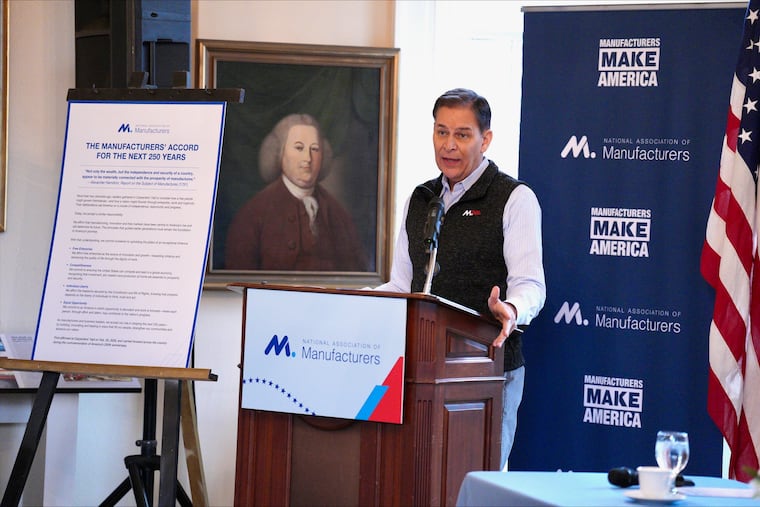
As the U.S. Supreme Court was announcing its 6-3 decision that President Donald Trump exceeded his powers by imposing “emergency” tariffs, the nation’s top manufacturing lobbyist was in Philadelphia rallying support for a pro-factory agenda.
Jay Timmons, president of the National Association of Manufacturers, says the factory revival Trump and his recent predecessors have championed has been aided by Trump’s business tax cuts and pro-fossil fuel agenda. But, he said, mass worker deportations or rapidly-changing import taxes are not helping.
Timmons appealed to leaders of Philadelphia’s port, shipbuilders, regional Chamber of Commerce, and other industry group leaders to embrace his group’s pro-factory agenda at Carpenters Hall. He made a similar appeal at Cleveland’s Rock & Roll Hall of Fame earlier in the week, and heads to the Carolinas next week.
After the Supreme Court ruled against Trump, Timmons said in a statement that industry shares Trump’s goal of strengthening U.S. manufacturing, and wants to work with Congress and Trump on more “durable” ways to do that. While Trump had boosted tariffs on U.S. neighbors and longtime allies, Timmons said, NAM’s position is that “if tariffs are utilized as a tool, they should be targeted to countries engaged in specific unfair trading practices,” especially countries where government controls production, which would include China and Russia.
He agreed to take questions from The Inquirer.
The conversation has been edited for clarity and length.
U.S. Sen. Joe Grundy, the Bristol mill owner who founded the Pennsylvania Manufacturers’ Association, led the pro-tariff movement long before President Trump. Has your group always backed high tariffs?
No, ours was founded as a free-trade organization. Thomas Dolan, our first president, was a woolen manufacturer from Philadelphia. We wanted to open markets and sell our stuff in other countries.
The president is obviously a fan of tariffs; that is a tool he has chosen to use.
Can American manufacturing become a larger sector of the economy again, as President Trump promised?
We’re on the launch pad, we are ready to go. We’re seeing success in terms of lowering the costs of doing business, in our tax code, in regulatory modernization, in energy development.
This year we are focused on other issues we would like to see addressed, hopefully in a bipartisan way. We want to see legal reform of the permitting process, so we are not constantly in court trying to reach a final decision on whether an industrial project can move forward.
Do you want the federal government to override state and local building limits on industry?
State and local need to have a say, but the process needs to be streamlined.
I served in Gov. George Allen’s administration in Virginia. His focus was on working together to attract jobs, communicating in a simultaneous manner. We attracted record investment and job creation [without damaging] air and water quality.
We need to [fix] the regulatory morass in Washington. Right now, several agencies have a say on a project. An agency reviews it, that takes months. Then another agency, and another.
Won’t you need more federal workers to do reviews all at once?
Whatever it takes. We aren’t saying we want a compromise on health and safety. We’re saying do it in an expeditious manner.
Virginia is one of the big states for data centers. Are there too many?
I don’t share this [concern], but there are folks concerned about the rising costs of electricity and putting that blame on AI data centers.
Demand will increase. You’ll have issues of local concern. But we have to supply more power, which means states have to step up and work with the utilities to improve transmission, the power grid; and the federal government should have a role.
What recent U.S. energy developments are you applauding?
Pennsylvania has led the way, with natural gas clearly helping the U.S., in terms of energy dominance and exports. Oil, also. Even nuclear is getting a kick start.
Southern Co. led the way with that, restarting a [uranium power] plant in Georgia. That is hard, it takes a long time. Also the small reactors, we don’t have a clue yet [if those will be deployed in large numbers] but it could be helpful.
What are your priorities to make manufacturing grow more rapidly?
First, to help us expedite investing in the U.S., which tax [cuts] have done.
Second is hiring and workforce development. We have 433,000 open jobs in the sector. Our goal is obviously to train more potential manufacturing workers. Apprenticeship programs — we have our own — need to expand dramatically.
And third, we want to see a reliable and consistent immigration policy that focuses on the needs of our country. We’ve endorsed the Dignity Act.
The Dignity Act, from Reps. Maria Elvira Salazar (R., Fla.) and Veronica Escobar (D., Texas), would let immigrant workers, who pay a fine and taxes, buy work permits; and mandate employers E-Verify job applicants. Is that like the Reagan reforms?
Reagan, directionally, was correct on immigration.
We are a nation of immigrants. We are a melting pot and that is what has made us successful.
Things are different today with public opinion. You have to focus on very narrow objectives that are directly related to the economic life of this country, because that’s what the president and Congress want to do.
What’s your goal for trade and tariffs?
To see certainty and predictability. The administration has been very focused on finding access to markets overseas, which is also one of NAM’s founding principles.
The U.S.-Mexico-Canada Agreement is up for renewal. [Negotiators] are dealing with transshipments from China through Canada and Mexico, which obviously was not our intent for the agreement. Getting another agreement is going to be really important for manufacturers who have used provisions to move manufacturing from China into the U.S.
When do you expect signs of increased factory investment and hiring in this second Trump term?
Rewind to 2017, we got tax cuts, regulatory modernization, and [faster] energy production. You saw three or four years later the highest employment growth in 21 years, the highest wage growth in 15 years. If you get the policies right it gives you an advantage. That’s our goal.
We have the rocket, but it needs fuel, and a clear sky. We need [to resolve] immigration, workforce development, and trade certainty.