How Peco’s proposed rate hikes, contract negotiations could impact you
Data centers are playing into the company’s planned projects, a Peco executive said, but rate hikes are also needed to avoid and address weather-related outages.

Peco asked state regulators this week to allow an increase in gas and electric prices for its Southeastern Pennsylvania customers. Meanwhile, the clock is running out for the utility company as it negotiates a contract with its unionized workers, who want Peco to pay them more.
Peco said Monday that the proposed rate hike, which would take place in 2027, would be used to invest in its infrastructure and improve reliability.
At the same time, employees who maintain the company’s infrastructure and respond to outages are among those asking for better pay and retirement benefits through their union, IBEW Local 614.
Peco, a for-profit company, provides electricity to 1.7 million customers in Southeastern Pennsylvania and provides natural gas to 553,000. Here’s where things stand for the company financially.
Why does Peco want to raise rates for electric and natural gas?
Peco executives said they need $520 million for significant grid updates, which will increase reliability amid heightened demand, including from data centers.
“There’s not enough electric generation to meet the forecast demand, and that makes the price go up,” Doug Oliver, a senior vice president at Peco, said Monday, citing a 400% increase in wholesale electricity costs.
Peco also needs infrastructure improvements that could keep customers’ power on in bad weather, Oliver said. These include stronger utility poles, tougher aerial cables, new transformers, and drones for quicker damage assessments.
Didn’t Peco just raise rates?
Yes.
Peco raised rates last year. The Pennsylvania Public Utility Commission (PUC) approved the hikes to be split over two years, with electric bills increasing by 10% on average in 2025 and 1.8% this year. Gas customers saw a 12.5% increase beginning last year. Peco was not permitted to apply for another rate increase until March 2026.
“Rising supply costs — set by competitive markets and not controlled or profited from by Peco — continue to be a major driver of customer bills,” spokesperson Candice Womer said in a statement earlier this month, in response to questions about winter heating costs. Supply costs increased nearly 20% for electric and 10% for gas from 2024 to 2025, Womer said.
Regardless of utility or fuel source, some consumers in the region said they paid more than ever to stay warm this winter. And in the summer, many saw record-high electric bills.
Outdoor temperatures, thermostat settings, and the energy efficiency of a customer’s home also influence individual bills, Peco and other utilities have noted.
Is Peco losing money?
No. Last year, Peco made $814 million in net income, up 48% from 2024, parent company Exelon reported in February.
This was in part attributed to the “distribution rates at Peco,” which increased in 2025, and “favorable weather” Exelon noted in its recent annual report.
Larry Anastasi, president of the Peco workers’ union, took issue with that during a union event Tuesday.
“Why does everyone pay more? Because in Harrisburg, they turn a blind eye. They rubber-stamp it,” said Anastasi. “They let them increase again and again with no accountability, and they did again last night. Peco is putting in for another rate increase because 50% profits isn’t enough.”
Peco is one of six utility companies within Exelon, a publicly owned Fortune 200 company with over 10 million customers. Its shares were trading at $49.02 when markets closed Tuesday.
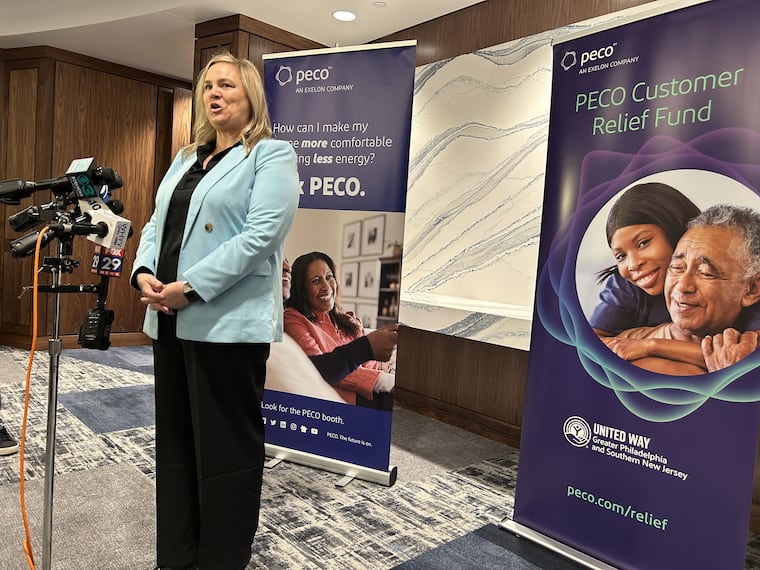
Asked about Peco’s 2025 profits, chief operating officer Nicole LeVine said, “90% of what we receive [from ratepayers] goes right back into our infrastructure, and that includes paying for the wages and benefits for employees so they can go out and restore power and improve our grid.”
What do Peco’s employees want?
Peco’s roughly 1,600 unionized employees include call center workers, linemen, and gas mechanics, some of whom work long hours during outages to help restore service. Peco has roughly 3,000 total employees.
They want their new contract to include raises and a single retirement plan for all their members
Roughly 600 of them hired after 2021 have no pension, union president Anastasi said Tuesday, and those who have a pension are split among different plans.

Will Peco workers strike? What happens if they do?
The union and Peco are not close to reaching a new contract. Anastasi said they’ve reached agreements on some small issues, but the union filed an unfair labor practice charge with the National Labor Relations Board on Tuesday, alleging that Peco is not negotiating in good faith.
LeVine, Peco’s chief operating officer, said the company shared a fair offer with the union. She would not discuss bargaining details.
LeVine said she did not know the specifics of the charge but added “I’m confident that we’ve been negotiating in good faith.”
“Every minute we’re doing this, it becomes more and more likely that at some point we’re going to have to get a strike authorization vote,” Anastasi said. Such a vote doesn’t immediately lead to a strike, but paves the way for a work stoppage and adds pressure on the company to reach an agreement.
Peco has a strike contingency plan in place in case workers do walk off the job, said LeVine, who declined to share details.
“If there’s severe weather, we’ll be able to restore any service issues,” LeVine said. “The customer should not see any impact to their reliability or service.”

Are data centers to blame for these energy price increases?
The proposed rate increase for 2027 would be the same with or without the expected addition of data centers, Peco executive Oliver noted Tuesday.
“Storms come through with or without data centers. People want electric cars with or without data centers,” he said, adding that a storm can knock down $60 million worth of infrastructure.
Peco has been making some efforts to hold data centers accountable for the costly infrastructure they require, according to Oliver. It has entered two transmission security agreements, which say a data center company is on the hook if it walks away after Peco spends money adding it to the grid.
But if the data center sticks around, connects to the grid, and begins paying Peco for energy, Oliver says, that revenue could benefit all of Peco’s customers by allowing for longer stretches of time between rate increases.
“We share the concerns that residential customers are not carrying the burden of investments that are made for specifically one large load user,” he said. “The transmission security agreement has become our best way to isolate the costs that we incur on behalf of a data center and making sure that that data center pays for those.”
Peco said preparing the grid for data centers is one reason behind the requested rate hike, but Oliver noted that even without the data centers, the company needs to make significant investments to its infrastructure.
“I don’t want to leave anybody with the impression that this rate case is about data centers,” said Oliver. “This is about the investments that we have to make into our grid to ensure that the lights stay on and the gas stays flowing.”
What’s next for Peco as they try to increase prices?
Peco’s rate increases are pending approval by the PUC, a regulatory body tasked with keeping consumer costs as low as possible while maintaining the financial stability of utilities.
The PUC ratemaking process typically takes nine months and can result in smaller increases than a utility requests, as happened with Peco in 2024. It includes hearings, expert testimony, and opportunities for consumers to give their input. Any member of the public can share their thoughts on rate increase requests via written comments or by speaking at a hearing.