U.S. refinery accidents, including in Pa., raise questions about cost impact as fuel demand rises
Delaware County's Monroe Energy refinery and three other U.S. plants have experienced unplanned shutdowns as fuel companies cope with shifting supply and demand.
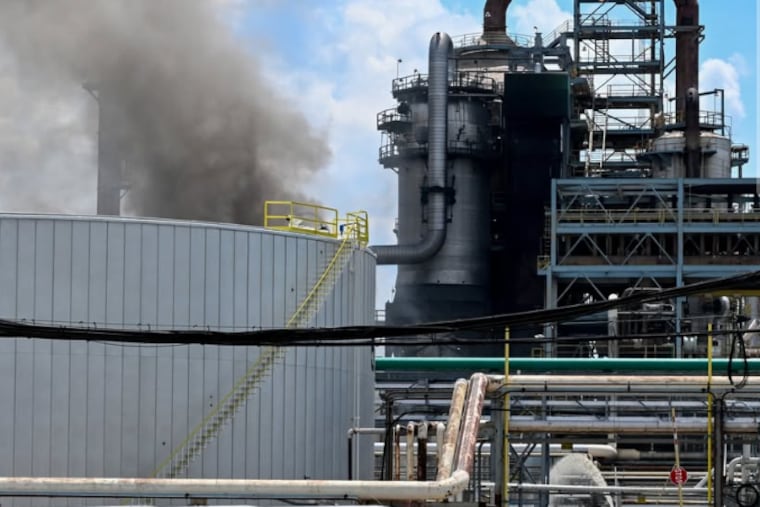
A leak and then a fire that stalled production at Delta Air Lines’ Monroe Energy oil refinery in Delaware County is just one of several unplanned stoppages that have dented U.S. oil production this summer, even as companies work to keep up with shifting supply and demand from the Iran war.
A welcome drop in U.S. gas prices “masks” a string of U.S. supply issues that put stress on fuel markets, Industrial Info Resources told clients in a note last week.
Beyond the stoppage at the 200,000-barrels-a-day Trainer plant, problems include:
A power plant fire at Marathon Energy’s 550,000 barrels per day refinery complex near Galveston, Texas. Neighbors were temporarily urged to shelter in place last weekend, but the plant kept operating.
A slowdown due to “undisclosed issues” that cut production at BP’s 430,000 barrels per day Whiting Refinery on Lake Michigan in Indiana, just east of Chicago.
A lightning strike that temporarily knocked out power to TotalEnergies’ 190,000 barrels per day Port Arthur refinery in Texas near the Louisiana border.
In all, U.S. refineries can produce up to 18 million barrels a day.
Refinery margins tripled after the U.S. and Israel attacked Iran in February and the Strait of Hormuz closed, and refineries felt pressure to boost production during what is normally the spring “maintenance season” of reduced production, said Stephen Schork, cofounder of the daily Schork Report on energy markets, based in King of Prussia.
» READ MORE: Three injured in a fire at Delta’s Monroe Energy refinery in Delco
During the missile attacks, “crude oil went as high as $120-$130 a barrel; jet fuel traded at $180-$190 a barrel,” tripling the usual profit margins, Schork said. “More than half the jet fuel on the East Coast comes from the Monroe refinery.”
Gasoline and diesel was also in high demand, he said.
“When you can make $50 [in profit] a barrel, you will be running that refinery as hot as you can,” Schork said. But “when you run as complex a piece of engineering as a refinery at nearly 100% capacity, the risk of unscheduled maintenance is increased.”
With prices now dropping, pressure from short-term shutdowns should be less, he said.
Overall, petroleum prices that spiked during the war have dropped since the U.S.-Iran ceasefire began bringing back oil refining and shipping in nations that had been attacking each others’ oil infrastructure.
The Brent crude benchmark price of oil fell to near prewar levels for the first time since the U.S. and Israel attacked Iran at the end of February and Iran retaliated with attacks on U.S. allies.
U.S. gasoline prices fell below $4 a gallon in late June, according to AAA.
But with the U.S. Strategic Petroleum Reserve half depleted to prevent prices from rising higher in the near future and oil-thirsty countries scouring the globe for new supplies, the industry is sensitive to slowdowns. President Donald Trump’s energy adviser, Kevin Hassett, has said he’s confident reserves are adequate.
» READ MORE: Delta’s Monroe Energy refinery in Delco shuts due to internal leak
Monroe confirmed an internal leak at the Trainer facility on Tuesday, six months after addressing a long-running gasoline leak at its Aston tank farm.
Industry sources say the plant leak shut the plant’s distilleries, which process up to 200,000 barrels of oil a day, much of it for jet fuel, to help Delta control the cost of keeping its commercial jets flying.
According to a Monroe Energy statement, a process pump at the Trainer plant caught fire Thursday, injuring a worker. County officials said two others were treated for heat effects after refinery staff and volunteer fire companies mobilized to fight the blaze. Monroe said air monitoring showed no risk to people outside the plant. The fire is under investigation.
Firefighters outside the plant noticed smoke rising from the refinery at 11:30 a.m. Tuesday, even before reports began flowing in from neighboring fire companies and Delaware County emergency workers, who urged residents to shelter in place, according to a statement by the Upper Chichester Volunteer Fire Co.
The fire was declared under control, and the shelter order lifted at 2:54 p.m.
In line with company policy not to discuss operations, a Monroe spokesperson declined to estimate when the plant would be fully back online.
The earthquake this week in Venezuela, an oil source for East Coast U.S. refiners, did not disrupt production at the nation’s main Paranagua oil complex, but the second-largest concentration, at Morón, was temporarily stopped, Reuters reported. The loss of electric power and other infrastructure damage across Venezuela is expected to slow tanker shipments out of the stricken nation.