Popular THC drinks will soon be illegal. Companies are fighting to save the billion-dollar industry.
The unregulated intoxicating hemp industry made billions through a legal loophole. Now these products will be illegal by 2027.
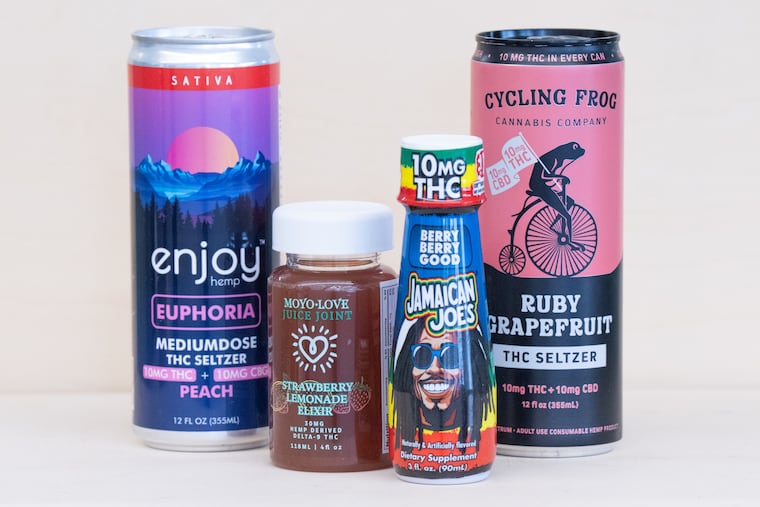
Right now, any Philadelphian 21 or older can go online or walk into a regional smoke shop and buy a THC-infused drink as potent as products in legal dispensaries.
But soon, that might all change.
The billion-dollar intoxicating beverage industry exploded in recent years, with THC-infused seltzers, lemonades, and teas that resemble popular products like Surfsides or White Claws. Sold in local gas stations, smoke shops, and liquor stores outside of Pennsylvania, these weed drinks deliver a cannabis high that is infused into bubbly, sweet canned beverages.
While marijuana is still federally illegal, the hemp industry had found a way to manufacture and sell hemp-derived THC drinks across the country through a legal loophole that is soon closing.
Last month, Congress banned all intoxicating hemp products, a slew of THC-infused smokeable, vape-able, and edible products that are derived from hemp plants but could be mistaken for actual marijuana. In many cases, the drinks are just as potent as conventional weed.
Starting in 2027, almost all of them will be illegal, spurring a nationwide movement within the industry to save the burgeoning market.
Arthur Massolo, the vice president of national THC beverage brand Cycling Frog, which sells its wares locally, said these restrictions will have devastating effects on the producers of thousands of hemp-derived products, like THC, but also CBD, the non-intoxicating cannabinoid popular for treating anxiety, sleep, and pain.
Will Angelos, whose Ardmore smoke shop and wellness store, Free Will Collective, relies on THC drinks for nearly 40% of its business, is hoping for some saving grace. “We’re either looking to pivot or we’re disappearing,” he said.
What are THC-infused drinks?
Seltzers, sodas, teas, mocktails, and lemonades all infused with THC — and sometimes non-intoxicating CBD — exploded onto the scene a few years ago and grew into a billion-dollar business, said hemp market analyst Beau Whitney.
“These drinks have transformed the hemp industry into this low-dose intoxicating health and wellness, alcohol-adjacent product,” said Massolo, who is also the president of U.S. Hemp Roundtable, a hemp business advocacy organization.
The THC-infused drinks sold in gas stations, smoke shops, and liquor stores are supposedly formulated using legally grown hemp, which is allowed to be grown under the 2018 Farm Bill that opened the door to hemp farming in the U.S.
Lawmakers carved out an exemption from federal drug laws for cannabis plants containing 0.3% or less of THC. These low-THC plants are considered “hemp” and are legal to grow. Cannabis plants over that THC threshold are considered marijuana and can carry felony charges if the plant is not being grown by state-licensed growers in places where adult use or medicinal marijuana is legal, like New Jersey and Pennsylvania.
While intoxicating hemp products have enjoyed consistent growth in the past years, these THC-infused drinks have increasingly appeared in aisles of liquor stores and supermarkets in some states, allowing adults who normally don’t visit dispensaries to pick up a bottle of infused wine in the same place they grab groceries, said New Jersey cannabis lawyer Steve Schain.
The ease of access to THC drinks allowed the national market to grow to $1.3 billion in annual sales, and if access continues, Whitney said, that figure could reach $15 billion in the coming years.
This is all thanks to what Whitney calls the “FPS,” or “Female Power Shopper.” These women, ages 29 to 45, are the ones who are likely shopping for a household in grocery and liquor stores, and may jump at the chance to try cannabis products without diving headfirst into dispensaries, Whitney said.
Women are becoming the fastest-growing demographic in the industry, and 2022 marked the first time daily marijuana users outnumbered daily alcohol drinkers. As alcohol consumption reaches historic lows, liquor stores and beer distributors have been “wonderfully buoyed” by THC drinks to keep them afloat, Schain said.
Mary Ellen, 55, of Bucks County, who asked to not to be identified by her last name over concerns for her cannabis use and employment, said these THC drinks are the perfect way to unwind after a long day, especially for adults like her who choose not to drink alcohol. As a medical marijuana patient, she uses regulated cannabis for a variety of ailments, but also enjoys THC drinks like Nowadays’ infused mocktails that she buys at Angelos’ Ardmore store.
“I’d rather come home and have a glass of Nowadays. That’s a lot better than having a glass of vodka or a benzodiazepine,” she said. “I’m not going to forget what I did the night before, and I’m not going to wake up feeling crappy the next morning.”
What are the concerns over THC drinks?
As the money started to roll in for THC drinks, fear among local communities and law enforcement began to grow. In the Philadelphia suburbs, the Bucks, Chester, and Montgomery County district attorneys’ offices finished a 10-month investigation into intoxicating hemp products and the local stores that sell them.
The 107-page grand jury report speaks of a public health crisis unfolding in “plain sight” across Pennsylvania, where retailers have little to no oversight, in some cases selling actual marijuana.
Montgomery County District Attorney Kevin Steele said the industry created a “Wild West situation” and urged state lawmakers to regulate the industry similarly to alcohol and tobacco, including age requirements, licensing, and mandatory lab testing.
Stakeholders in the industry support regulation of some kind. While hemp-derived THC companies fear the economic collapse of their industry, Massolo and Angelos say there is concern that these products will leave overt brick-and-mortar operations known by local officials for more covert, illicit operations, similar to how these products were purchased before the 2018 Farm Bill.
“We’ve basically traveled back to 10 seconds before the Farm Bill of 2018 was signed,” Schain said.
Mary Ellen says the lack of regulation is a major sticking point for consumers who flock to these products, but would like some reassurance on the drinks they are ingesting.
But, even if the ban goes into effect, she said, “people will just figure out another way for us to get it. It’ll be like a prohibition that we’ve seen in this country with alcohol and marijuana.”
Will THC-infused drinks be banned or saved by 2027?
Now, as the industry’s yearlong grace period begins before the ban takes effect, companies are scrambling.
The intoxicating hemp manufacturers and retailers who spoke to The Inquirer said the game plan is to offload all of the intoxicating hemp products in stock, including THC-infused drinks, flower, vapes, and even CBD products.
Some companies will see almost their entire product catalog become illegal, in some cases dwindling from 45 products on offer down to two, Whitney said of the firms he works with. The far-reaching impact will also hurt industrial hemp products, cannabis tourism, alcohol distributors, and even the legal cannabis industry, as some of their products, including CBD, will now have to contend with these new regulations, Schain and Whitney said.
At the U.S. Hemp Roundtable, Massolo is having daily board meetings, including on weekends, to coordinate a response to federal lawmakers. It’s now a race against the clock to remedy or claw back some of the new regulations before damage is done to the industry’s distribution pipelines, Massolo said. The group hopes to rally other industries, like traditional beverages, wellness products, and supplements, to bolster its case.
Among the U.S. Hemp Roundtable’s recommendations to lawmakers are an extension of the hemp ban grace period to two years, raising the limit on hemp-derived THC products, and allowing states to regulate these products as they see fit, to name a few.
Stakeholders say they want regulations to help legitimize this billion-dollar endeavor and save it from annihilation, but smaller operators like Angelos hope it’s not at the expense of small independent businesses.
While precautions like rigorous age verification systems and lab testing are necessary, Angelos said, if regulators “overtax, or over gate-keep,” many of the smaller retailers — who he said enjoy the benefit of knowing their local government officials and community — won’t be able to compete in the market.
“There obviously has to be standards, but I’m scared of an overcorrection,” Angelos said of the hemp ban. “It’s not just a singular choice. If you want your kids to be safe, have a mechanism where you can keep your eyes on the product.”