Rollouts have ‘twisted the knife’ at Big 5 games for 70 years, but can the tradition endure?
The clever play-on-words used to be a chance for a student body to take a shot at their rivals from across the court. Now, the rollouts, just like the Big 5, seem to be waning.
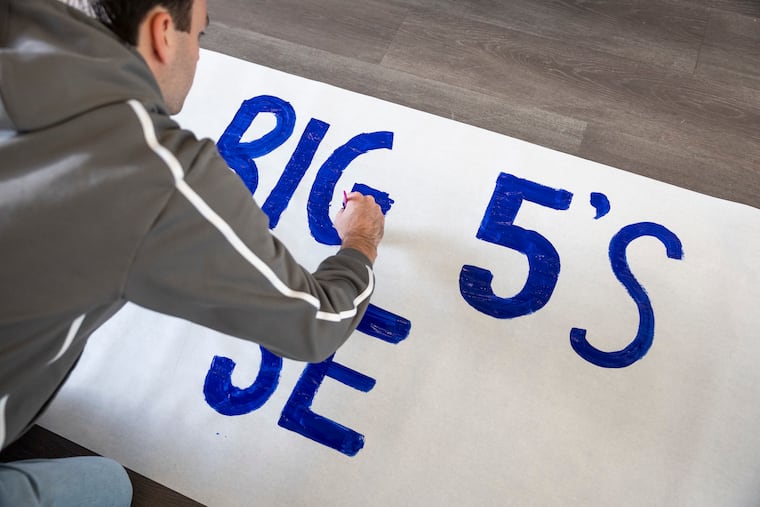
The banner made its way to the bottom of the student section, and a crew of security guards soon was hovering. Everyone had to go, they said.
“We were like ‘What?,’” said Luke Butler, who led the crew of Temple students that night at La Salle.
The fans — the Cherry Crusade — spent a few days crafting one-liners to paint onto 30-foot banners that would be rolled out during the Temple-La Salle basketball game. The “rollouts” have been a Big 5 tradition since the 1950s, even surviving a brief ban when the schools thought the messages had become too racy.
The rollouts often are a play on words or innuendoes that make light of the opposing school. You roll out your banner and then hold your breath while the other school shows theirs. Each student body takes turns dissing each other like kids in a schoolyard. The best rollouts, Butler said, are the ones that “twist the knife” just a little.
But this one, Butler learned, twisted a little too much.
The Explorers entered that game in February 2010 on a seven-game losing streak, and Ash Wednesday had been two weeks earlier. Temple, down a point at halftime, raced away in the second half. And here came the rollout: “LA SALLE GAVE UP WINNING FOR LENT.”
The Temple students — the same crew who held a “funeral” a year later for the St. Joe’s Hawk — thought it was good banter. But a priest was offended, and security had instructions.
“They were like ‘Father is pissed. You basically affronted their faith, and they don’t want you in the building,’” Butler said. “That was a good example of a rollout where we said ‘This will get a good reaction.’ It did. It just wasn’t the reaction we were thinking of.”
70 years of rollouts
The rollouts trace back to the Palestra, when the building was the home of the Big 5 and basketball doubleheaders. The bleachers were filled, the basketball was good, and the crowds were lively. Philly was the center of the college basketball universe, and the Palestra was a scene.
The “rooters” who sat behind the baskets would roll out banners during the games about opposing schools. The messages were a chance for a student body to take a shot at their rivals from across the court. When La Salle students hung a dummy of their coach in the early 1960s from a campus flagpole, St. Joe’s rolled out a banner a week later that said “We Fly Flags on our Flagpole.”
The messages became more pointed, as the Daily News wrote in January 1966 that “the rollouts wandered from the realm of good taste.” The Big 5 athletic directors agreed to ban them, saying that “certain rollout subject matter has been offensive and detrimental to the best interests and continued success of the Palestra program.”
The president of the St. Joe’s student section protested the decision at the Big 5’s weekly luncheon, telling the athletic directors that they were ruining “the greatest spectator participation event in sports” and the rollouts were part of the “spectacular” that was basketball at the Palestra.
» READ MORE: Kevin Willard may soon have his Massimino moment at Villanova, but does this Big 5 format make sense for all?
“It’s not a spectacular,” said Jack Ramsay, then the coach and athletic director for St. Joe’s. “We’re down there to play basketball. If the students want to join in, that’s fine.”
No longer allowed to roll out their messages, students at the Palestra began to shout what they would have written. Banner Ball gave way to Chorus Ball, the Daily News wrote. A year later, the students won, and rollouts were welcomed back to the Palestra as long as messaging was preapproved by the school’s athletic office.
The banners became as integral to a Big 5 game as a soft pretzel from the Palestra concession stand. You didn’t miss a basket during a doubleheader, but you also made sure you caught the dig the opposing students made during a timeout about your school.
The banners were the game within the game as the student sections planned their rollouts like a comedian preparing a stand-up skit. The jokes had to be fresh. How many times can you call the other coach ugly before it’s no longer funny? They had to be timely and tap into current events. That scandal involving a prominent alumni from the other school? Fair game. The football team stinks? That’ll work. A basketball player got arrested? There’s a rollout to be made.
And they had to be timed just right. You can’t come out swinging with your best bit. You have to build up the crowd with a few decent banners and then roll out the one you know will hit.
“You could tell from the other alumni if they were like, ‘Whatever,’ or if it really pissed them off,” Butler said. “Ultimately, that’s what you’re looking for. From brainstorming, to the making of them, to rolling them out, you’re looking for that reaction of them saying ‘Ugh.’”
A fading tradition
The rollouts, just like the Big 5, seem to be waning. Student attendance at local games is no longer what it was. The basketball programs have been down, the transfer portal has made players hard to identify, and conference realignment has introduced games with unfamiliar opponents.
Villanova — the lone Big 5 school to make an NCAA Tournament in the last five years — is the only team that regularly draws a large swath of students. Most schools fill up a student section for the marquee games but attract just a small group on most nights. Attracting students to a once-integral aspect of campus life has become a challenge.
Each school is trying to confront the decline of student participation, and Temple decided last year to revamp its student section. The Cherry Crusade does not have a student president, and the rollouts are made by athletic department staffers.
They sold out their tickets two years ago when they reached the final of the Big 5 Classic and still fill the student section for a big game. The challenge has been to build a consistent presence.
“We want to find those passionate fans to bring back what the Cherry Crusade was,” said Katie Colbridge Ganzelli, Temple athletics’ marketing coordinator for on-campus initiatives. “They’re still there. We’re just trying to find those passionate students who want to be in charge of the student section like it used to be.”
Villanova’s rollouts earlier this week vs. Temple — “Rocky would’ve gone to Villanova,” one said — didn’t twist the knife. Penn’s student section is dormant, forcing the band to provide rollouts. The tradition seems to be fading across the Big 5, but credit La Salle for trying to keep the edge.
» READ MORE: Here’s how the men’s and women’s brackets shape up in the Big 5 Classic
The school revived its student section this season, and the Olney Outlaws took aim at a Big 5 coach for being follically challenged and used another rollout to dunk on Villanova and St. Joe’s. They’re twisting the knife in Olney.
“We had noticed a lack of student engagement and thought this would be a fun way to get kids involved,” said Paige Mitchell, a senior marketing major who founded the Olney Outlaws. “I was working in the athletic department, and my boss at the time gave me a project to come up with something that would get everyone more engaged. It’s grown from there.”
The group of students — “I have a couple guys in the group who are pretty clever,” Mitchell said — brainstorm ideas for the rollout before they meet to paint their signs. They’re ready for Saturday, when La Salle plays Drexel in the Big 5 Classic.
“It’s stressful making sure they get rolled out at the right time,” said Mitchell, who’s also a center forward on the Explorers’ water polo team. “But I love seeing the way the students react. I have a couple friends who were sitting behind the rollout, and they’re blowing up my phone like, ‘What did it say?’ It’s just exciting.”
Perfectly Philly
Butler asked the La Salle security guard if he could talk to the priest, hoping he could ask for absolution. The priest was still steaming as Butler told him it was a misunderstanding. It was just some college kids making a joke, he said. The priest offered Butler penance: the Temple students could stay, but they had to hand over the rest of their banners.
But the Owls were going to clinch the Big 5 title that night, and the Cherry Crusade brought a rollout to celebrate it. Butler pleaded with the priest to allow them to keep that sign. He rolled it out to show the priest and security guard what it said. “Fine,” said the priest. The rollouts, once again, would not be banned. A perfectly Philly tradition lived on.
“There’s something in the Philly culture that rollouts hit a perfect vein,” Butler said. “The thing about people from here is that there is respect if you can dish it and you can take it. People love to twist that knife. When people did good rollouts against us, you were angry, but there was respect there.
“It’s making fun of people who appreciate it, but also hate it, and it gives you an opportunity to be a little bit of an a—. At the end of day, it’s all love. We all love Philly basketball, even though I’ll never root for St. Joe’s and I’ll never root for Villanova. But I still want them around. I want everyone to do well, so then the hate means something.”