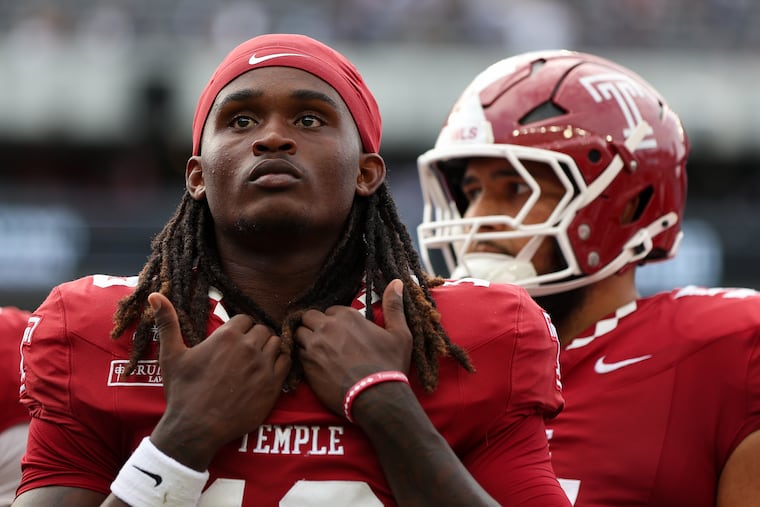
NIL and the transfer portal can be lucrative — if you know what to do. Just ask La Salle’s Truth Harris.
College sports, specifically revenue-generating college sports, have become a year-over-year proposition for coaches to find and retain talent. In a player's market, here's how it all works.
It’s been four years since college athletes have been able to legally profit from their name, image, and likeness.
It’s been less than 10 years since those athletes could enter the NCAA’s transfer portal without needing to redshirt. Yet, it feels like so much of what transpires is taking shape in real time, not just for the students who partake, but also for the coaches, officials, and administrators who navigate it.
College sports, specifically revenue-generating college sports, have become a year-over-year proposition for coaches to find and retain talent. The latter has become even harder, given the trend of student-athletes initially recruited to big-time schools jumping ship after not receiving what they anticipated, often to mid-majors, and becoming big fish.
Conversely, student-athletes who have outkicked their scholarships at a mid-major can enter the portal for a fresh start at a power program — and potentially a substantial payday.
» READ MORE: Darris Nichols and his brother have one mission at La Salle: Make Explorers men’s hoops a winner
It’s an extremely time-consuming process, depending on what side of the ball you’re on.
Coaches have retired as a result. Administrators have stepped down, possibly unable to keep pace with the new realities of the industry; some of whom have spent a major part of their lives involved in it.
But it’s been fantastic the athlete. It’s why, according to Front Office Sports, nearly 4,000 players in men’s and women’s college basketball entered the most recent transfer portal, the highest number of players in a year in the history of the NCAA.
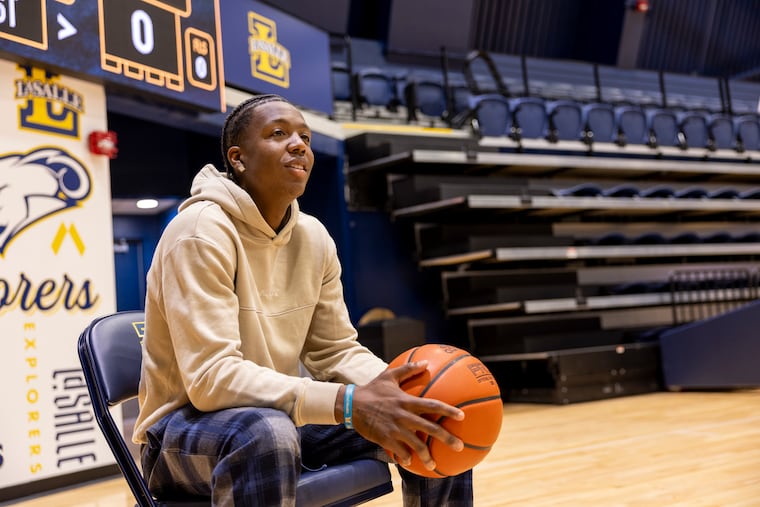
One of those players is Truth Harris, a graduate guard who followed new La Salle coach Darris Nichols after he succeeded Big 5 legend Fran Dunphy in March.
For Harris, 23, his fresh start with the Explorers was his third Division I program and his fifth school since 2020.
After his start at East Tennessee State, Harris, a Mt. Vernon, N.Y., native, who led Mount Vernon High School to a state title in 2017, spent two years at junior colleges, Pensacola State and Indian Hills Community College, where he starred. It afforded Harris a spot with Nichols at Radford ahead of the 2023 season — and he has been alongside him ever since.
While Harris sees these moves as opportunities, there are some within college sports who view them as exploitation and a lack of control by governing bodies.
Harris, who noted that his move to La Salle was paired with a five-figure sum through NIL opportunities, is why many students like him see the portal as a better way to navigate a college career.
“It was always going to get to this eventually,” Harris said in a sit-down with The Inquirer this summer. “I feel like students do deserve the recognition, do deserve the money. As student-athletes, we do go through a lot. We push our limits. We have to get paid for that. So, yeah, I think [the new reality of college sports is] right where it should be.”
» READ MORE: This La Salle triathlete competed in an Ironman world championship. She hopes it’s the first of many.
This season’s top earners likely would agree. The highest paid hooper, BYU guard AJ Dybantsa, is earning $4.4 million this year, according to On3’s NIL valuations. The top 10 earners in men’s college basketball, according to that list, stand to make over $1 million this season.
It’s a far cry from the days in which the guarantee of a college scholarship was the allure.
These days, that comes standard.
Student-athletes are guided by the promise of a payday, with the masses who continue to jump into the transfer portal serving as proof.
‘It’s not that hard, really’
Instructions on how to enter the NCAA’s transfer portal are available on the NCAA’s website. Once a player decides to go, though, there’s a bit of unknown. But if you’re a proven talent, it’s pretty straightforward, Harris says.
“When you enter the transfer portal, you don’t know what’s going to happen,” he said. “If we are saying if there’s stress [involved], I would say that’s the bad stress? But at the same time, when you start hearing from schools and hearing those schools out, it does ease you down a bit more.
“The hardest decision is picking the right school, picking the right option for you. And that all goes into [questions like], ‘Is the team good? What’s the coaching like? What’s their history, their culture?’ It’s about making sure they want you for the right things and you’ll be a good fit there. But once you do it once, it’s not that hard, really.”
Perhaps what causes little concern for student-athletes freely moving from school to school is that many are moving with general studies majors, or, in Harris’ case, chasing a master’s degree. He’s working on a master’s in communications, a degree he noted as “a well-known major that a lot of schools carry.”
In Step 1 of the NCAA’s guide to transferring schools, a line reads: “Your new school should help you satisfy both your academic and athletic goals.” However, graduation rates for athletes reflect the lack of emphasis on academics.
“I think we’ve opened up two different cans of worms. When we opened up the transfer portal and NIL at the same time, it became chaotic,” said Nichols, who added that fluctuating graduation rates and the impact it has on schools being treated like a revolving door isn’t being talked about enough.
“I think that if we’re about student-athletes graduating, we should be focused on retention and doing what’s best for both parties. Everybody’s talking about the money situation, but, to me, let’s clean up the situation of these student-athletes transferring so much but making sure they still graduate.”
However, according to the NCAA Division I Academic Progress Rates, a metric that is supposed to hold institutions accountable for the academic performance of student-athletes, graduation rates for men’s basketball players hovered around 83% as of the 2025 season — though that did have a 4% decline since last year.
“I think that there are just some challenges people don’t talk about,” Nichols said. “If you’re a player that’s transferring every year, are all your credits rolling over, so you’re actually eligible? Something as simple as uniforms, think about it: you bring in nine new players every year, you’ve got to get nine new uniforms. And for people who say, ‘Well, why don’t you just not put their names on the back,’ every one of them comes in different sizes, and [a player] can be number 0 to 99.
“So it’s not just about the cost of NIL for potential players, it’s about operating costs, budgets, revenue. Everybody’s talking about NIL, but there are the little things that go into all this change.”
» READ MORE: La Salle’s three-phase rebuild of its revived baseball program is now headed to second
Works both ways
Still, to Nichols, a former Division I star at West Virginia whose playing days preceded NIL, players should be compensated. That’s not the issue. The issue is the time coaches spend trying to field winning teams every season in what’s essentially a free-agent market.
“You’re constantly trying to get kids to buy in,” he said. “When I was playing, it was a buy-in for four years. And now it’s buy-in for a year. Look, we’re not in a position to try to hold anybody back. If you play here, you do well, and you want to go elsewhere, I get it. But as a staff, we do our utmost to just have honest conversations with [our players] about the new landscape of athletics and not try to hide behind it.”
It’s impossible to hide when the data is so stark in that most schools, especially mid-majors, will see significant movement across their programs each year, especially in revenue-generating sports like football and basketball.
Across the NCAA’s 364 Division I programs, 1,156 undergraduate transfer portal entrants found new homes in men’s basketball alongside 384 graduate entrants this past offseason. In women’s basketball, 720 undergrads found new homes alongside 344 graduate students.
On the men’s side alone, that averages out to four players a coach would need to replace on their roster — solely from transfers — before entering the 2025-26 season.
For players like Harris, who stands to graduate from La Salle after his five-year journey, he’s happy to have benefited from this new reality.
“It’s just a better feeling,” Harris said. “You’re more relaxed. You can do more things for yourself without having to ask your mother and ask your parents for money all the time. I feel like it’s a relief off my parents to know they don’t worry about me [financially]. They’re not worried if I’m good or not because they know I am.
“So if you’re asking me? Yeah, I think it’s a reality that’s right where it should be.”
» READ MORE: Follow the Inquirer's complete coverage of La Salle athletics right here!