Big Ten media day: Matt Campbell explains why Penn State was the right fit, keeping Terry Smith on staff, and more
Campbell says Penn State aligned with his beliefs about building a football program: “While many things surrounding college football continue to change, winning football games has not.”
Big Ten commissioner Tony Petitti addressed the media Tuesday in Chicago, and emphasized that the conference has never been in a better position.
Big Ten schools have won the past three national championships in football — Indiana (2025), Ohio State (2024), and Michigan (2023) — and it continues to try to influence the future of college athletics.
Petitti discussed the proposed Protect College Sports Act and said the Big Ten continues to withhold support until it can review amendments made to the bill’s language.
“Over the past 10 days, there have been hundreds of phone calls discussing key aspects of the bill,” Petitti said. “It is important to understand that this bill sets forth very specific language on how college sports will operate going forward. After a lot of productive work, it is absolutely imperative that we see the amended language of the bill. We cannot change our position until we see the amended bill and have an opportunity to share it with our leadership. And I will say … we expect to see the amended bill shortly.”
» READ MORE: What to know about the proposed Protect College Sports Act and its impact on NCAA athletics
Petitti said the Big Ten has been in communication with lawmakers about the proposed changes and believes progress has been made.
“There seems to be alignment in the direction with the senators,” Petitti said. “They understand our issues. I think we’ve been aligned with the SEC in pointing those out, which is really the case on most of the stuff around the bill and even really working together.”
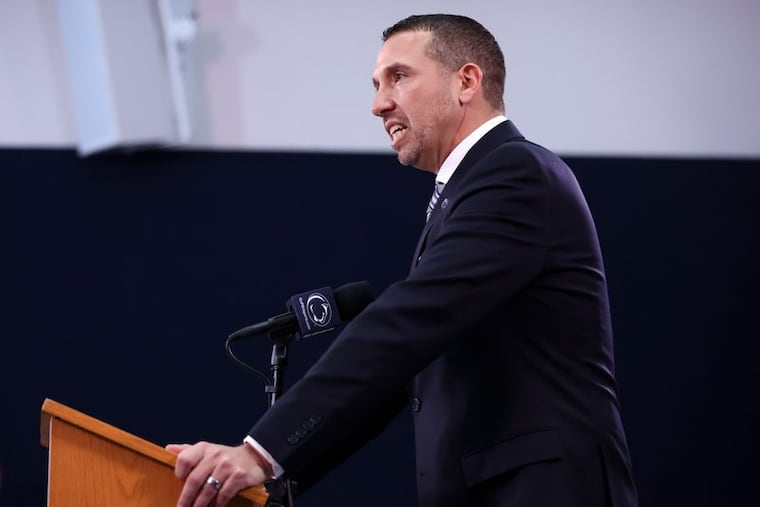
Later, new Penn State coach Matt Campbell, along with offensive tackle Anthony Donkoh, quarterback Rocco Becht, and linebacker Tony Rojas, took the floor to answer questions. Here were the most notable takeaways:
Decision to leave Iowa State
Campbell was hired on Dec. 5, 2025, after James Franklin was fired midway through his 12th season. Campbell was the winningest coach in Iowa State history, recorded more than half of the school’s Big 12 wins, and reached the conference championship in 2024.
A common question throughout Campbell’s tenure with the Cyclones was whether he would leave for another coaching opportunity. Campbell reportedly was offered an eight-year, $68.5 million contract to be the Detroit Lions’ head coach in 2021 and initially accepted the offer before deciding to remain at Iowa State.
Campbell was the Cyclones’ head coach from 2016 to 2025 and amassed a 72-55 record while winning Big 12 Coach of the Year three times. So the decision to leave Iowa State was a big one for him.
» READ MORE: How an unbreakable bond led a ‘true leader’ in quarterback Rocco Becht to Penn State
“If we were ever going to leave, it had to be for a place that aligned with my beliefs about culture, leadership, and building a football program,” Campbell said. “Over the past six months, we’ve been reminded every day why Penn State was the right fit. The history is special. The tradition is special. But what really resonated with me is how Penn State has always valued integrity, character, and class at its best.”
Campbell said he is focused on building a program centered on young men who value doing the right thing on and off the field, have a genuine passion for football, and are committed to receiving a meaningful education.
“While many things surrounding college football continue to change, winning football games has not,” Campbell said. “Neither has my belief in how you build a football program. I still believe it’s my responsibility to help turn young men into great husbands, great fathers, and great leaders. That responsibility hasn’t changed, and it’s one I embrace every day. At Penn State, we’ve chosen a culture that embraces doing what’s hard rather than what’s easy. We want people who are chasing something greater than simply winning football games.”
Bringing Iowa State with him
Campbell brought 24 players from Iowa State with him, including Becht, who is the winningest returning quarterback in college football.
Becht spent much of the spring recovering from surgery on his left, nonthrowing shoulder and was unable to participate in spring practices.
“I wasn’t able to do a lot in spring football,” Becht said. “So I think that ultimately helped me become a better leader off the field. To lead off the field, I had to make those meetings with the guys, with the running backs, with the receivers, with the tight ends, because all that offense was so new to them that I was probably, when the coaches are gone, the next resource to help them gain that knowledge of the offense. And so that was my mentality of going into the spring ball was how much time can I get with those guys off the field so then ultimately when I got back onto the field, that relationship just clicked.”
Taylor Mouser, Ryan Clanton, and Deon Broomfield joined Campbell’s coaching staff from Iowa State. Becht said one of the factors that went into following Campbell to Penn State was the type of person he is off the field.
“[The coaches] are down to earth and people of relationships,” Becht said. “They don’t just care about you as a football player, they care about you as a person as well. And that’s something that I wanted to experience for my last year in college football.”
Defensive changes
Campbell also discussed new defensive coordinator D’Anton Lynn. Lynn had spent the past three seasons as a defensive coordinator at Big Ten foes UCLA and Southern Cal.
“He understands this conference, the style of play, and what it takes to build great defenses,” Campbell said.
Lynn is a Penn State graduate who was a cornerback from 2008 to 2011. He recorded 162 tackles, including seven tackles for loss, four interceptions, and one fumble recovery in 47 games, while starting 37 of his last 38 games.
“He understands what it means to play here and what it means to lead here. He and his family have a deep passion for Penn State and the community,” Campbell said. “Beyond that, he’s an outstanding teacher. He’s assembled an excellent staff around him and has already made a tremendous impact on our players. Those qualities made him the right fit.”
» READ MORE: Penn State’s Blue-White takeaways: First look at the Matt Campbell era, Rocco Becht shines, and more
Along with the new defensive coordinator, Campbell is moving away from the 3-3-5 defense he used at Iowa State. During his time at Toledo and throughout his first two seasons at Iowa State, he primarily used a four-down front with multiple variations before evolving into the defense for which they became known.
“As the Big 12 evolved with more multiple tight-end sets and more pro-style offenses, we found ourselves naturally moving back toward four-down fronts in certain situations, anyway,” Campbell said. “When we got to Penn State, we evaluated who we are, what our personnel looks like, and what gives us the best opportunity to succeed.”
Variety in their defense is important, Campbell said, but the foundation will begin with a four-down front.
Keeping Terry Smith
One of the most important aspects of taking the Penn State job was keeping Terry Smith on the coaching staff, Campbell said.
“Watching him lead Penn State through a difficult stretch at the end of last season only reinforced my respect for him,” Campbell said. “It wasn’t an easy situation, but Terry steadied the program and gave us a strong foundation moving forward.”
Smith served as the associate head coach and cornerbacks coach before being named the interim head coach after Franklin was fired. Rojas said Smith taking on the interim role brought life to the locker room.
“Everyone wanted to play for each other and wanted to play for him,” Rojas said. “Especially the last bowl game, we’re all super excited to get that last one for him. So I think just keeping him on our staff has been a big blessing.”
Smith was a wide receiver at Penn State from 1987 to 1991.