Kevin Willard wants to push Villanova into the future — without casting Jay Wright into the past
Kyle Neptune couldn't escape the comparisons to Wright or win enough to buy himself more time. Willard doesn't want to fall into the same trap, and he thinks he knows how to avoid it.
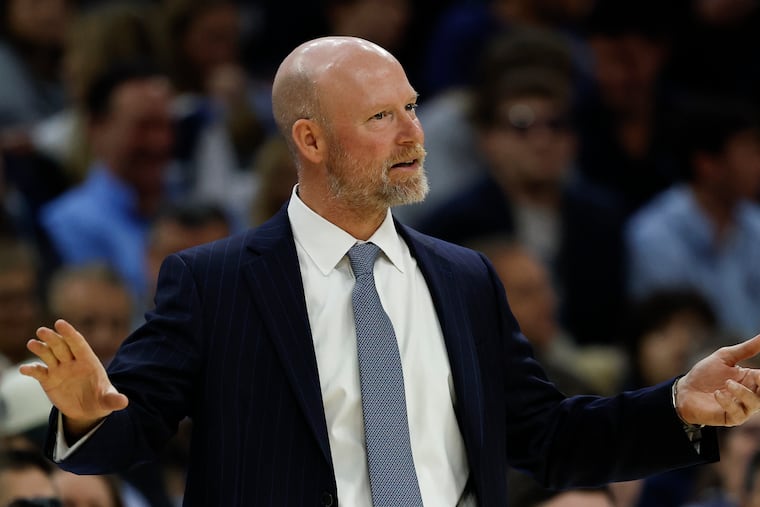
Over his 12 years coaching at Seton Hall and against Jay Wright, Kevin Willard figured that he knew Villanova as well as any outsider could, especially one who would eventually become the university’s men’s basketball coach. His next-door neighbors in Westfield, N.J., were ’Nova alumni, as were three of his golfing buddies at Plainfield Country Club, and there were all those Big East battles between his teams and Wright’s at the Finneran Pavilion, at the Prudential Center in Newark, and at Madison Square Garden in March.
Then he went to Maryland. Maryland wasn’t the northeast. It wasn’t Jersey. It wasn’t Philly. It wasn’t even the Main Line. It was the Big Ten. The Big Ten has big-time football, and more importantly, it has football money and a football mindset, even for its basketball programs. The Big Ten also has 18 member schools, so Willard stopped watching Big East basketball altogether. He had 17 conference opponents to study, after all. Then he returned to the Big East this season, replacing Kyle Neptune at Villanova.
He doesn’t feel comfortable there yet, he said. Too much to do. Too much change so quickly. Too much of a whirlwind.
“The comfort won’t happen until Year 3,” he said. “When I came, I definitely had rose-colored glasses. I had a perception of what this was, not remembering it had been three years since Jay had left.”
» READ MORE: Villanova recruited Devin Askew in high school. Six years and five schools later, he’s fueling the Wildcats.
The Wildcats are 17-5 following their 72-60 victory Wednesday night over Willard’s former team, Seton Hall. And Villanova’s strong season so far might allow its donors and alumni to regard the last three years as just a blip — a small stint in purgatory before Willard got the program back to where those who support it presumed it should and would always be. During an hourlong interview in his office late Tuesday afternoon, though, Willard made it clear where he comes down on Villanova’s future … and its recent past.
No matter Wright’s intentions, his tenure and presence loomed over Neptune as an ever-present reminder of his 21 years as head coach and nerve center, of two national championships and four Final Fours and the status as the top program in the country. Neptune, who had a single season at Fordham as a head coach and had spent 12 years at Villanova on Wright’s staff, couldn’t escape that shadow or the comparisons, and he couldn’t win enough to buy himself more time. Willard doesn’t want to fall into the same trap, and he thinks he knows how to avoid it, believing his three years at Maryland and in the Big Ten, that experience elsewhere, will be vital to understanding how Villanova has to evolve.
“It’s so important,” he said. “My 12 years at Seton Hall, I did it my way. You get very isolated, and Jay was here for so long, and they were winning. But it was Jay. And I know this because I went against him. It was Jay. It was Jay’s way. It was the way it was. They didn’t need to change anything. They didn’t need to worry about anything because they had Jay. Once Jay left, you need to go, ‘All right, what’s everyone else doing? Where has everyone else made gains where maybe this place didn’t because they had Jay?’”
For Willard, the caution and smaller-time approach that worked under Wright — that worked because of Wright, and because Villanova was operating in a pre-NIL/transfer portal/pay-for-play world — won’t fly anymore. It would be foolish for Willard to try. He’s a Villanova outsider still, rougher around the edges than Wright, than the man who was the most polished coach in the country, and the circumstances in this wild, wild west era of college hoops are different and more challenging.
The luxury of redshirting players such as Mikal Bridges and Donte DiVincenzo, for instance, allowing them to get acclimated and mature, won’t necessarily be available to Willard. The way to make up for Wright’s departure isn’t to operate as if his successors will be able to replicate his methods or even his culture. It’s to pay the cost of acquiring big-time players and tout their skills as part of social-media branding campaigns and recognize that this isn’t anything like amateur basketball anymore.
» READ MORE: Will Villanova end its NCAA Tournament drought? Here’s what the numbers — and Joe Lunardi — say.
“It’s like growing up in a small town and going to their amusement park, and then you go to Disney World,” Willard said. “You can’t say, ‘We just need to make the roller coaster better.’ Everything’s got to get better, bigger — fairy dust everywhere. It’s not even a money thing or a structural thing. It’s more about a mentality. Jay was monstrous. Jay was Villanova basketball. But we don’t have Jay anymore. …
“Everyone else is being Disney World. We can’t be the small, little amusement park. We’re not the small, little amusement park, but the mentality a little bit is. ‘We can do it like this because we’ve always done it that way.’”
Willard insisted he doesn’t intend to erase all of the Wildcats’ basketball history, that he can’t ignore or disregard what Villanova is as a university or how Rollie Massimino, Steve Lappas, Wright, and Neptune did their jobs and why. “If you just go against 60 years of tradition,” he said, “you’re going to get [expletive] blown out of the water.” So he views Wright’s presence as an asset, his knowledge and success as valuable resources.
“If I was in my third year of coaching, I wouldn’t feel the same way,” he said. “I’m 20 years a head coach. I’m not cocky, but I feel pretty confident that I know what I’m doing at this point. I love the fact [that] I have Jay around. It’s only going to help. If I was younger and was coming here after three years at Seton Hall, I would be like, ‘What the [hell]? Why is he at the game? This is [expletive] crazy.’ But I love that he comes to practice. I love that he’s at games. I love that I can text him or call him or go out to dinner with him because he built this. He knows this place better than anybody.”
He likely always will. It’s a standard, though, that Kevin Willard doesn’t have to exceed or even meet yet. It’s still just Year 1 for him. Check back in Year 3. He doesn’t have to know Villanova as well as Jay Wright did. He just has to do his part in this new time of college basketball. He just has to know it well enough.