Volleyball coach Josh Steinbach had a deadly scare. Villanova’s athletic trainers saved his life.
Steinbach went into cardiac arrest during a pickup basketball game on campus in June. About 10 months removed from the incident, the longtime Villanova coach has a new lease on life.
It was a regular Monday in June.
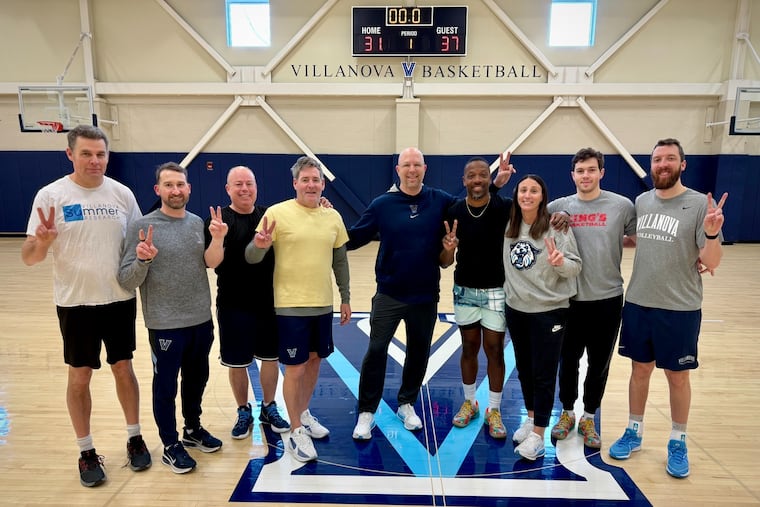
Villanova Athletics staffers were in the middle of an afternoon pickup game inside the Davis Center, the men’s and women’s basketball practice facility, and women’s volleyball coach Josh Steinbach was moving up and down the court.
That was until Steinbach dropped to one knee after grabbing a rebound. Many thought he hurt his ankle. However, he had gone into cardiac arrest. After that, he does not remember anything that happened. Fortunately, he was surrounded by CPR- and AED-trained staff, a requirement by Villanova Athletics.
About 10 months removed from the incident, Steinbach is grateful to have coached the entire 2025 volleyball season and thankful for the team of people who helped save his life.
» READ MORE: Villanova volleyball had its best start in 20 years. Now, it’ll keep trying to ‘serve the moment.’
“People will say to you your whole life, ‘Hey, life is fleeting. It’s delicate. Be careful and take care of your moments and enjoy them because you never know.’ And I think it points out how true that is,” said Steinbach, who completed his 19th season at the helm in November.
Near-death incident
“Noon Hoops” at Villanova had been around long before Steinbach landed on the Main Line. It takes place every Monday, Wednesday, and Friday. Players include coaches, trainers, media relations members, and other Villanova Athletics staffers.
It was the first game of the day on June 2, 2025. Steinbach, now 53, was guarding one of the “younger” players on the court, who was training Villanova men’s basketball players.
“There were about three or four of us in my age group,” Steinbach said. “So, I’m guarding some younger guy, and I’m running around. I was gassed. Heart rate was high. I could feel it. I was a little lightheaded. Somewhere in the middle of game one, I’m sucking air. I’m out of shape.”
Steinbach said he thought a little rest between the first and second games was all he needed. He headed over to grab some water.
“As I was walking around, I was saying something to Chuck [Davis], who’s over in academics, about, ‘Hey, I really like guarding that dude,’ Steinbach said. “I had fun. I was exhausted, but it was fun.”
However, Steinbach’s fingers began to have a tingling sensation. He eventually felt it in his toes. Steinbach did not think too much of it and moved on to the second game. That was the last thing he remembered before he regained consciousness in the ambulance after being shocked with an automated external defibrillator.
The second game tipped off minutes after Steinbach felt the sensation in his fingers and toes. That is when he went up for the rebound and collapsed. Steinbach had no previous heart issues.
» READ MORE: How past stardom led Moa Bönnemark, one of Sweden’s best in squash, to improve at Drexel
As 911 was being dialed, Dan Erickson, the head athletic trainer for the men’s basketball team, rushed to apply the AED to Steinbach’s chest.
The AED went off 90 seconds after the 911 call went through and Steinbach’s heart was revived. Weeks before the incident, Villanova conducted CPR and AED training to certify coaches and trainers. Steinbach credits that training with saving his life.
“I wouldn’t be talking to you otherwise,” he said.
The day before Steinbach went into cardiac arrest, he was at Ridley Creek State Park on a four-mile hike.
“I was really fortunate that it happened during basketball and not when I was on the trails,” Steinbach said.
Return to coaching
Steinbach spent the next few days in Bryn Mawr Hospital.
His volleyball team’s first game of the regular season was at the end of August, which gave Steinbach the summer to recover. But he was limited to how much he could do physically, and was not allowed to lift heavy things or go through extensive cardio workouts.
That concerned Steinbach since coaching any sport is not calm or relaxing. It is intense. At times, Steinbach’s heart rate when coaching is comparable to an easy run, he said.
If the doctors thought his return would risk his health, Steinbach would have to put coaching on hold. But Steinbech, thanks to wearing a WHOOP band, which tracks data such as heart rate, sleep scores, and recovery, already had some data handy to show his doctors.
That data was from the final few minutes of Villanova’s season-opening 3-2 win over Northern Iowa in 2023. In that match, Villanova was leading, 14-10, in the fifth set and almost lost. However, the Wildcats won the set, 19-17, to seal the victory.
“I pulled my heart rate down from that match,” Steinbach said. “And I took it to my cardiologists, my first visit after [his cardiac arrest]. I was like, ‘I just want you to let you know, this is my job.’ And she’s like, ‘That’s not a number to worry about.’”
During that match, Steinbach’s heart rate topped out at 147 beats per minute.
“I think that was reassuring that they kind of were able to look at some actual data and tell me it was going to be all right,” Steinbach said. “But there were times when my dad was in the hospital with my son and me, and we were talking about it. And I was like, ‘I don’t know what I’ll do if I can’t do this.’”
» READ MORE: For Bonnie Rosen, there’s ‘never a dull moment’ after 20 years as Temple women’s lacrosse coach
During his stay in the hospital, his doctors told him that patients who have had traumatic heart events tend to be emotional, which also comes with the medications prescribed. Steinbach was already an emotional person, and his doctors were right.
“I don’t think I made it through a national anthem without crying for the first two to three weeks of playing,” Steinbach said. “Every single time as we’re getting ready to play a match, tears [are] running down my face. It was astounding. I cried a lot.
“That was one of the things that certainly made me appreciate the fact that I was able to coach matches. I was just happy to be there doing it. And I still love doing my job. I have a fun job. And not everybody can say that. To be back out there felt really good.”
Before Steinbach’s ordeal, one of the volleyball team’s celebrations when someone got a kill was to have a player fake going into cardiac arrest, and then another teammate would yell “clear” and pretend to shock her back to life.
Entering the 2025 season, that had a new meaning. The team had a meeting with Steinbach. He had no issues with it.
“You could have a conversation with him, and he’ll crack jokes, but then when it’s go time, he kind of flips a switch,” said associate head coach Joe Portland. “He could project his voice. He could fill up a room with it, but you would never see that other than being in the competitive space.”
Steinbach led his team to an 8-0 start and a 20-8 record (11-5 Big East), as the Wildcats fell just short of making the NCAA Tournament.
The little things
Steinbach is almost back to his normal self.
His doctors had him on a beta blocker, a medication that suppresses the effects of adrenaline to help treat cardiac events, which he recently stopped taking, and a week after the incident, Steinbach received an implantable cardioverter-defibrillator.
The device monitors the heart and delivers electrical pulses or shocks to restore normal heartbeat in case of a cardiac event.
A life-or-death experience can alter the way one thinks. It has made Steinbach complain less about the little things and appreciate the present.
“It’s funny because I got really cranky about some stuff around the office here the past couple weeks,” Steinbach said. “I’m like, ‘What am I cranky about? It’s part of the process, right?’ Now it’s just part of my life. It’s a thing that happened, and I remind myself.”