2025 Toyota Prius Plug-In: Sipping gas and changing names
Gone is the Prime designator for the plug-in version of the best-known hybrid there is. Whatever the name, while you’re out there saving that world, don’t forget to put the pedal to the metal.
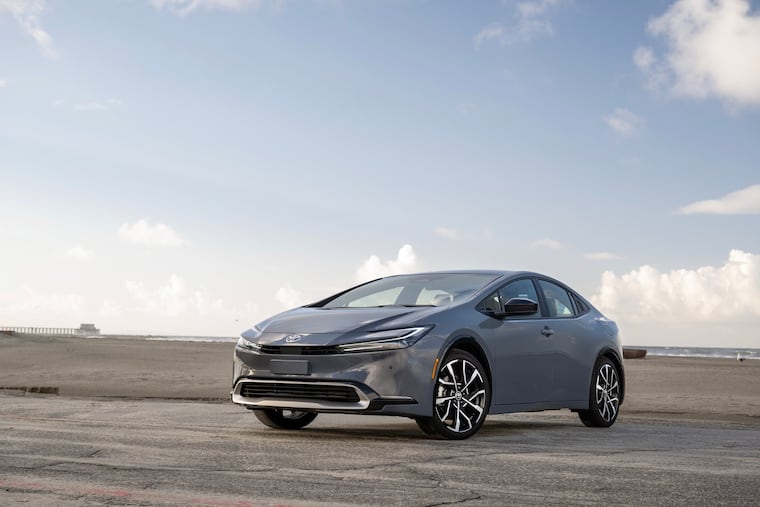
2025 Toyota Prius Premium Plug-in Hybrid: The pinnacle of efficiency?
Price: $43,849 as tested. Panoramic view and advanced park added $1,085; solar charging roof added $620; heated rear seats, $350; floor mats, $309; digital rearview mirror, $200.
Conventional wisdom: Consumer Reports likes that you “can drive on electric power part-time,” that it has “good fuel economy in hybrid mode, quick acceleration, hatchback versatility.” On the downside, it suffers from “access and outward visibility hurt by sleeker styling.” It has a “noisy engine when pushed” and lacks “rear-seat comfort.”
Marketer’s pitch: “Accelerate your efficiency.”
Reality: The marketers nail it this time.
What’s new: Maybe the Prius Plug-In Hybrid should get an unpronounceable symbol for a name because it’s the Prius Formerly Known As Prime. That’s the biggest change for the model year.
Competition: Honda Civic Hybrid, Honda Accord Hybrid, Hyundai Elantra Hybrid, Kia Niro Plug-In Hybrid, and Toyota Corolla Hybrid. And, of course, the Toyota Prius.
Up to speed: The 2.0-liter four-cylinder engine mated to Toyota’s Hybrid Synergy Drive battery and motor provided nice acceleration as I moved around on my first few days of driving, but I soon learned an important lesson.
While entering a very busy I-95, I suddenly had a vehicle change lanes behind me and start bearing down before I’d hit highway speeds. I floored it, and the Prius just leisurely continued its pace, unworthy of PHEV or EV. I was able to keep up with traffic but thought “there must be a different setting.”
And sure enough there is. I was in EV mode, but there’s also an automatic mode, where you can add in the power from the engine and make use of all 220 horses.
Always be sure you’re in the right mode when needed; that way, acceleration to 60 mph will be a pretty snappy 6.6 seconds, according to Toyota. (Look at Toyota, touting the acceleration in a Prius.)
Still it’s nice to have a PHEV that gives 44 miles of electric range in the lesser SE models and 40 in the XSE and Premium models.
Shiftless: Gears? This powertrain doesn’t need any gears.
The shifter stalk has become less Space Age than previous Prius models, with a more normal looking shifter, but it still requires up and left for Reverse and down and left for Drive.
On the road: Handling in the Prius Plug-In is crisp and direct, but never ventures into “joyful” territory.
Highway driving was smooth and calm; it’s where the Prius has always felt at home.
Driver’s Seat: Like so many vehicles, the Prius Plug-In moves the power front seat out of your way when you open the door. Unfortunately, Toyota has it set so that it really travels a great distance backward, and I actually fell into the Prius at one point.
Yes, the seat is very low; the Prius is designed by a crew that looked at the last generation’s wedge shape and said “Hold my beer,” coming up with something even wedgier. It’s so low and wind-cheating that 6-foot-2 Sturgis Kid 4.0 finds the legroom in the passenger seat delightful, but headroom remains an issue. “Just slouch down,” I told him.
Besides, that, though, the seat is comfortable and nicely covered in SofTex.
One other nit about the shape — the pillars stretch out so far that seeing to the right can actually be a challenge when crossing at an intersection.
In and out: I already described the problem for people up front. Rear-seat passengers have their own concerns: The door handle is well hidden in the window area, and the corner of the door wants to whack you in the abs.
Friends and stuff: After all that entry-exit adventure, though, the seat is comfortable enough. Legroom is just OK; headroom is tight, and foot room is good.
Cargo space is 20.3 cubic feet behind the rear seat and 36.6 with the seat folded, a small jump that further illustrates the swoopy nature of the Prius.
Play some tunes: Sound from the JBL system is pretty good, about an A-. The speakers offer clarity but not perfection. But this a Toyota, so I was joyful; many are so much worse.
Operation of the system is almost entirely through the touchscreen. Just a volume knob sits outside the 12.3-inch display. A column of choices along the left side of the screen does make getting around easier.
Keeping warm and cool: Toggles under the infotainment system provide all your assorted HVAC needs, and a small digital readout tells you what’s going on clearly enough.
Fuel economy: The Prius averaged 54 mpg when I picked it up and remained the same for me. It’s probably even more, because factoring in the motor can be tricky in a plug-in.
Where it’s built: Aichi, Japan
How it’s built: Consumer Reports rates the reliability of the Prius Plug-In as a 3 out of 5.
In the end: The Prius Plug-In is a great vehicle. But for about $5,000 less, a regular Prius gets just 4 fewer mpg without all the added maintenance fears of a plug-in system and a solar battery array. (That also may be why CR rates the Prius hybrid a 4 out of 5.) And it offers an all-wheel-drive option.