2026 Hyundai Santa Fe Hybrid: Fighting an intrafamily battle against the Palisade
Each Hyundai takes a different approach to motion, but the results are surprisingly similar. The Mazda CX-90 will join the battle for Week 3.
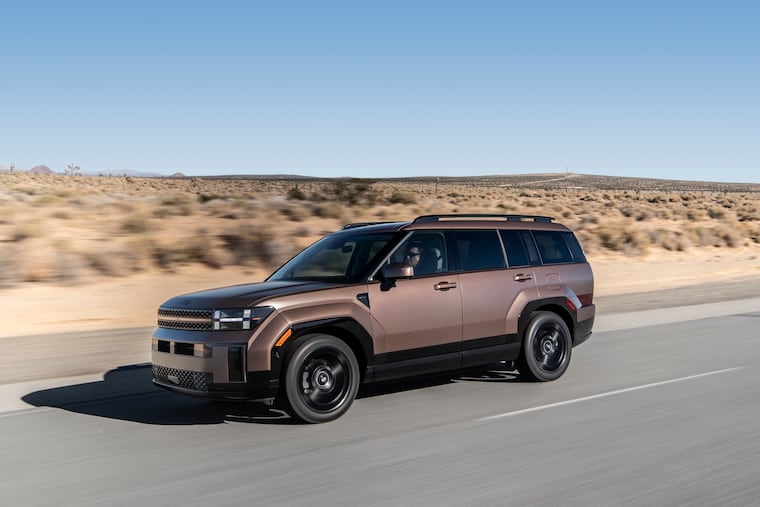
2026 Hyundai Santa Fe Hybrid Calligraphy vs. 2026 Hyundai Palisade XRT PRO vs. 2026 Mazda CX-90: Battle of the barely bigs (or monster mediums).
Price: $52,485 as tested.
Conventional wisdom: “Highs: Fresh and unique exterior styling, good fuel economy, generous standard equipment. Lows: Uninspiring handling, pokey acceleration even for the segment, tight third row,” says Car and Driver.
Marketer’s pitch: “Santa Fe Hybrid for the win.”
Reality: Well, it’s not a complete loser.
What’s new: The Hyundai Santa Fe gets few changes since its 2024 square-jawed revamp, which managed to sneak past me. I’ve seen one or two in the wild, but assumed it was a new version of the Palisade.
We’re going to straighten out this confusion: The Santa Fe is the square one and the Palisade is the slightly bigger swoopy one. I normally wouldn’t pit two models from the same make together, but they normally wouldn’t compete in the same category, and Consumer Reports agrees they do.
Our Santa Fe is a hybrid fuel sipper and the Palisade is an old-style V-6, equal on momentum but wildly different in fuel consumption.
And then the Mazda comes along for week three.
Competition: In addition to the Palisade and the CX-90, you can pick from among models like the Buick Enclave, Honda Pilot, Kia Telluride, Nissan Pathfinder, Toyota Highlander, Toyota Grand Highlander, and Volkswagen Atlas.
Driver’s Seat: The Santa Fe Hybrid front seat holds promise. It’s comfortable and supportive.
But on the road, drawbacks become evident. The steering wheel can hide important information from the gauges, and it didn’t telescope quite far enough for my evidently T-Rexish arms.
Up to speed: Actually getting rolling in the Santa Fe Hybrid proves even more troubling. The 1.6-liter turbocharged four-cylinder attached to the hybrid system is not well motivated, even for a midsize SUV. The vehicle arrives at 60 mph after 7.8 long seconds, according to Car and Driver.
Did you ever have one of those cars with a touchy accelerator, where a tap sends you roaring? The Santa Fe Hybrid is the opposite of that. The accelerator pedal almost dares you to force it to get to work, and that’s just in Sport or MyDrive mode. In Eco mode, it’s a real chore to get rolling.
Shifty: The Hyundai twisty stalk on the steering column still pleases me, and it gets the six-speed automatic into gear.
On the road: The Santa Fe Hybrid handles highways and back roads fine. Fine like your boss who wishes they just did the job themselves says, or your wife who took a chance on letting you clean before company comes.
Friends and stuff: The Santa Fe Hybrid has three rows and can accommodate seven people, if you all just believe in yourselves and try to get along, willya? Yes, the legroom is tight and you in the back row will have trouble moving your knees when you get out, and the tall ones will feel the ceiling, but isn’t togetherness fun? OK, let’s sing camp songs.
Cargo space is 14.6 cubic feet in back; 40.5 with the rear seat folded, and 79.6 behind the front seats.
In and out: It’s just a little bit up into the Santa Fe, about minivan height.
Play some tunes: Sound from the unnamed system was pretty good, about an A-. I could live with the reproduction but I wasn’t really going to get my groove on. (Because that’s what the world longs for, an old nerd getting his groove on.)
The 12.3-inch touchscreen is big and easy to navigate. Silver buttons across the bottom make getting to the usual places simple, and the big icons of the home screen help out as well. I could make sound adjustments on the fly — I shouldn’t, neither should you, but the idiot who’s late for work and had a bad Minecraft game last night until 3 a.m. certainly will, so we need to have systems that protect us from him.
Keeping warm and cool: Hyundai vehicles — at least the upgraded ones — are all getting ebony touch pad HVAC controls and they leave us one uncomfortable driver away from a crash.
Dials for the temperature are big and easy to use, but all the rest are very attractive ebony buttons. Little fake buttons for seat heating and cooling, fan speed, air source, recirc, the whole range. With no haptics for any of them, it’s easy to hit the wrong one with a dragged finger, and pretty difficult to see.
Fuel economy: The cramped spaces and slow acceleration will all prove worth it, because the hybrid fuel savings is spectacular, right?
Sadly, I keep having fuel economy issues with hybrid Hyundai SUVs. I’d bemoaned the 28 mpg I’d observed in the smaller 2024 Tucson Hybrid SUV and received enough feedback to think that maybe it was just me. I know I’m heavy of foot.
Here we go again, though — I struggled to observe 26 mpg in the Santa Fe Hybrid, and to do so I had to suffer through the pedal stiffness of Eco mode, though I confess I don’t really last all that long.
Where it’s built: Montgomery, Ala. Its parts makeup: 46% Korean, 39% from the U.S. or Canada.
How it’s built: Consumer Reports gives the Santa Fe Hybrid a predicted reliability of 2 out of 5.
In the end: I really like that boxy look, but unfortunately it comes with a boxy ride and boxy performance. If you want a hybrid that saves fuel, just get a Toyota.
Next week: Hyundai Palisade.