2026 Volkswagen Atlas: Nice drive, but then things got hot
Adjusting the heating and cooling was so cumbersome Mr. Driver’s Seat was tempted to just suffer, something he doesn’t do in silence.
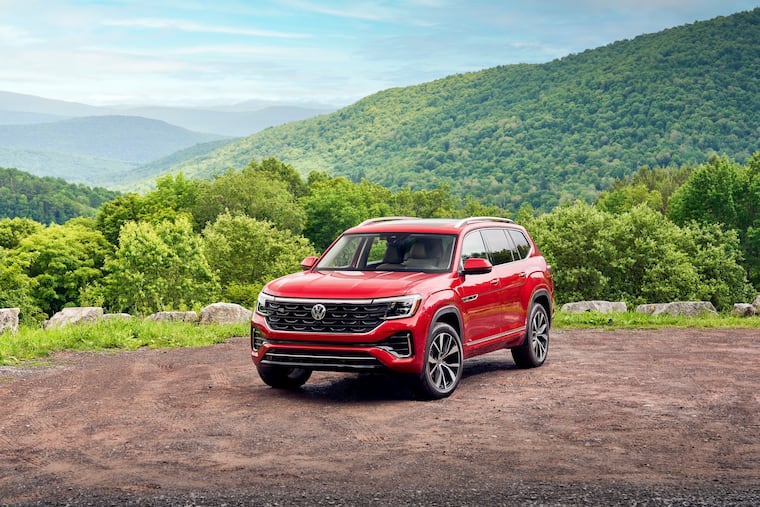
2026 Nissan Murano Platinum AWD vs. 2026 Volkswagen Atlas SEL Premium R-Line: Midsize SUV comparison
This week: Volkswagen Atlas
Price: $56,800 as tested
What others are saying: “Highs: Roomy interior with seating for seven, compliant ride, capable mid-size SUV tow rig. Lows: Leans too heavily on touch controls, interior quality falls short of rivals, lacks overall pizzazz,” says Car and Driver.
What Volkswagen is saying: “With three rows of seats, there’s room for all kinds of adventure.”
Reality: Kinda nice, but one overarching problem.
What’s new: The Atlas last received a major refresh in 2024, with a turbo and a new interior, and this version is all new to Mr. Driver’s Seat.
Competition: In addition to the Murano, there are the Chevrolet Blazer, Honda Passport, Jeep Grand Cherokee, Mazda CX-70, Subaru Outback, and Toyota Crown Signia.
Up to speed: The 2-liter turbocharged four-cylinder engine — whose description sounds suspiciously identical to the Murano’s — creates 269 horsepower, 29 more than the Nissan SUV. Still, despite those extra steeds, it moves the vehicle to 60 mph in about the same time as the Murano, 7.3 seconds, according to Car and Driver. No winner in this department.
Shifty: The shifter is an ugly stepbrother of the Audi toggle, with a flip forward for Reverse, a pull for Drive, and a button for Park. Having the emergency brake button just behind the shifter and the start button just in front of it makes exiting a breeze — press P, pull the brake, and press the button to turn off, all in a neat row, definitely an improvement over the Murano’s console confusion.
On the road: We had a chance to travel hundreds of miles in the Atlas, thanks to a belated holiday visit to Best Friend 1.0’s mom up north.
The Atlas made the trip through Pennsylvania’s Schuylkill valley a pleasant one. It handles highways smoothly and secondary roads with great ease.
On old winding country roads it’s good for a three-row SUV, and you can feel it going where you point it. Six choices among drive modes should satisfy everyone, but sport mode did the job for Mr. Driver’s Seat. Strong advantage Atlas.
Driver’s Seat: The seat is comfortable, with a real sporty feel, not as wide as the Murano’s but grippy and supportive, and the material doesn’t feel cheap at all.
Volkswagen hangs on to its traditional steering wheel buttons, which makes setting the gauge menu info easy.
Friends and stuff: The middle-row captain’s chairs ($695, the only option) in the model tested provided excellent legroom, headroom, and foot room. The seats themselves were not as comfortable as the front and felt a little on the small side. When reclining, both the back and bottom move, and I couldn’t get them set up comfortably. Definitely the Murano wins on comfort and style.
The rear row is nice for a three-row SUV, with plenty of space all around, even for knees, but the seat was smallish and lacked the quality feel so endearing just two rows away.
Cargo space is a cavernous 96.6 cubic feet with everything folded; 20.6 in the back; and 55.5 with the rear row folded.
In and out: Getting in and out for the rear row was less tricky than in most three-row SUVs, allowing passengers to easily maneuver between the seats to the back. The door also opened wide but not so wide that cars next door are in grave danger.
The vehicle height also is good for bad knees and hips.
Play some tunes: The 12-inch infotainment screen handles all the functions, except for a slider control along the frame that “handles” volume, the same way AI “handles” searches, with some hits but many misses.
Sound from the Harman Kardon premium system is good, about an A-, but nothing earth shaking. Still, better than the Murano.
Keeping warm and cool: The Atlas HVAC controls featured ebony sliders with red for warmer and blue for colder worked into the infotainment’s frame. Unfortunately there is no illumination there, so when you hop in at night for an initial journey, you have no idea what to do. And it doesn’t really get better with time.
Fortunately, a couple of temperature numbers on the infotainment display open the full HVAC option screen, as does a button in front of the console. But the icons are so fussy and small I actually considered several times whether it was worth the bother to try switching off the seat heater or change some other setting. This is distressing.
Fuel economy: The Atlas averaged 19 mpg in the long-term average, so it wasn’t just me stomping around.
Where it’s built: Chattanooga, Tenn. The Atlas is made up of 61% parts from the U.S. and Canada, and 28% from Mexico.
How it’s built: Consumer Reports predicts the Atlas reliability to be a 3 out of 5, tying the Murano.
In the end: The Atlas was definitely a nice drive, zooming competently around Pennsylvania and sounding kinda cool doing it. But that HVAC system really killed the experience.
The Outback was going to be my slam-dunk choice, but its controls have gone too far into the touchscreen as well; watch here for a review of the redesigned 2026 model.