Walling off Market East’s public spaces will stymie its comeback
In a clumsy attempt to address drug use on 12th Street, the Marriott Downtown has locked up its outdoor cafe and a well-known sculpture.
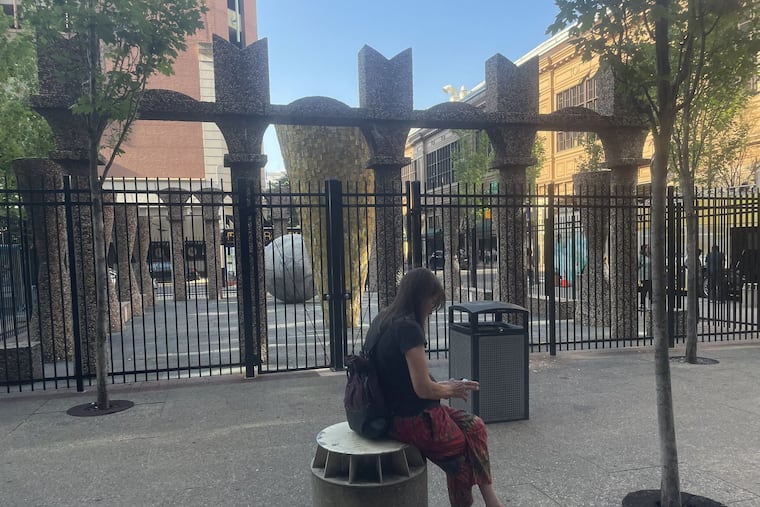
To be purely technical about it, the whimsical assemblage of pop art forms at the corner of 12th and Filbert is a work of sculpture. But since the Marriott Hotel installed the mosaic garden in 1995 as its contribution to Philadelphia’s celebrated Percent for Art Program, the piece has also served as a welcoming station for people shuttling between Market Street and the Pennsylvania Convention Center.
Reading Terminal customers ate lunch on the pebble-encrusted benches. Tourists waited among the exaggerated postmodern columns before boarding the sightseeing buses that park on 12th Street. Conventioneers studied the detailed mosaic globe during meeting breaks. And, yes, homeless people would rest there with their belongings. The little urban refuge was appropriately named World Park.
Now this haven is no longer accessible to anyone. The Marriott Downtown has locked the sculpture behind a tall metal fence. Public art has often been derided and dismissed, but this may be the first time a piece has been jailed.
Treating this artwork as a nuisance not only penalizes the public, it comes just as Philadelphia is about to launch yet another push to reinvent Market East.
When the Marriott opened in 1995, the 1,200-room convention hotel was justly hailed as the flagship for what was then a nascent tourist economy and a big boost for the perennially struggling retail corridor. The chain’s patriarch, Bill Marriott, personally helped select the sculpture by New York artist Ned Smyth, according to Marsha Moss, who served as the public art consultant for the project.
Yet, over the last few years, the hotel has increasingly walled itself off from the neighborhood it was supposed to help. Its main entrance on Market Street has been shuttered for months, turning the sidewalk between 12th and 13th Streets into a dead zone. To enter the building, pedestrians must now go around to the back of the hotel and cross a circular driveway on Filbert Street. All but one of its Market Street retail spaces are empty.
The Marriott isn’t the only Market East business to go into this kind of defensive crouch. Both the Ulta and Sephora stores at the Fashion District have locked their Market Street entrances and posted signs informing customers they can enter only through the mall. With those crude notices, the two cosmetic stores have largely undermined one of the main goals of the shopping mall’s $500 million renovation — to open up its blank Market Street facade and create a friendlier street presence.
Needless to say, closing entrances and imprisoning World Park won’t do anything to help Market East get its mojo back. It will simply leave sidewalks more deserted and perpetuate the idea that the area is unsafe.
An inflection point
We all know that Market Street faces existential challenges. Once Philadelphia’s main retail destination, the corridor has been hit hard by the shift to online shopping. The Fashion District’s plodding, multiyear renovation, completed just before the pandemic, didn’t help matters. Nor did the decision by the mall’s owners to mothball a two-block stretch of buildings on the south side of Market Street. And then the bitter debate over a Sixers arena kept the street in limbo for another two years until the team’s owners abruptly abandoned the project in January.
The Sixers’ about-face leaves Market Street at an inflection point. On the plus side, the team’s owners and Comcast are now working together to revive part of the street. They’ve purchased shuttered south side properties and promise to transform the two blocks between Ninth and 11th into something like National Real Estate’s successful mixed-use development on the next block.
One of the nicest features of National’s development — which it calls East Market — is the collection of intimate public spaces furnished with cafe seating and swinging benches. Last week, I saw lunch-goers happily sunning themselves in Jefferson Plaza, the improvised park created at 12th and Chestnut with little more than a few tables and planters. Food trucks did a brisk business. If there were homeless people in the plaza, they blended into the mix.
Contrast that inclusive space with the sorry conditions at World Park, just a block away. Although Marriott owns the sculpture, it has allowed the artwork to fall into disrepair. It’s disturbing to see tiles peeling off the mosaic globe and weeds sprouting at the base of the large gold cone. The new fence has done nothing to prevent trash from swirling around the geometric forms or, for that matter, to keep people in addiction from hanging out near the sculpture.
Not a good look for next year’s Semiquincentennial bash, which is expected to attract visitors to the stretch of 12th Street between the hotel and Convention Center.
A ‘defensive approach’
Susan Davis, who was running the Percent for Art program in 1995, and is now retired, said she believes the fence around World Park violates the city’s guidelines. The program’s spokesperson, Jamila Davis, would only say that officials are “engaged in discussions with Marriott” and then advised me to check back in November.
I wasn’t able to reach Marriott’s general manager, either, but people familiar with the hotel’s decision say it put up the fence in response to the presence of people using drugs or experiencing homelessness. Loitering has long been a problem at 12th and Filbert, but there are better, and more effective, ways to combat the problem than imprisoning an artwork.
“It’s completely counterproductive,” Elena Madison, the director of projects at the Project for Public Spaces, told me after I sent her photos of the caged artwork. “So many places have tried the defensive approach, and it hasn’t worked anywhere.”
What can succeed is outreach by trained social workers. By getting to know the regulars at the Porch — the Market Street plaza in front of Gray/30th Street Station — the University City District’s outreach team has steadily reduced the homeless population there, officials from the organization told me. The Center City District runs similar programs and could have been enlisted to help at World Park. Although its record of public openness is mixed, the CCD does a good job maintaining several small downtown parks.
Philadelphia is hardly alone in its struggle to reduce street homelessness and open drug use. During a trip to San Francisco last month, I was invited to tag along with the local chapter of the Urban Land Institute, which was holding an ideas competition to look for ways to revive that city’s Market Street.
I was interested in San Francisco’s Market Street because it occupies precisely the same geographical niche in that city as Philadelphia’s: It begins at the soaring Ferry Terminal on the waterfront and extends through the canyon of office towers that form its financial district. But San Francisco’s Market Street has far more empty storefronts than Philadelphia’s, and its opioid problem is even more daunting. The office vacancy rate in downtown San Francisco is 36%, compared to roughly 20% in Philadelphia.
To encourage new approaches, ULI offered $100,000 in prizes to the most creative place-making strategies. While some proposals might seem a bit fanciful, they all share an admirable commitment to keeping public space public in the face of difficult behavioral challenges. San Francisco has already succeeded in reclaiming its barren United Nations Plaza from drug users by turning it into a skate park. The presence of those skateboarders — once banished from downtown business districts — now makes office workers feel safer, observed Alicia John-Baptiste, chief of infrastructure for San Francisco’s new mayor, Daniel Lurie. Other activities, such as chess and ping-pong, have been added.
Revolutionary thinking
Market Street urgently needs the same kind of creative thinking and sponsored activities.
After the arena deal collapsed in January, Mayor Cherelle L. Parker promised to convene a task force to explore revival strategies. She even announced that Brandywine Realty Trust CEO Jerry Sweeney would lead the effort. But eight months later, no other members have been named. John Chin, who runs the Philadelphia Chinatown Development Corp., said no one from Chinatown has been contacted, even though that neighborhood has a vested interest in Market Street’s redevelopment.
When I asked Bruce Bohri, a spokesperson for the planning department, about the Market Street task force, he said there would be an announcement in the fall. That gives the group a little over six months before the 250th celebrations.
Thirty years ago, Philadelphia planners were empowered to lead such place-making efforts. They developed a detailed plan that shaped the design for the new Marriott, recalled Eric Rahe, who oversaw the hotel project for what was then called BLT Architects.
That plan recognized that Market Street’s future depended on the success of the north-south streets that linked it to the adjacent neighborhoods. As a result, the 12th Street sidewalk was widened to accommodate outdoor dining and other attractions between the hotel’s Market Street corner and the Convention Center.
In keeping with the city plan, Marriott built a Parisian-style cafe facing 12th Street. It still exists, but it, too, has been barricaded behind a tall fence. Somehow, the other outdoor dining spots that line 12th Street manage to thrive without such barriers.
If Philadelphia officials are serious about reinventing Market East, they’re going to have to think bigger than just one street. Freeing World Park and fixing 12th Street is a good place to start.