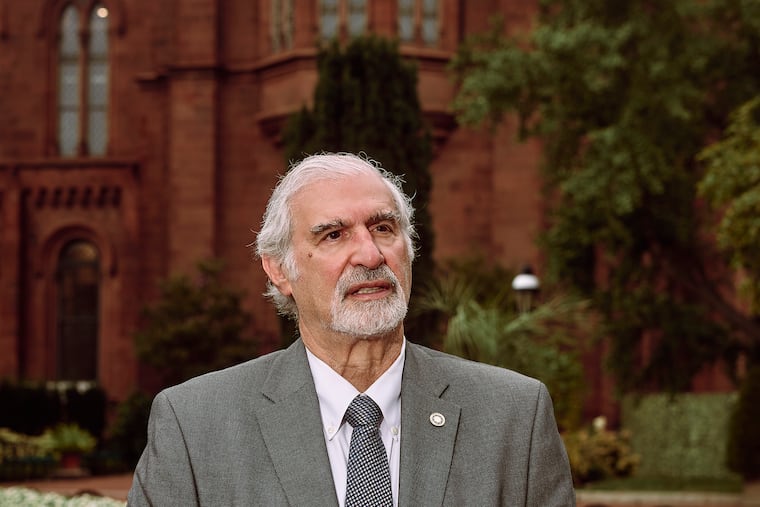
He spent four decades trying to overturn his murder conviction. Now, an old drug case might get him deported.
Subramanyam “Subu” Vedam was released from state prison last week after more than 40 years. A drug case from when he was a teen could get him deported.

Subramanyam “Subu” Vedam spent more than 40 years fighting to overturn his murder conviction.
Now that he has succeeded, a decades-old drug case may get him deported.
Vedam was released from state prison last week after prosecutors in central Pennsylvania said they would not seek to retry him in the 1980 shooting death of 19-year-old Thomas Kinser.
Kinser, of Boalsburg, Centre County, was shot in the head and his body was later found in a sinkhole outside State College. Police arrested Vedam, a high school classmate of Kinser’s, who they said was the last person to have seen him alive and who had bought a .25-caliber handgun around the time of the killing. A bullet of the same caliber was found in Kinser’s shirt.
Vedam insisted that he did not commit the crime, but he was convicted of first-degree murder at two trials: first in 1983, and again at a retrial in 1988. His appeals in the decades that followed were repeatedly denied.
Earlier this year, however, a Centre County judge overturned Vedam’s conviction after ruling that prosecutors had illegally withheld an FBI report from Vedam’s trial lawyers. The report detailed the size of the hole in Kinser’s skull, court documents say, and could have been used at trial to cast doubt on the type of gun used in the shooting.
The Centre County District Attorney’s Office declined to retry the case, citing the passage of time, the unavailability of key evidence and witnesses, and the fact that Vedam — who was 19 when Kinser was killed — had already spent decades in prison.
But as soon as Vedam’s murder conviction officially collapsed, he was taken from the State Correctional Institution at Huntingdon and into federal custody. Vendam, 64, now faces the possibility of deportation to his native India — in part because of a previous drug conviction.
While Vedam was in prison, a federal judge signed an order to deport him, not only because of his now-dismissed murder conviction, but also because of a conviction from the 1980s for possessing and intending to distribute LSD. Such orders, immigration authorities say, are intended to take effect when prisoners with immigration issues are released.
Lawyers for Vedam, a permanent legal resident of the United States who has lived in the country since his parents emigrated with him when he was 9 months old, have now asked immigration authorities to allow him to remain in the U.S.
They acknowledge that the drug conviction provides a legal basis for the removal order but say immigration law permits authorities to exercise discretion, in part due to the age of the conviction.
In addition, they said, Vedam has a host of supportive relatives and friends who live in the United States, including his sister, an American citizen.
They said he completed a series of “remarkable” accomplishments behind bars, including founding a prison literacy program and earning several college degrees, including a master’s degree in business administration. And they said he has already spent four decades of imprisonment for a conviction that has now been overturned.
“Without the wrongful murder conviction, [Vedam] would likely have been successful in defending himself in deportation proceedings decades ago, maintaining his status as a permanent resident,” said one of his lawyers, Ava Benach. “We believe deportation from the United States now, to send him to a country where he has few connections, would represent another terrible wrong.”
It remains unclear how or if those arguments might be received by the federal Board of Immigration Appeals.
But it seems unlikely that Vedam will receive support from U.S. Immigration and Customs Enforcement, which has been seeking to ramp up deportations under President Donald Trump.
ICE spokesperson Jason Koontz called Vedam a “career criminal” and a ”convicted controlled substance trafficker" and said the order for him to be removed from the country was lawfully issued by a federal immigration judge.
Benach, Vedam’s immigration attorney, disputed that characterization of Vedam, and said the drug case stemmed from actions he committed as a teenager. She added that he has since “forfeited four decades of his life to a prison sentence for a murder he didn’t commit.”
Vedam’s attorneys said they have filed paperwork asking to block authorities from deporting him before his immigration appeal is litigated.
That process could take several weeks, or longer, to play out.