Anti-extremism researchers say they’ve identified group claiming responsibility for Villanova hoax shooter call, provide audio of Bucknell incident
The Inquirer also learned that the King of Prussia mall received a hoax active-shooter call hours before one was placed to Villanova
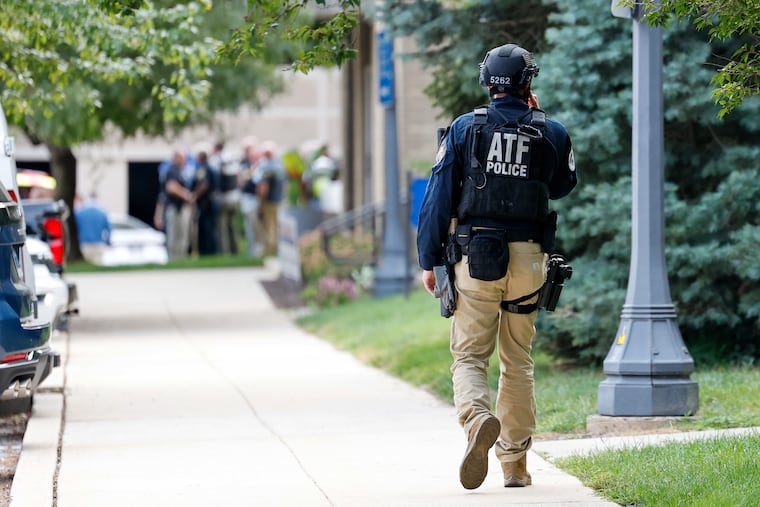
Anti-extremism researchers say they have identified a group claiming responsibility for the hoax active-shooter calls that led to massive police responses and widespread panic at Villanova University and other colleges as students returned to campus last week.
Members of the nonprofit Global Project Against Hate and Extremism (GPAHE) said Wednesday they believe the source of the calls is a group dubbed Purgatory, part of an online threat network called “The Com” that exists at the “intersection of extremism, cybercrime, child abuse, and violence,” according to the nonprofit, which was formed in 2020 by former members of the Southern Poverty Law Center.
The Inquirer reviewed screenshots and audio files from Purgatory groups on Discord and Telegram, two popular voice and text chat applications, that show members making and discussing the hoax calls.
The Inquirer also reviewed a screenshot showing the group was behind a hoax shooting call to the King of Prussia Mall just hours before the call to Villanova.
“WE DID THIS ONE LIVE BOYS,” one group member says in a screenshot of a Telegram group chat, linking to live news coverage of the Villanova police response.
“They claimed credit for Villanova,” said Wendy Via, GPAHE’s president and cofounder. “They talked about how successful it had been.”
Groups like Purgatory have previously been linked to swatting, the practice of calling in false reports of an emergency to law enforcement in order to provoke an aggressive police response that causes either physical or psychic harm to the person or institution targeted.
A flurry of swatting incidents have rattled colleges and universities across the nation this month, sending campuses into frenzied lockdowns just as students return from summer break. At least six schools received swatting calls on Monday, and several more fake reports unnerved colleges across the South a day later.
On Sunday, several days after the initial Villanova swatting call, the Catholic university received yet another “unfounded” call that sent Radnor police officers on a campus sweep and again panicked students and their families.
The FBI, which is leading the investigation into the Villanova incidents, declined to comment on the research. No law enforcement agency has publicly identified a group responsible for the calls.
Via said her nonprofit identified a Purgatory member using the alias “Gores” who touted his alleged success at swatting Villanova and other schools, including Bucknell University in Lewisburg, Pa., on Telegram and Discord.
The nonprofit shared an audio recording of the Bucknell call, allegedly placed hours after the initial call to Villanova last Thursday. The report was made using a program designed to conceal the caller’s identity and location from law enforcement, according to Via.
Speaking with an emergency operator, the caller says: “I’m currently at Bucknell University. I’m in the library right now. I just saw a guy walking around, 6-foot tall, and it looks like he’s holding an AR-15.”
The operator pledges to send help as the caller says he is hearing gunshots and doesn’t know what to do.
Mike Ferlazzo, a spokesperson for Bucknell, confirmed the university was the target of a swatting incident that evening, which the FBI identified and reported to the school’s public safety office.
Ferlazzo said that the call was not placed directly to the university, and that the audio featured in the clip did not involve a Bucknell public safety officer.
“While aspects of our emergency response protocols were briefly activated and local law enforcement responded out of an abundance of caution, the situation was resolved quickly once the hoax was confirmed,” Ferlazzo said.
“At no point was there an actual threat of harm to the university community,” he added.
Later, the caller made similar hoax reports at locations in Michigan, according to Via — some of which included audio that sounded like a shotgun blast.
At Villanova, incoming students and their parents had gathered for an orientation Mass when the campus’ Department of Public Safety received an anonymous report of an active shooter in the Widger School of Law.
The call spurred police from local and state departments to swarm the Main Line campus, triggering a two-hour lockdown that left students barricading classroom doors with desks and chairs.
Rumors spread on police radios and social media networks of an alleged gunshot wound victim, a report that turned out to be unsubstantiated.
Livestreamed chaos
As the chaos at Villanova unfolded, members of Discord and Telegram watched in real time, according to multiple anti-extremism researchers.
For example, a screenshot of a comment made by the user Gores in Purgatory’s Telegram group shows an image of a Fox News helicopter broadcasting the police response at Villanova.
“Im dead why didnt we notice these swat trucks,” the user wrote alongside two crying emoji.
“It is all for them to watch and glory in,” Via said, “and then be able to use it to build their credentials in the online world.”
She said Gores’ mention of “/ehoe” is a reference to the name of the group’s other channel on Discord. Gores told a reporter from Wired magazine Thursday that he and another user were responsible for “a lot” of hoax calls to universities. Gores did not reveal his identity.
Marc-André Argentino, an independent researcher and subject matter expert on terrorism and violent extremism whose Ph.D. work centered on the QAnon movement, also said Purgatory was behind the calls.
Argentino said that based on his research, the Villanova call and others like it played out in the group’s Discord chat room, allowing dozens of people to livestream the calls.
“While these swatting incidents were occurring the Com Group Purgatory (who specialize in swatting) were hosting a Discord Stage, where five of their members (with Gores leading the swatting calls) [livestreamed] in front of an audience of 41 individuals,” Argentino wrote on his blog.
As police flooded Villanova’s campus, Discord users within the Purgatory group shared an image of a TikTok user who claimed to have identified the nonexistent Villanova shooter via closed-circuit TV footage, according to a screenshot.
“THEY’RE BLAMING A RANDOM MAN,” one Purgatory user wrote in response.
Users made other observations, such as: “shes showing that people were in a hurry and she probably got trampled or fell down and scraped it on the ground or against a wall or chair”— a possible reference to either a broadcast news report from the campus or widely shared videos of students and parents frantically fleeing the scene.
That chaotic scene unfolded soon after an earlier attempt by the group to disrupt life in the region.
A screenshot of the Discord chat shared by Argentino shows a Google Voice call log with an outgoing call to the Upper Merion Township Police Department at 12:19 p.m., along with calls to police departments in other states and individual phone numbers.
John Kreuer, a detective sergeant with the Upper Merion police, said the department received a swatting call at that time with reports of an active shooter at the King of Prussia Mall.
“We were quickly able to determine that was a false report and that there was no danger to the public,” Kreuer told The Inquirer, citing the department’s partnership with mall security, which quickly confirmed the lack of a threat. “When Villanova happened, we realized we were dealing with a bigger problem.”
What is Purgatory?
Several Purgatory members were charged in 2024 in connection with threats made against a Delaware high school, an Ohio casino, Albany International Airport, and other locations, according to the U.S. Attorney’s Office for the District of Maryland.
Those members pleaded guilty this year to conspiracy, cyberstalking, and related offenses.
According to a screenshot of Purgatory’s Telegram group, the group offers swatting services in exchange for a fee, charging $15 for calls to a home, $20 for a school, and $25 for a mall. Via said her nonprofit had found no evidence that money was exchanged for the calls placed last week.
The nonprofit believes the Purgatory members allegedly behind the Villanova swatting might be an offshoot of the original Purgatory group targeted by federal investigators.
She could not confirm whether there were direct connections, however, beyond a reference in the latest group’s Telegram to one of the original Purgatory members’ guilty plea.