The Eagles have three obvious positional needs. History says they’ll watch these players closely at the NFL combine.
The offensive trenches and a secondary playmaker could be on the Eagles' wish list as they head to the NFL Scouting Combine.
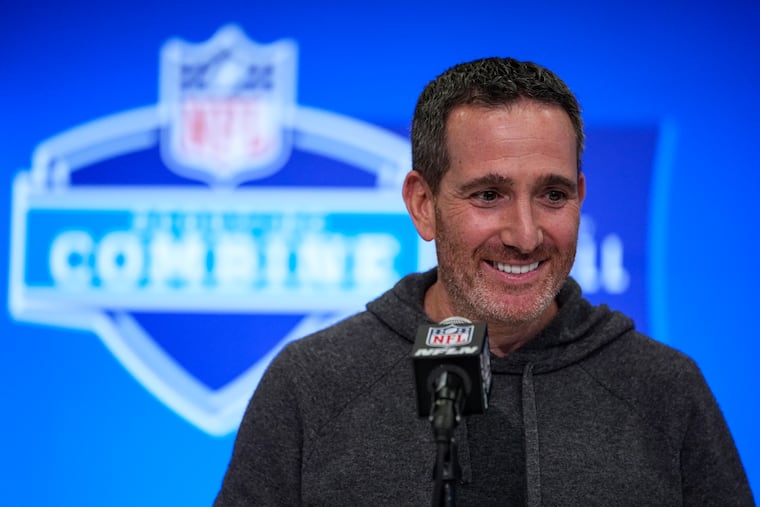
When evaluating NFL prospects, a player’s past performance is often the best predictor of future performance. The same can be said for the act of scouting itself.
Howie Roseman, who began serving as Eagles general manager in 2010, has an extensive draft history that can be used to project his future prospect preferences. Roseman has had personnel control during 15 draft cycles, not including 2015 when Chip Kelly was in charge of those decisions. Those 15 draft classes offer windows into Roseman’s valued traits and abilities at each position.
For years, the Eagles’ player personnel department has been gathering information about the 2026 draft class. At the scouting combine next week, Roseman and his staff will continue to learn about the scores of NFL hopefuls and determine their prospective fit within the organization.
What can the Eagles’ draft history tell us about the questions they will seek to answer about some of the top prospects at three positions of need next week?
‘Critical factors’ on the offensive line
Jeff Stoutland is no longer the Eagles offensive line coach, but will his philosophies in scouting prospective talent linger within the front office?
Throughout his 13-year tenure, Stoutland often emphasized the importance of his players possessing “critical factors” — traits that make them unusual (in a positive way) — to fit in on the Eagles line. Those factors were essential for everyone, from free-agent additions to Day 3 draft picks.
The Eagles may still take his approach in identifying offensive line talent, which is one of their key responsibilities this offseason. Given the uncertain future of Lane Johnson, regardless of whether he returns for the upcoming season or not, the Eagles could look to bolster their prospects at tackle.
For Johnson and Jordan Mailata — Roseman’s biggest draft success stories at tackle — “critical factors” trumped time on task. Johnson, the No. 4 overall pick out of Oklahoma in 2013, had three seasons of tackle experience going into the draft. Mailata, the Eagles’ 2018 seventh-rounder, had none.
» READ MORE: All this talk about trading A.J. Brown is madness. Anyway, you’re talking about trading the wrong Eagle.
They were remarkable athletes at their size, though. Johnson flaunted his athleticism at the combine, ranking in the 99th percentile in the 40-yard dash (4.72 seconds). But most offensive linemen aren’t running 40 yards unabated downfield. His 98th percentile 10-yard split (1.61 seconds) was a reflection of the short-area burst that would help provide the foundation for his All-Pro career.
This tackle class is top-heavy with talent that could interest the Eagles. Kadyn Proctor, the 6-foot-7, 366-pound tackle from Alabama, stands out for his movement skills at his hulking size. He can reinforce that notion with a strong performance at the combine. In addition to athleticism, Stoutland valued versatility along the offensive line. Proctor has the skill set to line up at guard, too, giving the Eagles another interior option if Johnson returns for a 14th season.
After a standout week at the Senior Bowl, Max Iheanachor, the 6-6, 330-pound tackle out of Arizona State, could be on the Eagles’ radar. He’s a rawer prospect than Proctor, beginning his football career in junior college only five years ago. Iheanachor has the requisite size and quickness at the position, though, and he could continue to improve his draft stock with eye-catching numbers at the combine.
However, without Stoutland on the staff developing the offensive linemen, it will be interesting to see if the Eagles gravitate toward a tackle prospect with a higher floor.
Tight end production
Come the start of the new league year next month, the Eagles will likely put up their “help wanted” sign at tight end. After eight seasons in Philadelphia, Dallas Goedert is set to become a free agent, and his asking price may be too steep for the Eagles to meet. Grant Calcaterra, the Eagles’ second-string tight end, is poised to hit the open market, too.
The Eagles will likely draft a tight end in April, but how early? Goedert was a 2018 second-rounder (No. 49 overall) out of South Dakota State. Zach Ertz was drafted in the second round, No. 35 overall, out of Stanford in 2013. With Roseman at the helm, the Eagles have never selected a tight end in the first round, but could that change in 2026?
Kenyon Sadiq, the 20-year-old out of Oregon, is the consensus top tight end in this year’s draft class who could come off the board within the Eagles’ range (potentially earlier) at No. 23 overall. His speed and athleticism are his strengths, and he will likely continue to turn heads at the combine workouts.
» READ MORE: 2026 NFL mock draft 1.0: What will the Eagles do at No. 23?
Sadiq doesn’t boast the college production that most first-round pass-catchers have achieved, though, a group that includes the Eagles’ pair of second-round tight ends. In three seasons at Oregon, Sadiq posted 892 yards and 11 touchdowns on 80 receptions. Since the turn of the century, only one offensive skill player with at least 40 games played and fewer than 1,000 yards from scrimmage has been drafted in the first round — tight end Benjamin Watson (by the New England Patriots in 2004, No. 32 overall out of Georgia).
Goedert and Ertz were their respective teams’ top weapons by the end of their collegiate careers. Sadiq, who declared for the draft after his junior season, was not. Why? That’s the question the Eagles must answer as they mull the decision to use a first-round pick on the versatile hybrid tight end.
At 6-3, 245 pounds, Sadiq is smaller than Goedert (6-5, 256) and Ertz (6-5, 249). Still, Sadiq makes for an intriguing fit in the Shanahan-esque scheme that new Eagles offensive coordinator Sean Mannion is expected to bring to Philadelphia. The speedy Sadiq has the ability to exploit mismatches in the passing game, given his ability to outrun linebackers. He excels at making plays with the ball in his hands, which could be a benefit to the Eagles in the screen game.
Realistically, Days 2 and 3 could be the ideal spots to draft a tight end given the depth at the position in this year’s draft class. But Sadiq, a better athlete than Goedert or Ertz, could quell some doubts about his college production by dazzling at the combine.
Need for speed, skill at cornerback
The cornerback position is a reminder that Roseman’s track record isn’t always predictive. Going into the 2024 draft, he had never drafted a cornerback in the first round. That year, he bucked the trend with the selection of Quinyon Mitchell with the No. 22 overall pick.
One of the biggest questions about Mitchell’s future in the NFL as CB1 was answered at the Senior Bowl. He had mostly played in off coverage and zone at Toledo, but he performed well in press-man against other top prospects in Mobile, Ala. Roseman said after the first night of the draft that Mitchell’s Senior Bowl showing helped him see his “diverse array of skill sets.”
Mitchell also helped his draft stock at the combine. He ran a 4.33-second 40-yard dash, the second-fastest speed by a cornerback that year. Unsurprisingly, speed seems to be one of the priorities for the Eagles at the position, with their cornerback selections over the last three draft classes running at most a 4.41 in the 40 at the combine. Cooper DeJean, who did not participate at the combine because of an injury, ran a 4.42 at his pro day.
» READ MORE: Five Eagles-focused takeaways from the Seahawks’ win over the Patriots in Super Bowl LX
Could Roseman go back to the cornerback well in the first round again? The Eagles have a need at CB2, with Adoree’ Jackson set to become a free agent in March.
Some notable draft analysts seem to think so. Daniel Jeremiah and Bucky Brooks, NFL Network draft analysts, tabbed Clemson cornerback Avieon Terrell to go to the Eagles in their first mock drafts of the year.
The 5-11, 180-pound Terrell is relatively undersized at the position, although that might not necessarily be a deal-breaker. By comparison, Mitchell has fairly average size at 6 feet, 195 pounds, but his 34th-percentile arms (31 inches long) haven’t seemed to hold him back in the NFL.
Regardless of his size, Terrell has solidified himself among the top cornerbacks in this year’s draft class with his smart instincts and competitive spirit, a pair of traits that would be coveted by Vic Fangio. He also has inside-outside versatility if the Eagles ever decide to move DeJean outside full-time. If Terrell tests well at the combine, he could get his foot in the door of the late first round.

The Eagles seem reluctant to address the handling of the Jalen Hurts blood clots saga, but the key questions involved in the story aren’t going anywhere. Throughout the week, in the absence of remarks from general manager Howie Roseman or team medical personnel, head coach Nick Sirianni was peppered by reporters. He’s offered few details in return. After speaking with high-ranking medical officials currently or previously employed by NFL teams, The Inquirer’s Jeff McLane frames four central issues that remain unanswered, while also looking at what this situation means for Hurts’ future in Philadelphia. Listen here.
Listen to all episodes here or wherever you get your podcasts.