Better than it looked? Four biggest film observations from the first preseason game of the Sean Mannion era
It might not have been pretty to watch, but the Eagles' offensive design on Saturday night provided a glimpse of what could be a bright future for the attack.
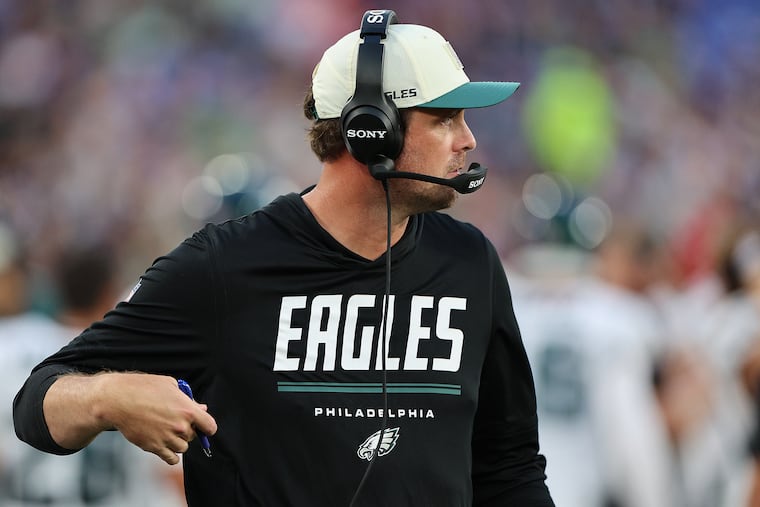
Much like Sean Mannion’s first-ever play-calling experience in an exhibition atmosphere at the East-West Shrine Bowl earlier this year, the first-year Eagles offensive coordinator’s debut on Saturday night didn’t offer detailed play designs nor gaudy production.
The Eagles’ 24-7 loss to the Ravens did, however, give the 34-year-old an opportunity to call and sequence plays at the NFL level and provided a glimpse into the many influences that could ultimately shape what the offense, in full, will look like during the 2026 regular season.
And there were encouraging signs that the offense has been modernized this offseason to keep pace with some of the league’s potent attacks.
Here’s what the film showed in Mannion’s first stab at calling plays for the Eagles:
Outside zone leads the way in run game
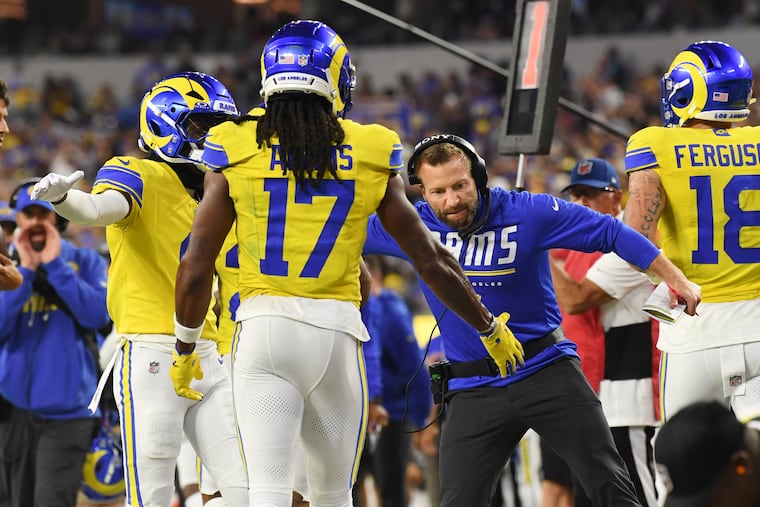
All spring and summer, there was an expectation that the Eagles would move toward running the Sean McVay/Kyle Shanahan outside zone run scheme as a key tenet of the run game, and the results from the preseason opener backed that up.
Six of the 12 called run plays (including those that included post-snap penalties) were of the outside run variety. Four of them gained 8 yards (and two were called back for holding), and one went backward for a 3-yard loss because of a missed block.
There will be growing pains implementing the new blocking style, which requires the offensive linemen and tight ends to create vertical seams to allow the running back to find a lane and go while stretching the defense horizontally.
With the Rams, McVay paired the duo run to his patented outside zone run scheme, thriving when implementing it from under center.
The Eagles ran duo three times from under center on Saturday, and it was the second-most called run scheme on a night where the ground game was hardly present in the second half. The run scheme allows the back to get downhill quicker and opens up play-action passing opportunities.
For the other three runs, the Eagles sprinkled in under-center split zone with tight end Eli Stowers coming from the back side of the formation to block the play side edge rusher, inside zone from shotgun, and a zone-read keep from Cole Payton with a tight end leading the way on the edge.
That last run should be particularly noteworthy should Jalen Hurts reemerge as a key part of the running game.
Pre-snap motion limited, but effective
Across the entire game, there weren’t many pre-snap motions or shifts as Andy Dalton and Tanner McKee got the offense set on their respective drives. In fact, of the six pre-snap motions that occurred, it was McKee who signaled them the most, accounting for five that Mannion dialed up.
There were flashes of success because of how it made the defense react. On McKee’s 13-yard pass to Darius Cooper, he motioned Stowers away from a bunch set on the left side of the formation to align at tight end off the line to the right, and changed Baltimore’s off-ball linebacker from a second-level defender to a standup edge rusher. It opened a lane for Cooper to get hit in stride on a slant route.
On another occasion, in the quick passing game, Cooper went from McKee’s right to his left on a motion, bumping the corner aligned over Stowers to outside the numbers, creating room for McKee to find the rookie tight end for a short gain.
There was also an example of the offense changing its formation after breaking the huddle. After coming out in 10 personnel (one running back, zero tight ends), Carson Steele motioned to outside receiver, creating an empty backfield for McKee. It forced Baltimore to show its blitz and McKee was able to identify it and get the ball out.
Compared to last year’s offense, there already seems to be a different approach to formation presentation. The more an offense can confuse the defense with motions and shifts, the more answers it can provide to a quarterback and keep defenses guessing.
Generating ‘layup’ throws
Under-center play-action throws have been an element of the offense the Eagles have shown during training camp, and carried over into the preseason opener.
Dalton, McKee, and Payton each had an opportunity to run play-action from under center, with the first two quarterbacks running bootleg actions off it.
The route combinations off the bootleg action — a deep corner route, a back side crossing route, and short flat route — are part of the McVay/Shanahan style of offense and can stress a defense that must respect the wide zone run threat.
As teams prepare for that threat of play-action, the other route options will open up if the Eagles can generate those types of easy completions that weren’t always available for Hurts last season. Those quick-hitting throws on the move also allow for receivers to generate big plays in space.
Grizzard’s pass game influence
As the Eagles were deciding their next offensive coordinator hire, Josh Grizzard, who previously worked as a the Buccaneers’ pass game specialist, then was promoted to offensive coordinator, was among the candidates.
Mannion has mentioned the offense would be a “blend” of various approaches and Grizzard, who was hired as Eagles pass game specialist, appears to have his fingerprints on the passing game — especially in third-down situations.
A play Tampa commonly ran in 2024, when Grizzard presided over the third-down offense, featured a bunch formation that had two receivers clear out and created space for an option route for the third receiver to sit in a vacant area in zone coverage, or take advantage of a defender’s leverage in man coverage.
On a couple of third downs in the preseason opener, the Eagles showed a similar type of play design: The two receivers ran in- or out-breaking routes and the tight ends got close to the first down line or found vacant space to turn and prepare for a pass to come their way, which was often a tight end.
Another play Grizzard has seemingly brought from Tampa is mesh rail, which features two inside receiver shallow crossing routes, a route sitting over the middle of the field behind the mesh action, an outside receiver running a deep route, and a running back running a wheel route out of the backfield.
The Bucs would catch teams off guard by quickly lining up and running the play while the defense was still getting set. The Eagles utilized this vs. the Ravens as they moved down the field on their lone touchdown drive.
While the Eagles’ offense was vanilla with the objective of not revealing much, Mannion’s scheme change appears to match the expectation of the style of offense the team intends to run. The key will be the execution, and limiting the mistakes that prevented Mannion and the offense to get into a true game flow on Saturday night.
We won’t see the offense in full until the season opener, but Saturday offered a glimpse of what the long-term vision can look like when plays are executed.