Ursinus College slashes funding to its Berman Museum in half
The $300,000 cut in museum funding is part of a larger move by the small liberal arts college to reduce its budget by $10 million by 2027 to cope with a deficit.
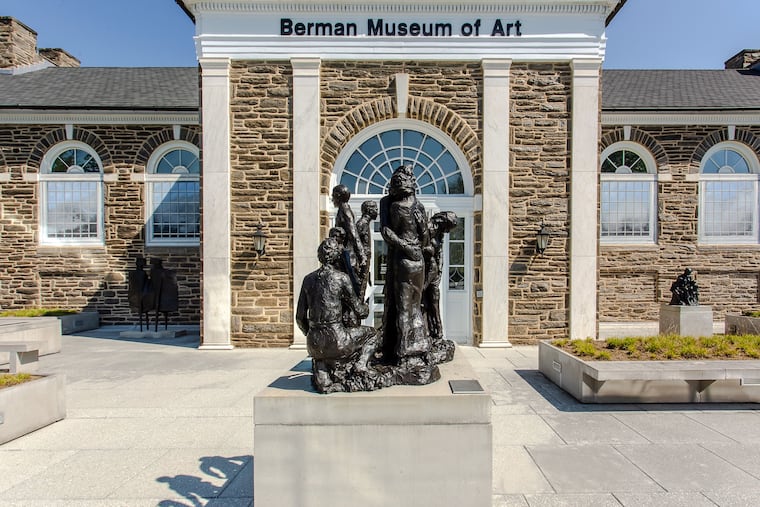
Amid a budget crunch, Ursinus College is slashing funding to its Berman Museum of Art in half. This will mean a reduction in full-time employees and external and traveling exhibits, the college said.
The teaching museum, which has been a part of Ursinus since 1989, houses a substantial art collection from the last five centuries. It is an international resource on French painter Françoise Gilot, who is best known for her 50-work “Labyrinth” series (1961-1963) and for being Picasso’s partner for over a decade. The museum also oversees a collection of outdoor sculpture notable in size and scope.
The move is part of a larger effort by the 1,406-student liberal arts college to reduce its budget by $10 million by 2027 to cope with a deficit. The school announced earlier this year it would reduce its full-time faculty positions by nearly a quarter.
“This reality requires difficult and, at times, painful decisions across the institution,” president Gundolf Graml said earlier this month in announcing the cut to the Berman’s funding.
» READ MORE: Years into ‘historic affiliation,’ Drexel University and Academy of Natural Sciences may sever ties
The Berman has operated on a $600,000 budget, half of which was funded out of Ursinus’ general operating budget. The college will no longer provide that $300,000, said Graml, who had been serving as interim president of the Collegeville school since October and was named to the permanent position last month.
The other half of the funding comes from donors’ endowed funds that provide about $300,000 in distributions annually. That will continue, the college said.
Students and staff expressed concern about such a large cut and what it ultimately will mean for the museum.
“A lot of decades of work have gone into building this institution, the museum — not just its programs but its partnerships and relationships on which it has relied,” said Lauren McCardel, the museum’s executive director. “It’s not just me, but all those who came before me. A lot of that work could be undone quickly.”
She said that cutting the budget in half “is going to necessarily lead to a significant reduction in staff, which is going to kneecap our ability to engage with our community and audiences in the way we have.”
Ursinus student Hayden James, an art and art history major with minors in museum studies and creative writing, was at a meeting when the decision was announced to students who are associated with the museum, according to the Grizzly, Ursinus’ student newspaper.
» READ MORE: Ursinus College announces new president as it cuts faculty and faces budget challenges
“The room was very emotional and full of tears as we listened to [those] who have shaped our college careers announce such a drastic change,” James told the publication.
“I actually interned at the museum back in high school because I went here locally,” student Syd Libby told the Grizzly, adding that “the museum is the reason why I’m at Ursinus.”
Students held a protest on campus Tuesday, criticizing the school’s cuts to the arts, which also include temporarily reducing its dance major to a dance minor for incoming students next fall. Current majors will be permitted to continue, a college spokesperson said.
The Berman Museum of Art is named for its founders, Philip and Muriel Berman, Allentown art collectors and philanthropists. Philip Berman, an Ursinus graduate, owned Hess’s department stores and was board chairman of the Philadelphia Museum of Art. He died in 1997. Muriel Berman, his wife, was a practicing optometrist who died in 2004.
Most of the works in the impressive trove of outdoor sculpture were donated by the couple. The collection, on the museum’s terrace and spread across the Ursinus campus, features almost 80 works by artists Lynn Chadwick, Michael B. Price, Joe Mooney, and others.
Among its more famous residents is Cubed Curve, William Crovello’s brilliant blue 1972 sculpture that sat in front of the Time-Life Building in New York at 50th Street and Sixth Avenue for more than four decades.
The Rockefeller Group donated it to Ursinus, and it landed on campus in 2018.
The museum is a major repository of materials relating to Gilot, who was close with the Bermans, and made substantial gifts to the museum.
It holds her personal archives plus more than 270 of her works, including what the museum has said is the most comprehensive collection of lithographs and etchings anywhere beyond the artist’s own holdings.
Gilot died in 2023 at age 101.
The museum’s permanent collection holds works from across half a millennium. William Blake, Albrect Dürer, Eugène Delacroix, Hendrick Goltzius, Francisco Goya, and J.M.W. Turner are represented. Among more contemporary artists with works on view are Roy Lichtenstein, Robert Rauschenberg, James Rosenquist, Andy Warhol, Alexander Calder, Robert Indiana, and Claes Oldenburg.
The Berman collection — which the museum says numbers more than 9,000 works and has continued to grow — encompasses folk art, photography, Japanese prints, and Pennsylvania German pottery, quilts, and furniture.
The museum and the arts in general have been seen as integral to the student experience at Ursinus.
But in recent years, the school has had financial struggles.
The college has been running total operating losses for most of the last nine years, reaching $13.4 million in 2024 but falling to $4 million in 2025, financial records show. Ursinus had experienced a 10% decline in first-year enrollment last fall and a 6.4% decline in overall enrollment.
Ursinus is not the only local college struggling with how to fund its museum. Last month, Drexel University gave the Academy of Natural Sciences the choice of fully merging into the university or disaffiliating. The university has provided the academy with substantial support — $8,288,000 and $8,914,000 for operations in fiscal years 2025 and 2024, respectively, according to financial statements posted on the academy website.
“They have a separate board and kind of expect [Drexel] to treat it more charitably than [Drexel] thinks is appropriate,” a source told The Inquirer in April. “They think [Drexel] should underwrite it and [Drexel] thinks they should stand on their own feet.”
The academy became part of Drexel in 2011.
Graml said that the Berman will remain open, and that the school is “committed to sustaining a vibrant presence for the arts at Ursinus, with a particular focus on elevating and supporting the work of our students and showcasing our impressive collection of owned assets.”
The college said it will reduce full-time staff from three positions to one and feature its own collections, while reducing the number of external exhibits. The museum will continue to have a director position, he said, and the college said the museum will continue to use the same number of student workers.
“Through the Berman Museum, students will continue to create, exhibit, and engage with original works of art as part of their academic and creative lives,” Kelly Sorensen, interim provost and vice president for academic affairs, said in a statement. “There will be a continued focus on showcasing student work, utilizing and exhibiting the college’s permanent collection, and supporting academic connections between the museum and curriculum.”