Constance Clayton was Philly’s longest-tenured superintendent — and now the school district’s headquarters is officially named for her
Constance Clayton “believed in the infinite power of young people,” Superintendent Tony B. Watlington said, and “she also thought they should come to school, rain, sleet, or snow.”
In 1955, Constance E. Clayton began her career teaching fourth graders at the now-closed William Henry Harrison Elementary in North Philadelphia.
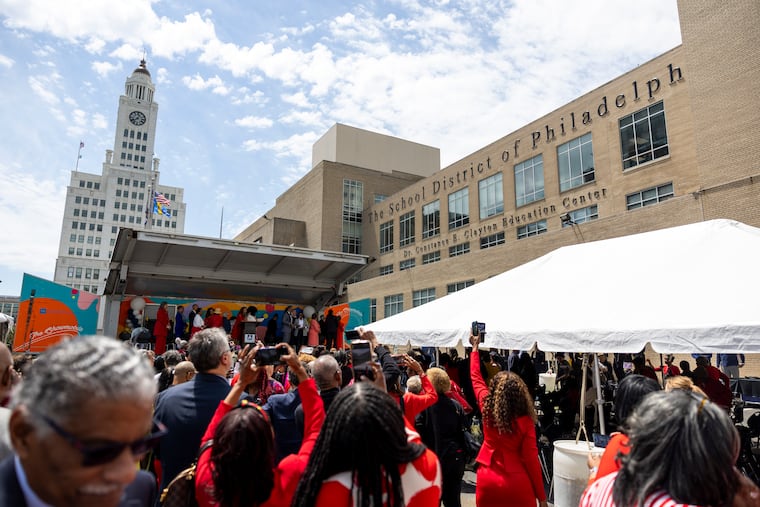
On Wednesday, the city honored its longest-tenured superintendent — perhaps the most beloved educator the system ever produced — by officially renaming Philadelphia School District headquarters the Constance E. Clayton Education Center.
Clayton, the city’s first Black and first female superintendent, died in 2023 at age 89.
But her imposing presence was felt Wednesday. Inside the school system’s Center City building, a series of new Mural Arts Philadelphia displays depicting Clayton is front and center. And outside, Buttonwood Street between Broad and 15th Streets has a new name: Dr. Constance E. Clayton Way.
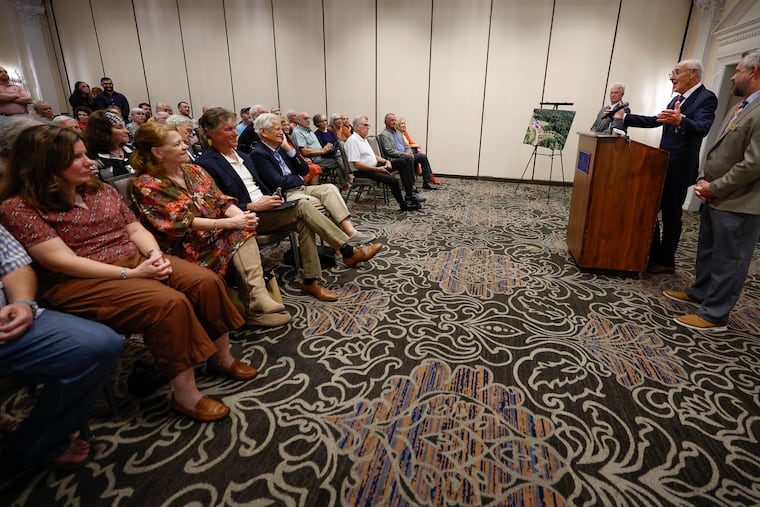
A parade of city, state, and school district leaders current and past honored her and cheered enthusiastically. Many wore red, in honor of Clayton’s membership in the Delta Sigma Theta sorority.
School board president Reginald Streater — a graduate of Germantown High, a now-closed neighborhood public school — said Clayton’s insistence on high standards for all city students saved his life.
“In naming the district’s central office the Dr. Constance E. Clayton Education Center, we submit her ‘children first’ philosophy as our standard of excellence, ensuring it remains the guiding principle of our leadership and a promise to every student,” Streater said.
Superintendent Tony B. Watlington Sr. said Clayton quickly became a mentor to him when he arrived in Philadelphia in 2022, calling him “young man” and reaching out to him just three days before her death to discuss the school system’s new math curriculum.
‘Infinite power of young people’
Clayton was often the only woman and only person of color in many rooms she occupied, but “she never shrank herself to fit the room,” said Deirdre Farmbry, who worked for years as a special assistant to Clayton. “She commanded it.”
She was tough, expected much of those who worked for her, and did not brook nonsense. Clayton handpicked 17 speakers for her funeral, and left instructions on what topics she wanted covered. But she was tender and funny, too; she called those she loved “sweetheart” and loved making jokes, especially about politics.
Clayton relished her reputation as the superintendent who rarely gave students a day off from school for inclement weather.
“She believed in the infinite power of young people,” Watlington said, and “she also thought they should come to school, rain, sleet, or snow.”
Mayor Cherelle L. Parker said her knees never shook so much as they did when, at age 16, she recited a speech she had written for an oratorical competition to Clayton. Parker won that competition, and Clayton told reporters that Parker and the other winners were proof that irrespective of income or family background, a high-quality education is paramount.
“It is the great equalizer, and it still is today,” Parker said.
Parker invoked Clayton as she alluded to her push to raise $50 million in new, recurring revenue via a $1-per-trip rideshare tax.
“I want you to know that I didn’t run to be the first to become a footnote in somebody else’s history book,” the mayor said. “If I am going to make my seat at the table matter, it better translate into new and recurring revenue to support the School District of Philadelphia so that you will remember our commitment in a very meaningful way.”
A national presence
Michael Casserly, former executive director of the Council for Great City Schools, said Clayton was a figure of national importance.
“Connie helped change the national conversation about what urban public education could and should be,” said Casserly, who was once fired — and then rehired — by Clayton.
During Clayton’s 11 years leading Philadelphia schools, from 1982 through 1993, the school system neither ran a deficit nor had a labor strike.
She standardized grading, curriculum, and promotion criteria citywide, ended a system of patronage appointments, saw test scores rise, and had a strong reputation in the business community. And at a time before diversity, equity, and inclusion were part of the national conversation, Clayton pioneered an African American education curriculum.
There are also other efforts afoot to memorialize Clayton. U.S. Rep. Dwight Evans (D., Pa.) has proposed renaming the Manayunk Post Office in her honor.
And State Sen. Sharif Street (D., Philadelphia) said he was working on getting part of Broad Street — which is governed by state rather than city law — renamed for Clayton.
“The rules need to bend when the legacy is great enough,” Street said.