Temple will provide extra resources and support for two North Philly elementary schools through a new partnership
Duckrey Elementary and Bethune Elementary will join the Temple Partnership Schools Network, which will make them learning labs for Temple students and provide extra resources for the schools.
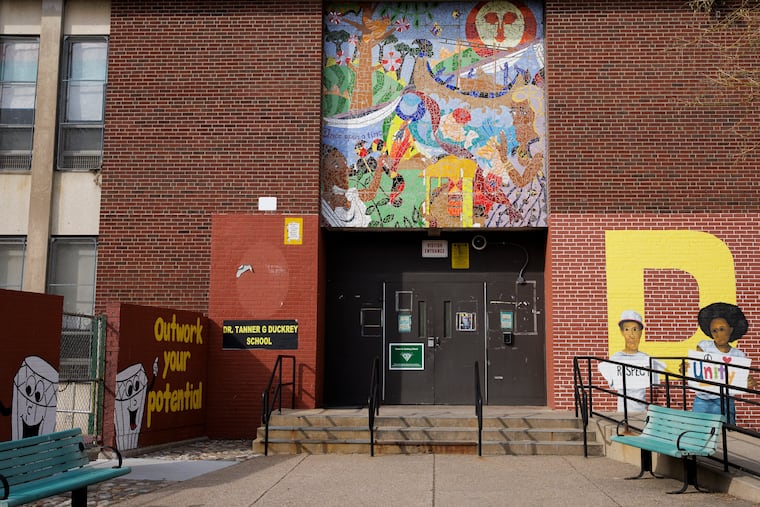
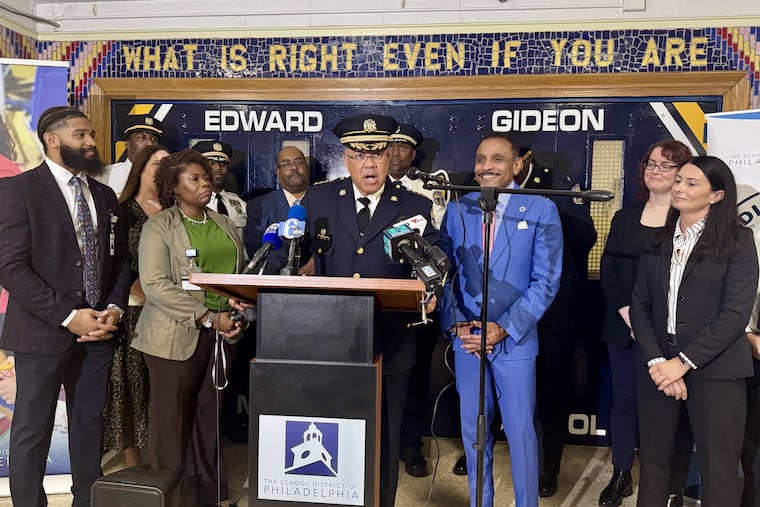
Two Philadelphia public schools will become learning labs for Temple University students — with extra resources for North Philadelphia children and families — in a collaboration formalized Thursday night.
Duckrey Elementary, near the university’s main campus, and Bethune Elementary, near its medical school, will join the new Temple Partnership Schools Network. The university has long had contact with schools near its main campus, but the network represents a significant deepening of the work.
“This is a full wrap-around relationship, and these schools will have access to all of our resources,” said John Fry, Temple’s president.
University students and professors will be embedded inside both Duckrey and Bethune, with education professors and aspiring teachers, school psychologists, counseling psychologists, and doctors all present to address learning needs and offer support for students and families who have experienced trauma.
Temple will offer a course at Duckrey in the fall, with school staff and university students able to participate. Both Duckrey and Bethune, which are K-8 schools, will get a middle school career exploration program under Temple’s auspices.
The network, according to a resolution the school board passed Thursday night, “aims to create sustainable structures that strengthen PK-12 learning, improve educator preparation and retention, and generate knowledge that informs both local practice and the broader field of urban education.”
Temple officials did not immediately have figures available for the network’s cost.
But the partnership will not mean direct funding for the district, which does receive a more than $1,000 extra per student from another university partnership model — the University of Pennsylvania’s with Penn Alexander and Lea elementaries in West Philadelphia. Penn Alexander and Lea receive that Penn funding to support their students.
As an executive vice president at the University of Pennsylvania from 1995 to 2002, Fry was instrumental in efforts to launch the Penn Alexander partnership//.
More resources as classrooms are squeezed
Temple officials said they’re aiming to emphasize place-based learning for Temple students that provides significant supports for North Philadelphia children and families.
“We’re not trying to change the neighborhood so that the neighborhood looks different in terms of who we’re serving,” said Monika Williams Shealey, dean of Temple’s College of Education and Human Development. “We’re trying to do a better job of ensuring success.”
Some have criticized Penn’s school Penn Alexander model, which has dramatically raised property values in its catchment, squeezing out some long-term lower-income residents.
That’s particularly key at a time when national and local pressures are squeezing classroom resources, Shealey said.
Shealey said she wants North Philadelphia residents to see Temple as an extension of their community. That’s not always the case now, she said.
“They see Temple as this place over here that they’ve had this relationship with — at some points it’s been really great, and others it’s been really challenging,” Shealey said.
When Shealey first met with Aliya Catanch-Bradley, Bethune’s longtime principal, Catanch-Bradley said, “‘You know, I have to sometimes remind Temple to be a good neighbor to us,’” said Shealey. “I never forgot that, and I use that as a way to make sense of what our charge is, and what our work is.”
Catanch-Bradley was recently announced as the principal on special assignment who will oversee designing and opening two new year-round schools in North Philadelphia. The K-8, which will open first, will be co-located with Bethune.
Temple will provide support on the development of the new schools, Shealey said.
From kindergarten to Temple
The network builds on the concept of “professional development schools,” a nationally-recognized model that both better prepares teachers and lifts up K-12 schools, particularly those in historically marginalized communities.
Watlington, in a statement, said he was excited for providing “an added layer of expertise” for Bethune and Duckrey students. Temple and the partnership will “further develop foundational academic skills that will enable students to graduate college and career ready; ensures educators are well-trained and further prepared for their roles of high-quality teaching and learning; and, further strengthens our partnership and engagement with parents and families in North Philadelphia.”
On the Temple side, the work dovetails with other university initiatives already in place for North Philadelphia, including the Temple Future Scholars program, which offers mentoring and college readiness preparation to seventh through 12th grade students at schools including Bethune and Duckrey, and Temple Promise, a last-dollar scholarship program for low-income city students.
The goal, Fry said, is that eventually, North Philadelphia students “from kindergarten on will have something to do with Temple, and hopefully one day, some of them will even be joining us as undergraduates or graduate students. If we do our work right, we’re going to impact the lives of all the kids who go to public school in our zip codes.”
The initial Temple Partnership Network memorandum of understanding runs through the 2027-28 school year, but Fry said he expects the effort to eventually scale up to other North Philadelphia schools.