Lower Merion parents are in a standoff with the school district over opting out of Chromebooks
About 200 parents signed a petition to opt out of receiving school-issued Chromebooks. They say kids are spending time using low-quality programs, and fear impact to cognitive development.
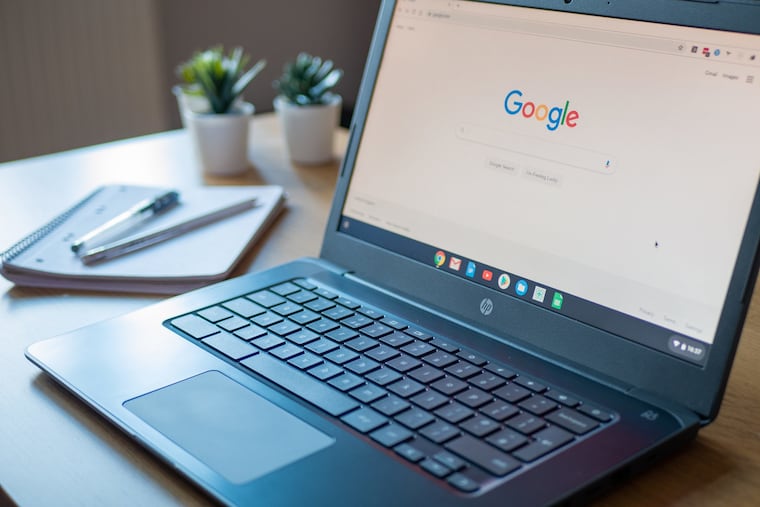
Sam Handlin doesn’t think his daughter, a second grader at Cynwyd Elementary in the Lower Merion School District, is gaining anything when she opens her school-issued Chromebook.
Handlin, who also has a ninth grader at Harriton High School, said his children made no progress through DreamBox, an online math program Lower Merion uses. Instead, Handlin said, they learned math at a private Kumon center — with pen and pencil.
“Our kids don’t learn anything when they go on these programs, and they largely just are frustrated by them,” Handlin said.
Handlin is among a growing number of parents in Lower Merion — and nationally — who do not want their schools to issue their kids electronic devices, worried that an overreliance on technology is diminishing their education.
Some parents say their kids cannot focus while having access to the internet, and they are messaging friends or playing games during class. Others, like Handlin, think kids are spending unnecessary time on programs they see as low-quality, and fear cognitive development is being impacted by excessive time on screens.
More than 200 parents have signed a petition asking Lower Merion to allow families to decline to participate in the district’s one-to-one electronic device program, according to the petition’s organizer — citing district regulations that say building principals must accommodate students who opt out.
Administrators, however, say it is not possible to opt out of having a computer. They are moving to change the district’s rules providing that option.
“We can’t have a room for 20, 30 kids that want to opt out, and the rest of the school is operating differently,” Superintendent Frank Ranelli said at a school board policy committee meeting Monday.
“Public schools are not just an open forum for whatever any kid needs that does not have an IEP,” Ranelli said, referring to individualized educational programs for students with special needs.
Megan Shafer, Lower Merion’s assistant to the superintendent for district administration, said the district’s policy dated to when it introduced one-to-one devices 15 years ago — which, Shafer noted, was “a real cause for celebration,” leveling the playing field between families who had the money to buy computers for their kids and those who did not.
If a parent did not want their kid to have a computer back then, “there was an opportunity to say, ‘Here’s how we did it a day ago,’” Shafer said. But “it’s simply not an ability we have any longer, to say there would be an equivalent experience for a child that opts out.”
Shafer said the district’s language “will need to be adjusted to reflect the current status of how we deliver curriculum and instruction in our classrooms.”
District spokesperson Amy Buckman declined to comment further on possible policy changes.
Parents are determined to stop Chromebook use
Yair Lev, a parent who started the petition, said parents won’t take no for an answer.
“We know the current situation with Chromebooks and sending them home is detrimental to our children,” Lev said. “By September, we will opt out. It’s not about if they say no. It’s happening.”
According to data provided by Lev, the petition signers come from every school in the district. Nearly 40 are from Cynwyd Elementary, where Lev has a second grader and a kindergartener. (He declined to accept an iPad for his kindergartner this year, and said his son has had “an amazing experience.”)
Lev has organized fellow second-grade parents at Cynwyd, including Jackie and Brian Mandell, who have not been impressed with the educational programs they see their girls using on their Chromebooks. “A lot of the software seems to be very dopamine-driven,” Brian Mandell said.
As the Mandells joined Lev’s efforts, Jackie Mandell decided to reach out to families of her older daughter’s third-grade classmates — thinking it would not be fair if only their younger daughter benefited from “an enhanced educational experience” without a Chromebook.
About 20 third-grade families have expressed interest in opting out, Jackie Mandell said, and “every day I get another family reaching out to me about it.”
While the Mandells are concerned about the current use of screens in their daughters’ classes — Jackie Mandell, who performs surgeries as an ophthalmologist, worries they are not getting enough practice holding pencils and developing fine motor skills — they are particularly concerned about middle school, when friends have told them the use of Chromebooks ramps up.
“I see middle school as this looming shadow in the future,” Jackie Mandell said. “We’ve got to fix this now.”
District leaders, who fielded parental criticism around technology during a meeting last month, said they hear the feedback and will seek to limit screen time in classrooms.
“We’ll work with our teachers more and more to lessen that, to make sure there’s more play time, more pen and paper,” Ranelli said Monday.
Software to monitor students’ technology use
Ranelli said the district was considering software that would allow teachers to monitor what students view on their Chromebooks during class.
He also said the district has a filtering system that parents could use to impose more filters at home on their students’ devices.
“You can have an app on your phone that can monitor what your child did that day,” Ranelli said.
Later in the meeting, Ranelli said those features were not currently available for parents, but did not say when they would be.
Some parents were not convinced by Ranelli’s assurances. “If screen time is as minimal as claimed, there should be little barrier to opting out,” Carrie Palmisano, a Cynwyd parent who wants to opt out her rising third grader and kindergartener in the fall, told board members Monday.
Palmisano said she was not opposed to kids using shared computers in their classroom, but said her son “doesn’t need his own personal Chromebook.” She voiced concern that he does not write out steps while working through math homework, because he was not used to doing so while doing math on the computer.
The district recently voted to buy iReady, a math curriculum, which would include physical books as well as a digital component. District officials say the program includes diagnostic testing that can allow teachers to identify where particular students are struggling and narrow achievement gaps.
Handlin, whose younger child also attends Cynwyd, told the board the backlash against educational technology was not going away.
In an interview, Handlin said his children had both had great teachers in Lower Merion. But he is concerned about how increasing technology use might be affecting kids; a professor of political science at Swarthmore, Handlin said he has seen students unable to analyze texts at the same level as a decade ago.
While he feels equal access to technology is critical when students are older, Handlin argued that educational technology use among young kids could create inequity if affluent parents can get tutoring to make up for what their children did not learn on a computer.
“Those without those resources are stuck with their kids learning how to count bananas on a computer, rather than learning how to do real math,” Handlin said.

Inquirer Lower Merion