Some Lower Merion parents want to ‘opt out’ of Chromebooks in classrooms. The district says they can’t.
Some Lower Merion parents complain that Chromebooks are used for cheating with AI, playing games, and accessing inappropriate content.
At home, Pooja Garg’s children don’t have phones or tablets. She monitors what they watch on Netflix.
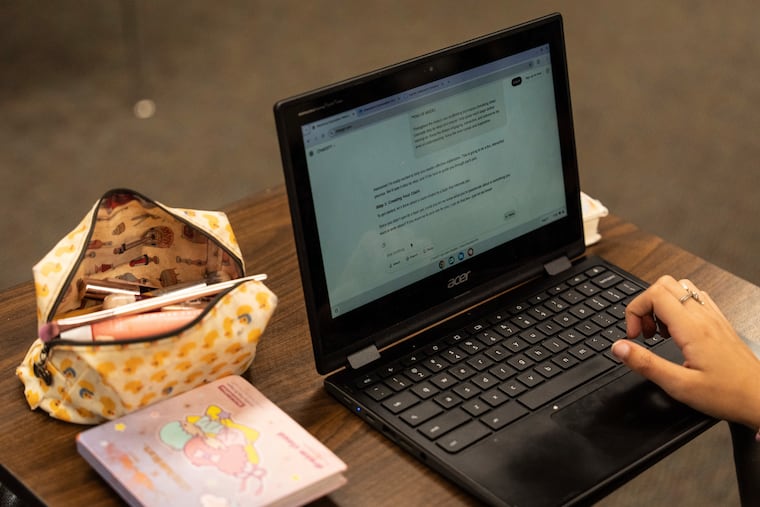
But when her sixth grader goes to school in the Lower Merion School District, “he’s gaming all the time,” Garg said — on a school-issued Chromebook. When Garg has volunteered during indoor recess, kids are playing on computers.
“They’re not thinking critically,” Garg said. “They’re on their laptops.”
Garg was among dozens of Lower Merion parents, and some students, who voiced their frustrations with the district’s use of technology at a community meeting Monday at Harriton High School.
The meeting came amid a mounting parental backlash to technology in schools that has been playing out in communities across the region, and country.
“We’re hearing from parents constantly on this issue,” said Alex Bird Becker, a Wallingford-Swarthmore parent who is co-lead of PA Unplugged, a group pushing back on devices in schools.
As states have increasingly barred cellphones in schools — Gov. Josh Shapiro has called on lawmakers to pass a bell-to-bell ban in Pennsylvania — Becker said many parents see phone bans as a “foregone conclusion” and have turned their attention to what they consider a more pervasive problem: laptops.
“How am I supposed to have my child learn, if they have this distracting device on their desk at all times?” Becker said.
Laptops have become part of the fabric of the school day in Lower Merion and other districts around the Philadelphia region — used for everything from learning programs to digital textbooks. One parent at the Lower Merion meeting said her child had to open a laptop to request a bathroom pass.
» READ MORE: Suburban parents say they’ve been sucked into smartphone ‘whirlpool.’ Now, they want the devices out of schools.
Some of the technology usage in schools has ramped up since the pandemic, when there was a push to ensure every child had a school-issued device to complete virtual instruction.
Those devices were the topic of most of the concerns confronting Lower Merion Superintendent Frank Ranelli and a panel of 22 administrators, board members, teachers, and students Monday. Parents raised alarm about the ways in which screens and technology had become increasingly present during the school day.
Ranelli told the crowd the meeting wasn’t intended to be confrontational. “We’re all on the same team,” he told parents.
But not all parents saw it that way — accusing the district of taking a misguided approach that was weakening the quality of education.
Eleanor Stanford, a parent of two Lower Merion graduates and an 11th grader, said her youngest son has to read fewer books in school than his siblings did, and “the amount of writing they have to do almost doesn’t exist.”
When kids do write, “they’re using AI,” said Stanford, who teaches writing at Bryn Mawr College. “We’re preparing them to be servants to AI.” She said the district’s focus should be on teaching students how to think, rather than using technology, which she argued they would learn intuitively.
“We are a district that has so much money and so many resources. We can do whatever we want and still get the highest test scores. Why don’t we do something that’s actually innovative?” Stanford said, drawing applause.
Lower Merion doesn’t have a full ban on cell phones; the district’s “Off and Away” rules call for students to store their phones during classes, but allow high school students to use phones at lunch.
Some parents complained Monday that the phone rules were inconsistently enforced, or not at all — pressing Lower Merion to not wait for the state to enact a ban.
An effort to opt out of Chromebooks
Scott Weinstein, assistant superintendent, said there were “pendulum shifts” in education, and that schools “probably went too far” in adopting new technology.
Now, “we’re trying to strike the right balance,” Weinstein said. “What we don’t want to do ... is overcorrect and get rid of it completely.”
Several administrators and teachers spoke about the value of technology. Ashley Rosenbaum, a kindergarten teacher at Merion Elementary, said iPads allow her to provide differentiated instruction to entering kindergarteners, some of whom have never been in school before, while others know their letters and can write their names.
“The iPads are used very sparingly,” said Rosenbaum, who is also a district parent. “I send my son to school and I trust his teachers. I teach children because I love children. I want to work with them — I don’t want their faces in an iPad.”
Numerous parents, however, voiced skepticism of the district’s educational technology products, and asked about opting out of using Chromebooks.
Yair Lev, a parent of a second grader at Cynwyd Elementary who has been organizing webinars with advocates against technology in schools — including an upcoming talk with neuroscientist Jared Cooney Horvath, author of The Digital Delusion — said that educational technology companies had been pushing products with unproven results.
Lev said 20 families from his child’s grade were planning to opt out of using Chromebooks next year — and “opt in to traditional education,” relying on pen and paper.
Ranelli told parents they could not opt out. “You’re basically opting out of our curriculum,” he said. “That’s not the plan, though 20 families might want that.”
Subashini Subramanian, another parent of a Cynwyd second grader, said she wanted to see how her daughter fared without a Chromebook for a year, to see if her academics suffered without using it.
“Basic foundation has to be learned with pen and paper, someone teaching you,” said Subramanian, who voiced concern with online reading and math programs her daughter’s school uses for about 20 minutes a day.
Subramanian said she had heard reports of middle schoolers on Chromebooks for four to five hours a day, “and I’m scared.”
Ranelli said the district looks at “how long kids are online a day,” but didn’t share any figures.
Inappropriate content and cheating on Chromebooks
Beyond the opt-out requests, parents questioned why students were able to access inappropriate content on their Chromebooks. One mother said her son reported that kids were playing a game called Five Nights at Epstein‘s, in which players are on an island with financier and convicted sex offender Jeffrey Epstein.
Earlier in the meeting, the district’s director of information technology and cybersecurity, Robert Catalano, said the district was “constantly updating” its filters to block access to games, though “at times, it’s like Whack-a-Mole.”
Others, including students, warned of pervasive cheating with AI tools. “Sometimes I feel like I’m in the minority, because I actually do my homework, instead of like, a robot doing it,” said Rosalie Chinen, a seventh grader at Bala Cynwyd Middle School.
As parents and students spoke, Ranelli said their opinions weren’t necessarily representative. Of about 13,000 parents in the district, “there might be 150 here,” he said.
He also said that kids’ addiction to social media and screens wasn’t caused by schools.
But he and board members said they were committed to hearing the concerns.
Anna Shurak, one of the board members, said the board couldn’t commit to specific changes because “we have to know all the issues.”
But “I’ve been shocked by many of the things that were shared here,” Shurak said.

Inquirer Lower Merion