Penn’s engineering school says it can’t count on federal research funding, so it’s trying to raise $200 million on its own
The Trump administration has threatened research funding at universities and "is no longer a reliable partner," said the Penn engineering school dean. The school hopes to raise money over five years.
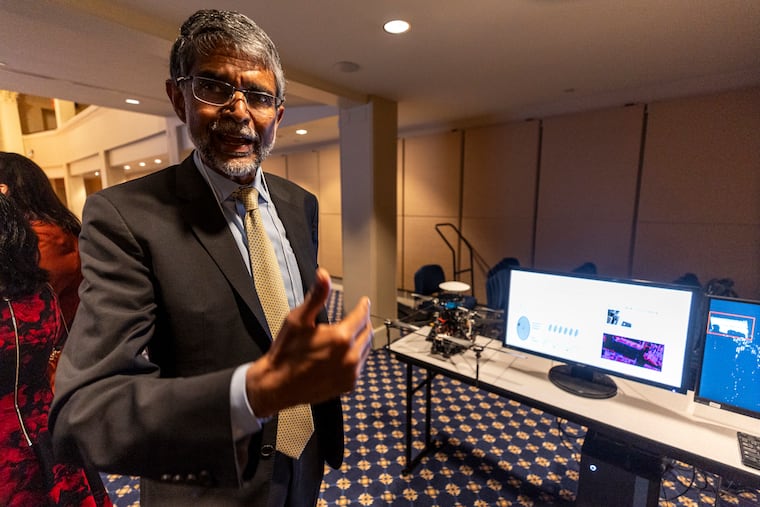
With continued uncertainty about federal research funding, the University of Pennsylvania’s engineering school on Friday launched a $200 million fund to finance innovative projects at their earliest stages.
The initial fund will support research and educational advances at the School of Engineering and Applied Science over the next five years, the school said.
“The federal government is no longer a reliable partner,” said Vijay Kumar, Penn’s engineering school dean. “And what we’d like to do is to make sure that we can establish partnerships on which our faculty can rely on, going into the future. And that’s through philanthropy.”
It is the largest such venture ever launched by the engineering school and comes as President Donald Trump’s administration continues to threaten research funding at the nation’s universities. Penn earlier this year directed its schools and centers to cut 4% from certain expenses in the next fiscal year while keeping in place earlier reductions made in response to Trump administration’s policies and ongoing threats to federal funding.
The new fund is not designed to replace lost federal funding, Kumar said. Penn traditionally has received about $1 billion in federal research funding annually.
But he said it can fund early-stage research and back research areas the Trump administration may not support, such as climate change and vaccinations.
» READ MORE: Penn says its finances are stronger than anticipated. More budget cuts are still coming.
The fund already has $30 million in pledges from high-profile donors, including engineering board of advisers chair Robert M. Stavis, a partner at Bessemer Venture Partners, and his wife, Amy; JPMorgan senior adviser Rohan Amin, his wife, Sejal Amin, and their family; and Goldman Sachs & Co. managing director Ryan Limaye and his wife, Grace.
“Early-stage research dollars are the hardest to find and the highest in impact,” Stavis said in a statement. “At a time when federal and institutional funding is becoming more constrained, the Futures Fund steps in at exactly the right moment — seed capital that unlocks game-changing innovation before anyone else is willing to fund it.”
The Trump administration last year temporarily paused $175 million in funding to Penn over allowing a trans athlete to participate in women’s swimming. Penn stood to lose about $250 million if Trump’s indirect cost reimbursement from the National Institutes of Health, currently the subject of litigation, had been allowed to proceed. An appeals court blocked the effort in January.
‘A wake-up call’ on research funding
Kumar said Trump’s targeting of research funding last year was “a wake-up call.”
“It just showed how overly reliant we are on federal policymaking,” he said.
The idea for the fund came in September and since then has been in development until its launch this week, Kumar said.
Relying on federal funding alone poses several problems, including that it only allows a university to go after money for projects the government supports at that time, he said.
“We have faculty we’ve recruited to target important problems in climate change,” he said. “Well, climate change is not necessarily a term that is accepted, at least universally, in the federal government.”
Work on MRNA vaccines to cure cancer are another example, he said.
“We don’t want any hang-ups about the vaccine to get in the way of development of this technology,” he said.
Also, good ideas take time to build traction if they are unconventional or interdisciplinary, but they still need funding, he said.
“It’s a fund to ensure that we continue to do the high- priority, high social-impact work that we know our engineers can perform,” he said.
Targeted areas of focus
Penn engineering outlined three specific areas for funding: human health, sustainable infrastructure, and physical intelligence.
“Penn Engineers are advancing biomedical devices, gene and cell therapies, computational biology and AI-driven drug discovery, helping to translate fundamental discoveries into real-world medical breakthroughs,” the school said in a news release.
The infrastructure piece includes “clean energy, carbon management, sustainable materials, climate-resilient infrastructure and large-scale systems that support growing populations while reducing environmental impact,” the school said.
And the physical intelligence includes robotics, artificial intelligence, advanced computing, and machine perception, the school said.
The fund, which will be supported by alumni and industry leaders, also will help finance new approaches to teaching and learning, including helping faculty to integrate artificial intelligence into classrooms, the school said.
The fund will be ongoing with the goal of raising $40 million a year for five years, Kumar said. Other major donors include Ivette and Alan Atkinson, the chief business development officer at Commvault; Lee and Alex Krueger, chairman of private equity firm First Reserve; and former Tesla executive Robin Ren and philanthropist Linda Ye.
“Over time, we want the returns from this fund to manifest itself in terms of new intellectual property that could be licensed, new industry collaborations, new startups, and all of those will yield revenues, part of which we could use to replenish the fund,” Kumar said.