Penn State board awards president top performance bonus
“It’s clear that stability in leadership is very important right now in a higher education space,” the board chair said.
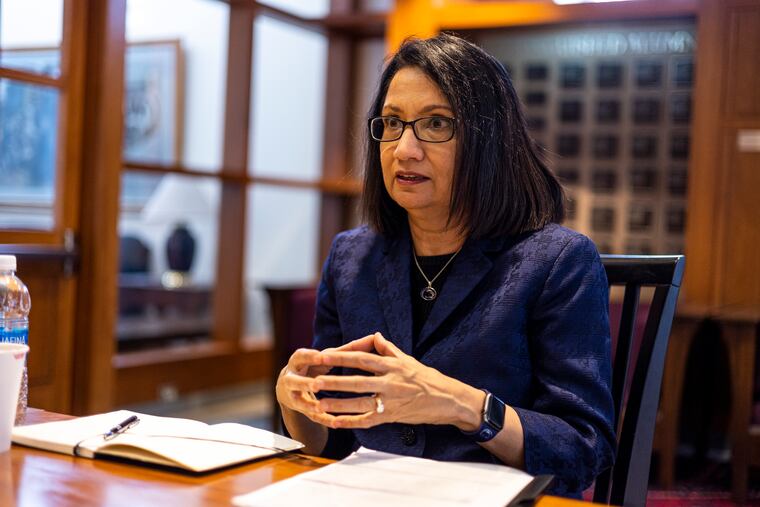
The Pennsylvania State University board of trustees on Friday unanimously approved a 15% performance bonus for president Neeli Bendapudi for the 2025-26 academic year — the top amount available under her new contract approved last September.
Under the resolution, the percentage is on her base salary, which was $1.4 million. That would make her bonus $210,000.
Board chair David M. Kleppinger praised Bendapudi’s leadership, noting the second consecutive year of a balanced budget, a $1.44 billion research enterprise, the integration of the health system and College of Medicine, and efforts to improve the Commonwealth campus system — seven campuses are set to close at the end of the next academic year.
» READ MORE: Penn State board approves $1 million compensation hike for president
“Throughout all this, Neeli, you’ve led with optimism, with purpose, and an unwavering commitment to Penn State’s mission,” Kleppinger said at the meeting. “You’ve challenged the university to think boldly, and we’ve tried … We’re proud of what we’ve done under your leadership and we’re excited about what lies ahead.”
Bendapudi oversees two dozen campuses across Pennsylvania including a health system and the Hershey Medical Center and a major research enterprise. The state flagship university enrolls 86,500 students.
She is one of the highest paid public college presidents in the country. In 2024, she ranked seventh in total compensation among public university presidents, according to The Chronicle of Higher Education. Schools with presidents who earned more included the University of Houston, Ohio State University, and University of Kentucky.
The board last September voted to give Bendapudi, who has led Penn State since 2022, a $1 million increase in compensation and extend her contract to 2032. That increased her total compensation for 2025-26 to $2.8 million, up from $1.8 million. The performance-based incentive, which allows the board to award Bendapudi up to 15% of her base salary if she meets mutually agreed upon goals, was part of the new contract.
In supporting the vote, board member Jay Paterno noted the short tenure of presidents in the Big Ten Conference.
“Retention of presidents is vital,” he said. “It’s important that we understand the marketplace that we are in and why these things are meaningful and important to do … We’re fortunate that we have a president who’s been here for four years already because that’s not the norm.”
Kleppinger agreed.
“It’s clear that stability in leadership is very important right now in a higher education space, which is changing rapidly, and we’re fortunate to have a president that’s committed to being with us for the long term,” he said.
The board also voted to accept Bendapudi’s performance goals for the coming year, but those were not made public.
Also at the meeting, the board approved tuition and room and board increases for 2027-28. The finance committee approved the rates on Thursday and recommended them to the full board. Penn State sets its rates a year in advance.
Among the rates approved was a 2.5% tuition and room and board increase for undergraduates on the University Park campus.
Under the plan, undergraduate freshmen and sophomores at University Park would pay $21,400 in annual tuition for 2027-28, up $522 over last year. Room and board would rise 2.5% to $15,896 annually.
During remarks, Bendapudi said the university raised $662.7 million in 2025-26, more than the average annual amount of $360 million raised in the last fundraising campaign.
“That I would say is a wonderful commitment,” Bendapudi told the board.
Penn State had been planning to publicly launch a multibillion-dollar fundraising campaign in April, its largest ever and first under Bendapudi. But the school decided to delay that public launch amid a change in leadership in its development office.
No new date has been given for the launch.