Philly’s teachers union says it’s coming up with an alternative to closing 17 schools
The Philadelphia Federation of Teachers said there’s not enough data to support shutting a single city school.
The Philadelphia Federation of Teachers said there are not enough data to support shutting a single Philadelphia school, and union leaders said Tuesday they would soon propose an alternative to a now-adopted facilities plan that would close 17 schools and renovate 169.
The PFT’s school-by-school analysis — a precursor to a counterproposal it says it will complete and release imminently — pokes holes in the district’s rationale for all 17 closures and says those decisions have not been adequately explained.
“The plan that the district came up with is inherently a flawed plan,” PFT president Arthur Steinberg said. “It’s a half plan at best.”
Steinberg, flanked by a clutch of state and local politicians who have previously threatened to halt closures via methods that include blocking district funding, presented the analysis at a news conference at Overbrook Elementary, one of the 17 schools the school board voted April 30 to close. There was no time frame given on when the closure alternative will be released.
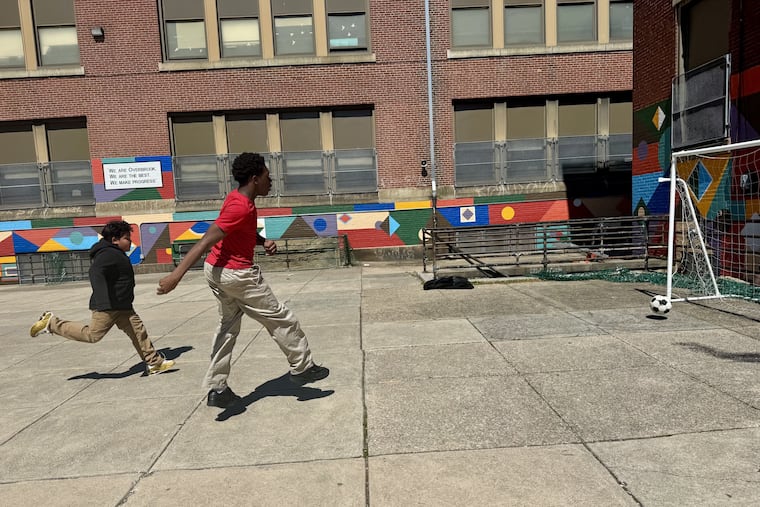
The union and political leaders spoke on Tuesday as families walked to pick up their young children and a group of students participated in the school running club. They gathered in the school’s garden, adjacent to the schoolyard in which the Trust for Public Land has already invested $100,000 to transform.
That playground project is now on hold, a Trust for Public Land official has said, amid the uncertainty around the school’s future. The board has said it wants to close Overbrook and disperse its students to four separate schools in 2027 and, by 2029, renovate and reuse the space as district offices.
School system officials have said they must close schools both to improve academics and extracurricular offerings citywide — the district now has about 70,000 empty seats — and because the underfunded district cannot afford to maintain its current building footprint.
While Overbrook, at 62nd Street and Lebanon Avenue, is a small school, with just 215 students, it is using about 85% of its building, a decent score by the district’s own measure. Attendance-wise and academically, it outperforms some of the schools set to receive its students.
“The PFT believes the district’s plan to close Overbrook Elementary School is not adequately justified on the current public record and should not move forward as written,” the PFT’s analysis says. “From a practical perspective, Overbrook appears to be a candidate for an ‘improve and keep’ strategy supported by stronger maintenance and operations, improved cleaning and response systems, and targeted modernization of critical systems.”
To justify the closures, Steinberg said, the PFT wants much more granular detail than what the district has released publicly. Both Steinberg and Jerry Roseman, the union’s environmental sciences director, have asked for the data but have been stonewalled, they said.
According to district data released more than a decade ago, it would cost $5.3 million to complete all essential repairs at Overbrook, and $9.3 million to complete all repairs. That’s “relatively modest in real dollars compared to some of the receiving school needs,” the union’s analysis said.
‘We can’t get a couple million dollars to fix this building?’
The facilities plan as adopted by the board calls for $3 billion in fixes, including the modernization projects, but much of that money is not promised — it would have to come from state or philanthropic sources.
School officials have indicated that closing schools would help justify the district’s case for more money to Harrisburg Republicans, many of whom are skeptical of the need for more money for the district.
Neither Steinberg or Roseman would say whether they believed any closing was justified.
But, Steinberg said, “we believe we have come up with a way that is financially viable, and we’ll be presenting a more detailed plan when we finish all the analysis.”
Roseman, who has a deep historical knowledge of district buildings, said there could be “some information that may support closing some schools, but not here” at Overbrook.
That was welcome news to the dozens of Overbrook parents, students, staff, and community members who sat in folding chairs in the school garden.
Debra Joell, a longtime Overbrook teacher, has worked elsewhere but cherishes Overbrook’s small-school feel: “Music in the hallways, children laughing, smiling — laughing with joy and confidence,” she said. “Isn’t that what the school district promotes? Isn’t that what the school district advertises? Isn’t that what the school district promises?”
Joell said she was furious about the idea of millions being spent on celebrating the country’s 250th birthday and the World Cup.
“But we can’t get a couple million dollars to fix this building?” Joell asked. “Are you kidding me? Spending money on FIFA and spending money on every other thing, but throwing our citizens into the trash?”
‘We will not stand for it’
The elected officials on hand repeated claims they made at the extraordinarily heated meeting when the board voted to close schools, saying they would continue to push to prevent closures from happening.
Councilmember Jamie Gauthier said it didn’t matter that the vote had already happened.
“That is decisions being made for our neighborhoods without our neighborhoods, and we will not stand for it,” Gauthier said.
Councilmember Isaiah Thomas, who was not present at Overbrook, has said he will sue the district over the closures. He also introduced legislation calling for hearings about potentially exploring an elected school board.
And Councilmember Curtis Jones Jr., who represents Overbrook, said Tuesday that he and others will block Mayor Cherelle L. Parker’s proposed rideshare tax, designed to raise funds to prevent the district from cutting 340 classroom positions.
“It ain’t over until the budget is passed,” Jones said. “It ain’t over until that $50 million they want to get from rideshare is appropriated.”
Asked to comment on the PFT’s contention that the closings are not justified, the school board said in a statement that it “appreciates the continued engagement, and we know that facilities are not separate from academic outcomes — they are foundational to them.”
The plan, the board said, is about more than buildings and “allows us to invest more deeply in the schools our students attend, providing modern, high-quality environments that support both teaching and learning.”
The board on April 30 passed a resolution beginning the closure process; under state code, each school that closes must have its own closure hearing. Those have not been scheduled.