The Philly school board voted to close 17 schools, and Council made big threats. What’s next?
The Philadelphia school board vote on Thursday raised more questions about how funding would be secured and if City Council would retaliate.
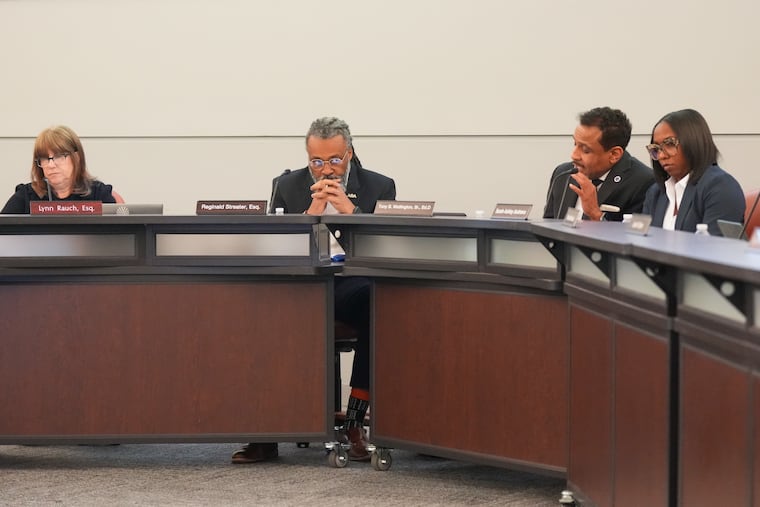
The extraordinary showdown at Thursday’s Philadelphia school board meeting — in which members voted to close 17 schools and renovate 169 others despite being protested by lawmakers and students — laid bare a major rift between City Council and the school district and prompted numerous questions for city leaders.
Topping the list: What will the board’s vote mean for Mayor Cherelle L. Parker’s plan to help plug the district’s budget deficit with a $1-per-ride tax on services like Uber and Lyft?
Councilmember Jamie Gauthier, one of the lawmakers who shouted down the school board during the contentious meeting, said Friday that the board’s decision made voting for the rideshare tax more difficult for her.
“I’m not fully decided, but I would say they made it harder,” Gauthier said in an interview, “because I don’t understand how we as Council members go to the community and tell them that we’re going to make all of their trips more expensive while we’re shutting their schools in their faces.”
But Council President Kenyatta Johnson, who had previously indicated he was willing to use the tax as leverage to force the board to delay or amend its facilities plan, on Thursday opened the door for the tax to move forward despite the board’s decision.
Adopting Superintendent Tony B. Watlington Sr.’s facilities plan answered one question — would school officials bow to the enormous pressure being applied by city and state lawmakers?
Watlington made some tweaks to his plan, but the board ultimately declined to bend more. The board did not remove Lankenau High, Robeson High and Overbrook Elementary from the closure list, despite Council threatening to withhold funding from the district, sue the school board, and refuse to reappoint any board members who voted yes to approve the plan.
But the plan’s adoption raised more questions: Can the district secure $2 billion in new state and philanthropic funding to pay for it? Will Council follow through on its threats to the school board? Where’s Parker, champion of a united Philadelphia, on all this?
A living plan
Watlington’s plan has been adopted. But it doesn’t technically close a single school, nor is it meant to.
The board adopted a resolution underscoring they wanted a “living plan, based on currently available data and reasonable assumptions regarding enrollment trends, population movement, programming needs, and fiscal conditions, which will evolve based on factors over which the board and district possess and/or lack control.”
That is: Things could change.
Up next is the establishment of a transition office that will support schools undergoing changes — closures, absorbing students, colocating, or growing grades. Watlington has promised “white-glove treatment” for impacted schools and communities, and the office will report directly to him, but it’s not clear what form it will take or what its budget will be.
The office is charged with handling academic continuity, staffing, transportation, student services, timelines, safety planning “and ways to recognize legacy considerations for closing schools,” as per the board resolution.
No closures or changes are to happen in the 2026-27 school year — the district is going straight into a planning year. It has vowed to come up with schedules for the proposed changes and must abide by schedules set forth by the Pennsylvania Department of Education to hold legal hearings on the closures.
Watlington has been tasked with keeping up “meaningful citywide engagement” throughout the plan’s implementation.
The board has said it will be watching closely; it expects reporting on measurable indicators such as transportation, safety and access to advanced coursework.
Will Council punish the school district?
The image of Council members shouting down a school board meeting will not soon be forgotten.
“I was ready to cry yesterday,” Councilmember Isaiah Thomas, one of the most vocal participants in the showdown, said in an interview Friday. “This is a moment I’m never going to forget.”
But now what?
In the lead-up to Thursday’s vote, some Council members threatened to vote against a Parker proposal to create a new $1-per-ride tax on services like Uber and Lyft, which would drive about $50 million per year to the district if the board approved the plan.
Although they are ostensibly separate issues — the facilities plan affects the long-term capital budget, while the rideshare tax was meant to plug a year-to-year operational funding deficit — several Council members said they viewed the issues as linked in an effort to pressure the school board to save school buildings like Lankenau and Robeson.
It’s unclear whether Council will follow through on the threat now that the facilities plan is approved, removing lawmakers’ leverage over the process.
Johnson previously indicated that he was treating the tax and facilities plan votes as connected issues. But when asked shortly before the school board vote if a yes on the facilities plan would mean a no on the rideshare tax, he said both could be considered separately.
“The budget process isn’t done until June, and so we’re still working amongst ourselves,” Johnson said Thursday. “Those two conversations are totally separate at the moment.”
Thomas said that, for him, the issues were never linked.
“I think each individual member is going to make their own decision on that,” he said Friday. “I never conflated the facilities plan with the tax.”
That doesn’t necessarily mean Thomas will be voting for the tax.
“We need to continue to examine it and look at every possible option before we ask Philadelphians” to pay a new tax, he said. “I haven’t made a definitive decision.”
All 17 Council members are on the ballot next year, and they are very aware that voting for a new tax in the run-up to a municipal election is bad politics. But voting against a proposal that could save 340 school-based positions could also be dangerous, as public education advocates are sure to let voters know who opposed throwing the district a lifeline.
Thomas said he’s not worried about that prospect.
“That narrative that we’re voting against kids — that’s not going to work," he said. “I have a track record of fighting for funding for public education that can’t be disputed by the current moment, and that includes last year’s budget, the year before that, and ever since I became the chair of the Education Committee.”
Mayor Parker largely stays mum
Despite the mayor’s proposed rideshare tax now being in jeopardy, Parker has said nothing about the school closure vote since it took place.
She spent much of the day Thursday wooing Democratic National Committee Chair Ken Martin, who was in town for a site visit because the party is considering holding its 2028 convention in Philadelphia.
During a media event Thursday afternoon, Parker declined to comment on what was then an impending vote by the school board, saying she wanted to focus on the city’s bid for the DNC.
On Thursday night after the board meeting, Parker hosted a party at the Museum of the American Revolution for Martin, his advisers, and dozens of political supporters. It featured performances from West Philadelphia’s own DJ Jazzy Jeff and the musical group Sister Sledge.
Joe Grace, a spokesperson for Parker, again declined to comment on Friday.
Parker’s silence stands in sharp contrast to the lawmakers in Council. And it is something of a surprise for the mayor, who appointed the school board members and has largely been in lockstep with Watlington as he lobbied Council for support.
Last month, Parker delivered an impassioned 75-minute speech in Council’s chambers, imploring members to support her proposed rideshare tax and making the case for closing schools. She said the city must generate new, recurring revenue and make tough decisions on spending to show lawmakers in Harrisburg that Philadelphia is doing its part as officials ask for more state support.
“Right now, we are maintaining square footage as it crumbles, instead of investing in opportunities our students actually need,” Parker said on April 22 during a biannual address to Council. “Yes, this means making difficult but responsible decisions, and that’s what the district has worked through.”
School closures can be politically unpopular.
In 2012, former Mayor Michael Nutter faced significant blowback for backing the district’s plan to shutter two dozen schools with low enrollment.
Protesters jeered outside Nutter’s City Hall office, and the teachers union funded an ad campaign criticizing him. At the time, Nutter was in his second four-year term, and Philadelphia mayors are limited to two.
Parker is a first-term mayor who will be up for reelection next year.
Will the district’s belt-tightening lead to more state funding?
Proponents of the district’s plans to simultaneously eliminate its budget deficit and consolidate facilities have said the belt-tightening measures could help curry favor with Republicans who control the state Senate and are vital to unlocking additional funding for education.
Philadelphia is the only district in Pennsylvania that is prohibited from raising its own revenue, leaving the city’s schools dependent on Council and Harrisburg. GOP lawmakers in the Capitol regularly cite alleged mismanagement by the district when shooting down plans to boost funding.
That may be changing. Senate President Pro Tempore Kim Ward on Friday indicated that the school board’s vote may have improved the district’s image in GOP circles.
“Accountability & fiscal responsibility are important for positive student outcomes in PA,” Ward posted on X, linking to an article about the school board vote. “Glad to see @PhiladelphiaGov & @PHLSchools recognize the need for reform. Optimistic decision-makers can work w/ us to ensure Philadelphia students are set up for success.”