Philadelphia school board votes to close 17 schools
The vote to implement the facilities proposal capped a tumultuous day during which several Council members made their displeasure clear.
The Philadelphia school board Thursday night adopted a sweeping $3 billion facilities plan that would close 17 schools and renovate 169 over the next decade, reshaping the system for years to come.
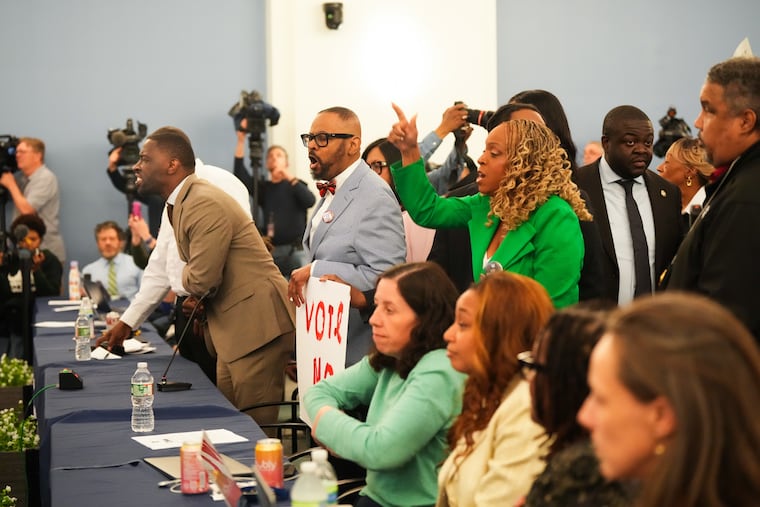
The vote came amid intense opposition and over the objections of hundreds of students, parents, and teachers who begged the board to spare their schools. And it happened at an extraordinarily charged meeting that a majority of City Council shut down twice, exposing a schism between the school district and one of its main funders.
With police and school security officers hemming them in, several Council members stood as close to the board as they could, shouting their displeasure as board president Reginald Streater demanded order. Ultimately, the board took its vote remotely, in a locked room, as some audience members remained in the auditorium to see the meeting streamed via Zoom.
Now in line to shut permanently are: Blankenburg, Fitler, Morris, Overbrook, Pennypacker, Welsh, and Waring elementary schools; AMY Northwest, Harding, Stetson, Tilden, and Wagner middle schools; and Lankenau, Parkway Northwest, Parkway West, Penn Treaty, and Robeson high schools.
The vote was 6-3 to pass the plan, with members Crystal Cubbage, Wanda Novalés, and Whitney Jones voting against it.
Cubbage said she believes the plan, which relies on $2 billion from yet-unsecured state and philanthropic sources, “is not financially viable.” Nor is it bold enough, Cubbage said.

Wholesale changes are coming to the Philadelphia School District, with the school board passing a $3 billion facilties plan that aims to close 17 schools permanently, and renovate 169.
Superintendent Tony B. Watlington Sr. presented the plan to the school board Feb. 26 and it immediately faced strong opposition. After some amendments, the board passed the plan April 30. Here's what we do and don't know about it.
And to see the proposed list school closures and check how your school could be impacted, use our interactive charts.
Each of the schools proposed for closure has its own story. Find them all here.
Streater said adopting the plan was painful but necessary.
“We cannot continue doing the same things and expect different results,” Streater said. “If we are serious about improving student outcomes, we must be willing to disrupt the status quo — and that starts with adults making different choices and taking new approaches.”
Streater said he heard the public pleas, but “we cannot fully modernize every building, ignore enrollment shifts, or postpone action anymore. We must call the question today before financial instability forces the hands of all of us in this room.”
‘We will fight them until the bitter end’
The meeting capped a wild day that began with City Council members promising civil disobedience and legal action if the board did not remove some schools from the closing list. Members were particularly outraged about the closures of Lankenau and Robeson High Schools and Overbrook Elementary.
“We will fight them until the bitter end,” Councilmember Isaiah Thomas, one of 11 Council members who attended the meeting, shouted at the board. “If they vote for it, not only are we calling for their resignations, we are committed to suing them if they want.”
A visibly furious Thomas personally challenged Streater and shouted “you’re done!” as board members left the room.
Councilmember Jamie Gauthier, who made a strong stand against the closure of Paul Robeson High, said Council was not going to sit by quietly while the board approved the plan.
“Dr. Watlington comes from North Carolina. We come from right here, and we’re going to be here, right? So we’re not going to allow him and the board to make decisions that are going to destroy our neighborhoods and be bad for our children,” Gauthier said.
Councilmember Curtis Jones Jr. said the school board vote will kill Mayor Cherelle L. Parker’s proposed $1-per-trip rideshare tax, which she proposed to close a $300 million district budget gap. The district had said the facilities plan and the rideshare tax were not connected, but Council dismissed that notion.
“It ain’t gonna happen,” Jones said. “They had nine votes before. I think they might have three — that’s being optimistic.”
‘A living plan’
Though the board approved Watlington’s plan Thursday night, it is by no means the final word.
Accelerating Opportunity, the district’s name for the facilities blueprint, is a “living plan,” the board resolution said, “based on currently available data and reasonable assumptions regarding enrollment trends, population movement, programming needs, and fiscal conditions, which will evolve based on factors over which the board and the district possess and/or lack control.”
The board, it said, “retains the authority to require modification of sequencing, timing, scope, and prioritization of recommendations determined to be necessary after consultation with the superintendent.”
Moreover, school closings call for specific hearings and processes under the Pennsylvania school code, and all of those must happen before any school can close.
No schools would shut until 2027 under the plan.
A ‘watershed moment’
The vote was necessary, district officials say, as the nation’s eighth-largest school system confronts 70,000 empty seats and a huge stable of aging buildings it struggles to maintain.
It also has significant academic concerns. Though the district has made some progress, just 33% of students meet state standards in reading and 25% in math.
“The reason is we cannot drive faster improvement and at the same time support really small high schools,” Watlington has said. “It is just inevitable that we’ve got to reallocate some of our resources.”
Closing schools will allow the district to bolster academics and extracurriculars in the schools that stay open, officials say. They have promised that if the plan passes, the district will be able to provide access to algebra for all eighth graders, offer more prekindergarten, expand career and technical education programs, and add AP courses at neighborhood high schools.
The plan will also boost building utilization, now at 65% systemwide, and eliminate all schools in poor or unsatisfactory building condition over 10 years.
But there is a large question mark appended to the plan. The district will put up $1 billion of the $3 billion price tag itself through capital borrowing, but is banking on $2 billion from the state or philanthropic sources.
Watlington has called passing the facilities plan a “watershed moment” for the district.
The plan has been years in the making; though City Council criticized the district and school board in recent months for rushing its public process and keeping too much of its data under wraps, Council members had been among the loudest voices calling for the district to produce a plan for its large stock of aging buildings.
Multiple versions of the plan have been presented to the public since its introduction in January: The first iteration had 20 school closures, six colocations, and 159 modernizations.
First, Conwell Middle School and Motivation High came off the closure list. Then Ludlow Elementary was removed last week, and 10 modernization projects were added. No further changes came Thursday, despite pleas from City Council and the public.