Mayor Parker appeals to City Council to step up to stave off Philly classroom cuts, makes a case for school closings
"Right now, we are maintaining square footage as it crumbles, instead of investing in opportunities our students actually need," Mayor Cherelle Parker said in a passionate lengthy speech to Council.
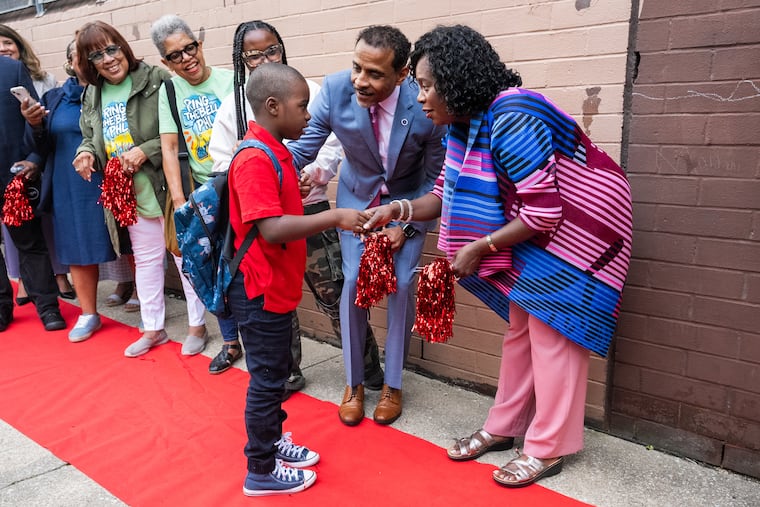
Mayor Cherelle L. Parker on Wednesday made her best case for public schools, urging a skeptical City Council to rally behind her proposed rideshare tax and to understand why some schools must close.
The extraordinary, 75-minute speech came after several City Council members threatened to hold up Philadelphia School District funding if the board continues with plans to close certain schools, including Lankenau High School.
In surrounding suburban counties, and elsewhere in Pennsylvania, Parker noted, if school systems need money to fix buildings, buy books or hire teachers, their boards raise the money themselves. In Philadelphia, the school board lacks that option.
“It’s this legislative body, not that school board, that has the power to generate the revenue that the School District of Philadelphia needs,” Parker said. “We’re not like the other school districts in our region. We have to work together in order to get it done, and I want us to figure out a way to get to yes.”
The state contributes about half of the district’s funding. But a landmark 2023 Commonwealth Court decision certified that Pennsylvania fails to meet its obligation to fund low-wealth districts like Philadelphia, which is underfunded by more than $1 billion annually, according to a state analysis.
Council members have made clear that though the district is insisting the rideshare tax and Superintendent Tony B. Watlington Sr.’s $3 billion facilities plan — which would close 17 schools and modernize 169 — are unrelated, separating them is impossible.
Though closings are painful, Parker said, they are a must. And if Philadelphia wants to get more funding from the state, she said, the city must show that it’s made tough decisions and has put up extra funding, too.
“Mr. President, I know we’re not trying to build the education system for the past — we’re working on our children’s future,” the mayor said, speaking to City Council President Kenyatta Johnson at the district’s annual budget hearing. “Right now, we are maintaining square footage as it crumbles, instead of investing in opportunities our students actually need. Yes, this means making difficult but responsible decisions and that’s what the district has worked through.”
In the past, Parker said, when the district faced financial crises, the city stepped up with new, recurring revenue.
As the district faces a $300 million structural deficit and classroom cuts that would mean the loss of 340 teachers, counselors, and climate staff, it’s time to step up again, Parker said.
“This legislative body and the executive branch, we have always risen to the occasion,” Parker said.
The mayor ended her speech by calling each council member by name.
“I can’t do it without you,” Parker said. “Humbly, humbly, I say to each of you, I’m asking you, whatever meetings need to take place, one-on-one conversations ...everybody acknowledges that we can’t keep doing the same thing and expecting a different outcome and expecting them to respond when they ask us, ‘Are we willing to do the hard work?’ I want to work with each of you.”
Later, City Council asked Watlington and school board president Reginald Streater pointed questions.
Councilmember Curtis Jones Jr. said he willingly took public hits for voting to raise taxes in the past when the district needed them. And he acknowledged the district’s academics are improving, and that the facilities plan does some good, like moving the Workshop School into Overbrook High, Jones’ alma mater, to boost utilization at Overbrook.
But, he said, the lack of willingness to work with council on things like keeping open Lankenau, which sits in his district, makes him wonder.
“I want to continue my track record of being supportive of you and in public education,” Jones said. “But it’s difficult for me to knock on the door and say, ‘Oh, by the way, I’m raising your taxes, and I’m closing your kids’ school.’ Make that make sense for me.”
Several council members pressed the board to delay its scheduled Thursday vote on the facilities plan. Councilmember Isaiah Thomas, chair of the education committee, was clear.
“If you’re telling us that we have to deal with this facilities plan, this is where we are, there will be no modifications, just know that we’re gonna return that same energy,” Thomas said, adding that based on council’s unanswered questions on the plan, “we’re just not ready for [a school board vote] yet.”
Streater said he could not make the call to delay a vote without engaging with the full school board.
“In good faith, I am unwilling to tell you exactly what I’m going to tell my board to do, because that’s not how it works,” Streater said. “You will know as soon as I can possibly get the answer.”
City Council is scheduled to meet Thursday at 10 a.m.; the school board is scheduled to meet later Thursday, at 4 p.m.