It’s the first day of school for 117,000 Philly kids, and the PFT has a tentative contract
The 2025-26 school year began with Superintendent Tony B. Watlington Sr. and Mayor Cherelle L. Parker welcoming students and families at Steel Elementary in Nicetown.

Sanari Barnes is 7, with a new pink backpack, a coordinating lunch box, and a firm conviction that second grade at Edward T. Steel Elementary in Nicetown is going to be the best year ever.
“I think I’m going to learn a lot of math,” said Sanari.
The first day of school for Sanari and 117,000 Philadelphia School District students began on a high note Monday.
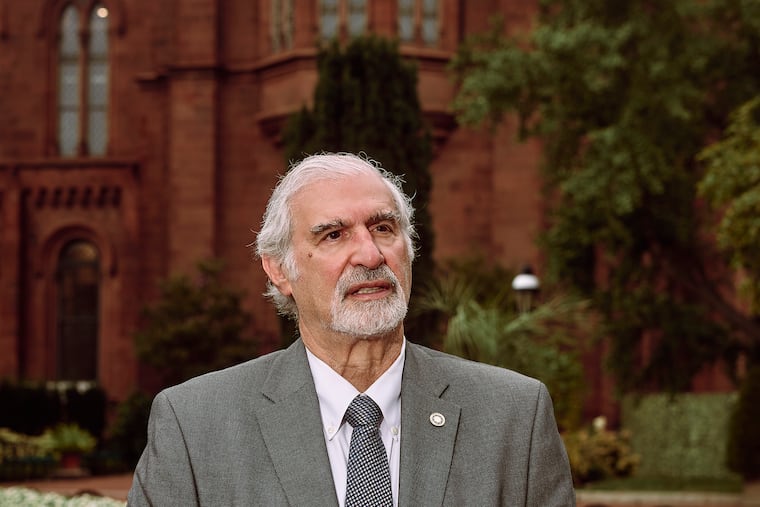
As school buses rumbled to life, the Philadelphia Federation of Teachers arrived at a tentative three-year contract with the school district. Arthur Steinberg, the union president, declined to release details, but said it was a “contract that had something for everyone.”
The deal eliminates a real strike threat. Though deep SEPTA service cuts will still complicate commutes to school for 50,000 students, the labor peace is a definitely a mood lightener.
The PFT deal had Mayor Cherelle L. Parker beaming, high-fiving students as they walked a red carpet into the Steel schoolyard, and shaking shiny red pom-poms.
Parker has emphasized unity; she said the deal — which came a full week before the prior contract’s Aug. 31 expiration date — is an object lesson in her “One Philadelphia” mantra.
“We are grateful that the adults came together,” Parker said outside the Steel cafeteria Monday morning. “They came together with our school district and they figured out a way to get to yes, because we cannot compromise the learning potential of our young people because the adults can’t seem to get it together.”
The union’s 14,000 teachers, school counselors, nurses, paraprofessionals, secretaries, and other workers had already authorized a work stoppage if their leaders called for one.
Union officials have not yet released details of the deal, but were holding firm for raises. They also wanted parental leave — PFT members currently get none — and expressed a desire to end the controversial “3-5-7-9″ policy that imposed penalties on educators for taking their earned sick time.
Steinberg, who stood outside Steel shoulder-to-shoulder with the mayor, Superintendent Tony B. Watlington Sr., and school board president Reginald Streater, declined to release contract specifics. He said members will receive them soon, with a ratification vote scheduled quickly, likely this week.
“Once the details of this are released, I think everybody will be very happy,” Steinberg said. “There is something for everybody. Not only do we take care of the economic needs of our members because they have to feed their families as well, but there are quite a few things in there that are good for kids.”
‘Some wind underneath our wings’
Assuming the PFT membership ratifies the contract and the school board approves it, Watlington now has his first labor contract under his belt.
The superintendent came to Philadelphia from North Carolina, a right-to-work state where teachers unions were largely symbolic organizations.
He said his focus would continue to be on accelerating student achievement — the school system has posted gains in reading and math at nearly every grade level, its graduation rate is up, and its students and teachers are attending at higher rates.
» READ MORE: The start of Philly’s school year is shaping up to be a doozy with SEPTA cuts and a looming PFT contract deadline
“This is a school year where we have some wind underneath our wings,” Watlington said, “even though we have a lot of challenges in front of us.”
Parents Shawna Miller and Bashir Robinson said they felt it.
Miller and Robinson dropped their kindergartner, Justin Bashir Robinson, off for his first day of school at Steel on Monday.
Justin was excited, and his parents were, too. Robinson said hearing news that there wouldn’t be a PFT strike after Labor Day was the icing on the cake.
“The anxiety is gone,” he said.
As Steinberg walked into Steel, on Wayne Avenue, a few staff — wearing PFT red shirts — stopped him.
“We’re teachers,” they said, “and we just want to thank you.”
Nicole Wyglendowski, a Steel special education teacher, said she was happy — but still anxious to see the terms of the contract.
“I hope it’s a relief. I hope it’s a good contract,” she said. “But it’s a positive sign that we have a tentative agreement.”
Pizza and a prediction
Throughout the day, district leaders zigzagged the city greeting students, teachers, and other staff.
At Hunter Elementary in North Philadelphia, Watlington and school board members Sarah-Ashley Andrews and Cheryl Harper donned gloves and hit the lunch line — first, serving food, then sampling it.
The superintendent chose pizza, carrots green beans, peaches, a juice box, and chocolate milk, and ate while quizzing students about their first day.
Iliana Madera Pantojo, 9, a fourth grader, said she had a good feeling about the 2025-26 school year.
“The teachers are being nice,” said Iliana. “It’s going to be fun.”
SEPTA causes snafus
Though the vibes were good in most places, the SEPTA cuts did cause some issues.
At Furness High in South Philadelphia, first-day attendance is typically over 90%.
“Because of some of the transportation impacts, those numbers have dropped down to the 70s,” Watlington said at a City Hall news conference.
The superintendent said his administration was monitoring the situation closely. More than 50,000 district students rely on SEPTA to get to and from school.
“We’re going to stay in the office until we can assure that all of our children made it home safely,” said Watlington.
Zairean Wills, a sophomore at Roxborough High, now has to rise an hour earlier to catch a bus that will get her to school on time.
Her Route 9 bus now comes every 30 minutes, making her morning commute tight, despite getting up earlier.
“It sucks that I have to wake up earlier for no reason,” she said.
Lincoln High 10th grader Carlos Aquino used to take the 88 bus directly to and from school. Now, he makes a transfer, then walks for 40 minutes.
“We’re getting tardy to classes, tardy to school,” Aquino said.
Brandi Allen, a Lincoln junior, learned of the SEPTA cuts Monday morning, when she and her boyfriend had to take another bus in lieu of the 88. Her backpack, heavy with first-day supplies, made the walk unbearable, she said.
Ryan Berroa, another Lincoln junior, has cut out SEPTA entirely — his mother drove him Monday, and when she can’t drive him he faces a long walk.
“I’ve got to walk really far. It’s just really hot and the weather is killing me,” he said.
Enrollment worries
More than 600 students attend the Philadelphia High School for Girls. A full 90% rely on SEPTA to get there, said Principal KaTiedra Argro.
Girls’ High’s attendance was strong on Monday, at 98%, but Argro worries that figure might drop.
SEPTA’s woes have already affected her enrollment; Argro and her administration have already discussed how they may need to adjust their recruiting messaging.
“Parents are already starting to transfer students to another school,” Argro said, noting that two parents called Monday to withdraw their daughters.
Argro understood those parents’ decisions, she said. But it’s frustrating.
“It doesn’t make me feel good,” she said. “It affects our students and our students’ choices.”
Staff writers Michelle Myers, Maggie Prosser, and Brett Sholtis contributed to this article.